
Key Takeaways
- Approval First: Never drop a dumpster in the driveway before you have a signed Architectural Review Committee (ARC) approval form.
- Specific Specs: Most Killingly HOAs require specific brands and color lines (for example, GAF Timberline HDZ in Weathered Wood) rather than general colors.
- The Contractor Factor: Using a contractor who isn't familiar with HOA submittal packages can delay your project by 4–6 weeks.
- Documentation is King: Keep every email, sample board, and signed approval in a dedicated folder for at least five years.
Killingly homeowners in communities with active associations are hitting a wall this March. I've spent the last three days reviewing violation letters sent to folks in the Quiet Corner who thought they were doing the right thing by fixing a leaky roof. The problem? They assumed that because their new shingles looked "close enough" to the old ones, the board wouldn't notice. But in a managed community, "close enough" is an expensive gamble that usually ends with a legal notice and a demand to tear it all back down.
The reality is that your Homeowners Association (HOA) doesn't care about your leak; they care about the visual uniformity of the streetscape. If you swap a weathered "Autumn Blend" for a modern "Charcoal," you aren't just updating your home—you're violating a contract you signed when you bought the place. I've seen boards levy fines of $75 per day until the roof is "corrected." That's $2,250 a month just for picking the wrong shade of gray.
The "Like-for-Like" Trap: Why Your Eyes Are Lying to You
The most common mistake I see in Windham County is the "like-for-like" assumption. Homeowners think if they replace an asphalt shingle with another asphalt shingle of the same general color, they don't need permission. They are wrong. Most bylaws in Killingly developments specify not just the material, but the weight, the profile, and the exact manufacturer color palette.
I worked with a homeowner near Alexander's Lake last year who replaced his roof with a high-quality architectural shingle. It looked great. It was objectively better than the 20-year-old 3-tab shingle it replaced. But because he didn't submit a formal application, the board cited him for "architectural inconsistency." He had to spend $430 on a specialized consultant just to prove the new shingle met the community's aesthetic "spirit."
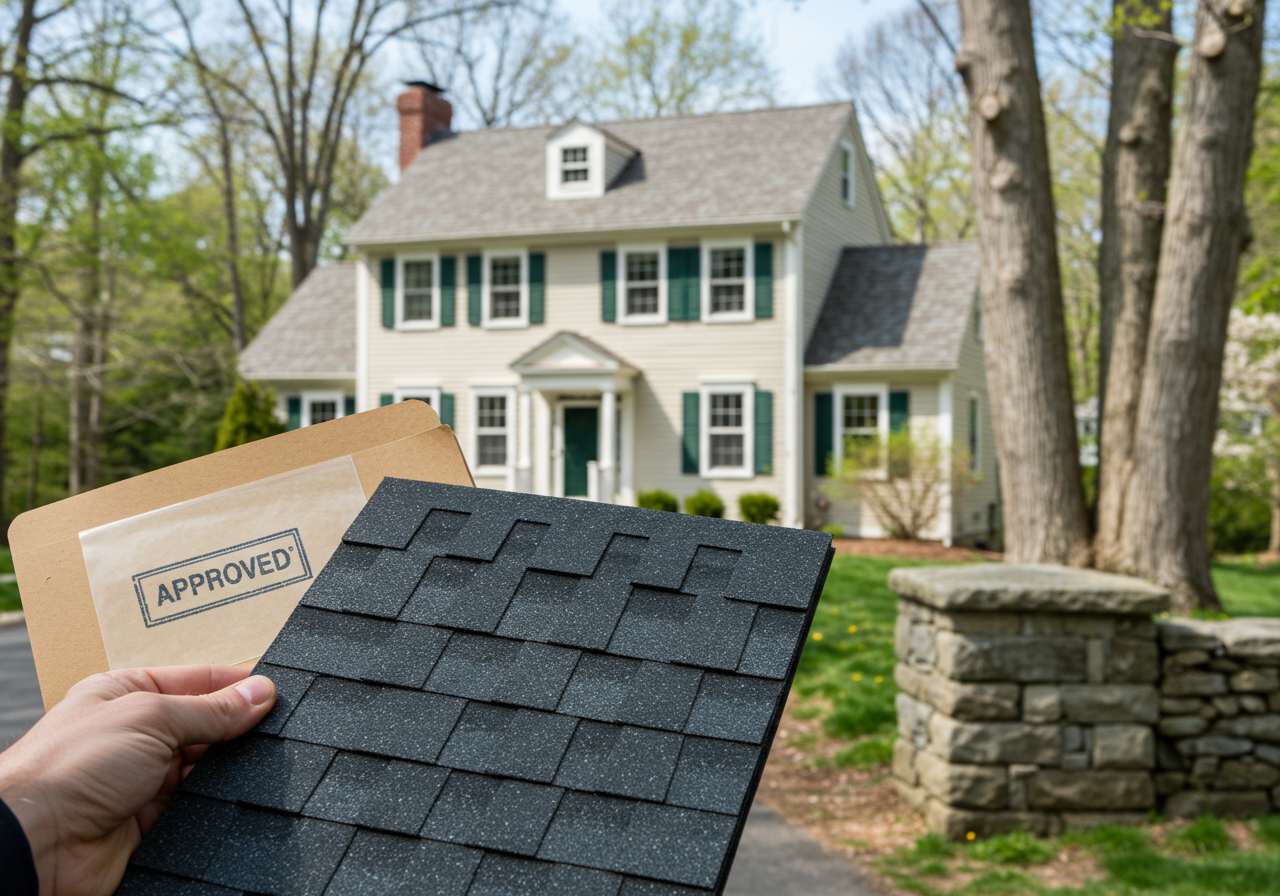
HOA Roof Rules in Killingly
Why “close enough” shingle colors and profiles often trigger violation notices in managed communities
Understanding the Architectural Review Committee (ARC)
The ARC is the group of neighbors who decide if your roof "fits." They aren't roofing experts; they are rule-followers. When you submit your plan, you need to provide a physical sample of the shingle, a copy of the contractor's insurance, and a detailed scope of work. If you skip any of these, your application sits at the bottom of the pile. This is why finding a contractor who actually shows up with the right paperwork is half the battle in a managed community.
The Cost of Non-Compliance
If you move forward without approval, the HOA can place a lien on your home. It's not just about the fine; it's about your ability to sell or refinance. According to Connecticut's consumer protection laws, your contract with a roofer is binding, but that doesn't excuse you from HOA bylaws. If the board makes you tear off a $14,000 roof because the color is off, the roofer still gets paid, and you're out the cash twice.
Material Restrictions vs. 2026 Roofing Tech
We're seeing a lot of Killingly boards struggling to keep up with new materials. In 2026, we have shingles that reflect more heat and resist algae better than anything available ten years ago. However, if your HOA guidelines were written in 2005, they might still mandate "organic mat" shingles that aren't even manufactured anymore.
I recently helped a client negotiate with a board that insisted on a specific discontinued shingle. We had to present a "comparable performance" packet. If you find yourself in this spot, don't just argue; show the math. Bring a spec sheet showing the new material has a higher wind rating—especially important given the historical wind events in Windham County—and the board is much more likely to budge.
Synthetic vs. Natural: The Aesthetic Debate
In some higher-end Killingly clusters, there's a push for synthetic slate or cedar. These look identical to the real thing but last twice as long. But because they are "plastic-based," some old-school boards reject them outright. My advice? Get a sample and put it on your roof. Ask the board members to stand at the curb and tell you which is which. Usually, they can't.
Average Lifespan: HOA Standard vs. Performance Materials
The "Preferred Vendor" Myth and Vetting Your Crew
Some HOAs in the Quiet Corner will "strongly suggest" a specific roofer. Let's be clear: unless your HOA is responsible for the actual maintenance (like in a condo where the association owns the exterior), you usually have the right to hire whoever you want. These "preferred" lists are often just companies that have worked in the neighborhood before, not necessarily the best value.
You need to verify that your chosen crew follows OSHA fall protection standards. If a worker falls off your roof in a private community, the HOA's insurance might get dragged into a lawsuit, and guess who they'll come after for the deductible? You.
"We don't want to be the bad guys, but if one house has a neon blue roof, the property values for the whole cul-de-sac take a hit. It's about protecting the investment."
The Line-Item Verification
When you get an instant roof estimate for an HOA project, make sure it includes the "administrative fee" if your contractor has to spend hours at board meetings. A professional roofer will charge for this time, and they should. If they say they'll do all the HOA paperwork for free, they're likely cutting corners on the actual installation.
The Negotiation Script: How to Talk to Your Board
If your HOA is pushing back on a material or color you want, don't get emotional. Use a business-case approach. I've found that boards respond well to three things: fire safety, longevity, and "future-proofing" the neighborhood's value.
Here is the exact script I give my clients in Killingly: "I understand the goal is visual uniformity. However, the requested material [Brand A] is prone to [Specific Issue, like streaking]. I am proposing [Brand B], which has the same color profile but carries a 30-year algae warranty. This prevents the 'dirty roof' look that currently affects several homes on our street, thereby maintaining our collective curb appeal."
Download the ARC application
Pull the current Architectural Review Committee form from your HOA portal or management company.
Request a physical shingle sample board
Ask your contractor for the exact manufacturer board—not a phone photo—matching the proposed product and color line.
Submit at least 30 days before your start date
File the complete packet early so you are not racing a leak against a monthly board meeting.
Wait for written Notice to Proceed
Do not sign the final contract or schedule tear-off until you have a signed ARC approval or equivalent written clearance.
Close the loop with inspection paperwork
Provide the board with the final inspection certificate once the job is done for your long-term file.
Verbal okay is not approval
If you're dealing with a sudden failure and can't wait for a monthly board meeting, you might need to look into emergency roofing services that can provide a temporary tarping solution. This keeps your interior dry while you fight the bureaucracy for the permanent fix.
Get Your Free Roof Quote
Enter your zip code to get started
Conclusion
Navigating an HOA roof replacement in Killingly requires more than just a ladder and a hammer—it requires a paper trail. By treating the board as a partner rather than an obstacle, you can often get higher-quality materials approved that will save you money in the long run. Don't let a "close enough" color choice turn into a $10,000 mistake. Put the numbers on paper, get the signatures in ink, and then—and only then—start the work.