
Key Takeaways
- A roof doesn't need visible debris to be structurally compromised—seal failure is often invisible from the ground.
- 64% of wind-damaged roofs in CT show seal failure before shingles actually blow off.
- Look for 'creasing' lines and excessive granule loss in gutters as early warning signs.
- March is ideal for repairs—fix winter damage before spring rains arrive.
Contrary to what most folks in Hampton believe, a roof doesn't need to look like it was hit by a tornado to be structurally compromised. There's a persistent myth in Windham County that if you don't find a stray shingle sitting on your lawn near the mailbox after a gusty night, your home dodged the bullet. I hear it constantly while grabbing coffee near the Airline Trail—homeowners assuming "no debris" equals "no damage."
But here's the reality: the most dangerous wind damage is the kind you can't see from your driveway. In my years tracking Connecticut's micro-climates, I've seen hundreds of roofs in the Quiet Corner that looked perfectly intact but had actually lost their structural integrity weeks prior. By the time the first heavy April rain hits, those "intact" roofs become sieves. March is a tricky transition month for us; the ground is thawing, the winds are shifting, and your roof is likely exhausted from a winter of expansion and contraction.
The Hidden Threat of Seal Failure in Windham County
The biggest problem I encounter isn't missing material—it's seal failure. Modern shingles rely on a strip of thermal sealant to bond them to the layer below. When we get those sustained gusts that roll across the open hills of Hampton, they can get underneath the edge of a shingle. It doesn't always rip the shingle off. Instead, it lifts it just enough to break that factory seal. Once that bond is broken, the shingle "flaps" invisibly.
I remember inspecting a cape-style home out near Route 97 last year. From the ground, the roof looked maybe 8 years old and in decent shape. But once I got a ladder up, I could lift entire sections of shingles with one finger. They were essentially just sitting there, unattached. According to FEMA's hurricane mitigation guide, this loss of adhesion is the primary precursor to catastrophic roof failure during high-wind events.
When that seal breaks, dust and granules get into the sticky strip. Even when the wind dies down and the shingle lays back flat, it will never re-seal on its own. It's now a "tab" waiting for the next breeze to let water drive right underneath it. If you've noticed your attic feels a bit draftier or you see odd shadows on your roof during a sunset, you might already have this problem.
Spotting the "Quiet" Signs of Storm Stress
Since we can't all spend our weekends on a 40-foot ladder, you have to look for the subtle clues. In Hampton, where our homes are often tucked into wooded lots, the wind patterns can be erratic. One house might be shielded by oaks, while the neighbor's roof takes the full brunt of a westerly gale.
Look for "creasing." This happens when a shingle is lifted repeatedly by the wind until a dark, horizontal line forms across the top where the granules have been rubbed away. It looks like a pencil mark from the ground, but it's actually a fracture in the shingle's fiberglass mat. Another red flag? Check your gutters. If you see an unusual amount of "sand" (granules), it means your shingles are rubbing against each other in the wind, shedding their protective layer.
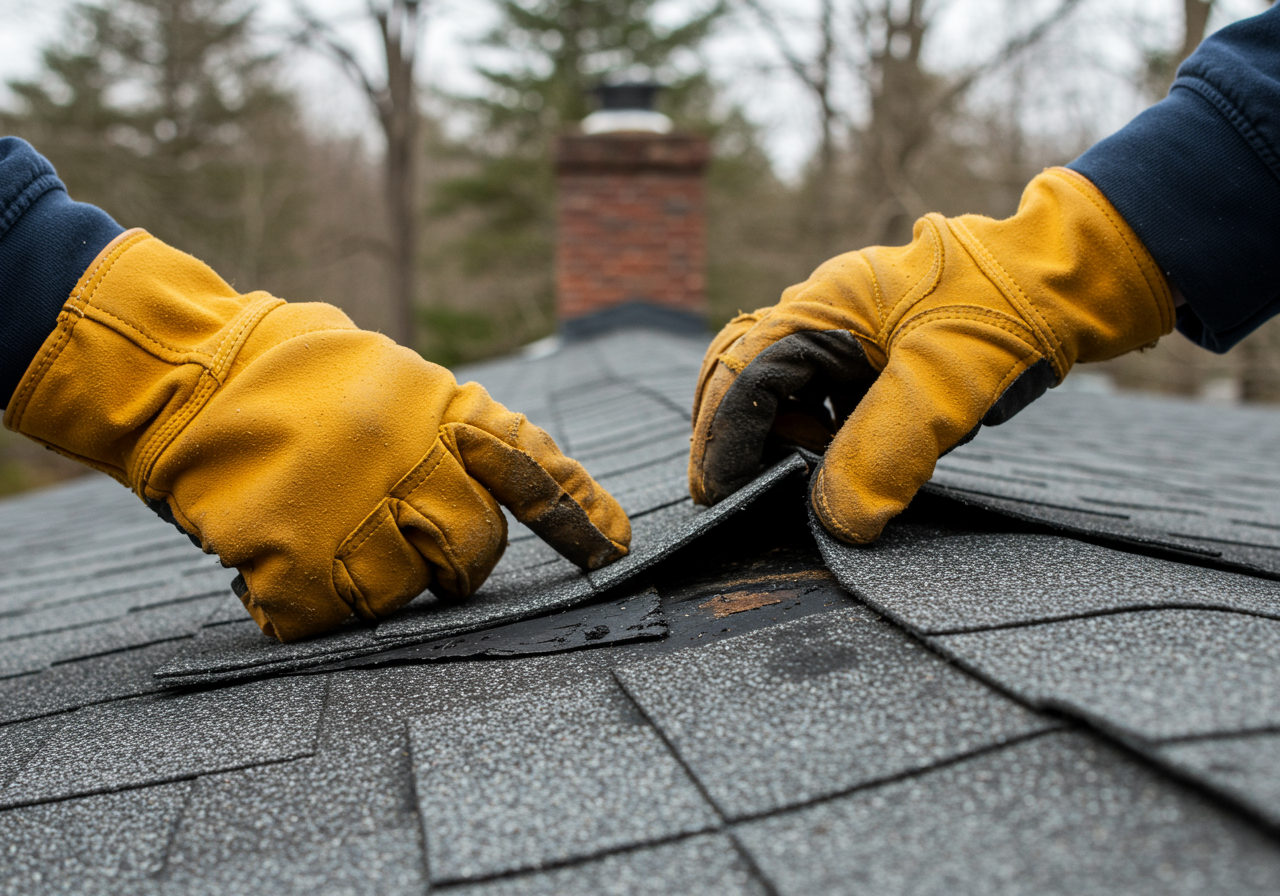
Hidden Wind Damage in Hampton
Seal failure and creasing are often invisible from ground level
I often tell my neighbors that the best way to handle this is by finding a contractor who actually shows up to do a physical hand-check of the tabs. You can't diagnose a broken seal from a drone or a sidewalk. It takes a pair of gloves and a little bit of manual pressure to see what's still attached and what's just "floating."
Repairing vs. Replacing: The $12,000 Decision
So, you found some loose shingles. Now what? This is where the "Problem-Solution" dynamic gets real for your wallet. If the damage is localized—say, just one slope that faces the prevailing winds—a targeted repair is often possible. We can hand-seal those loose tabs using a high-grade asphalt plastic cement. It's a surgical fix that can save you a fortune.
However, if the roof is more than 15 or 17 years old, the shingles might be too brittle to lift for repair. Trying to fix one shingle can crack the three surrounding it. In that case, you're looking at a replacement. But don't look at it as just a cost; look at it as an upgrade to your home's envelope. The Department of Energy recommendations suggest that a properly sealed and insulated roof system is your best defense against both wind and rising energy bills.
Repair vs. Replacement Decision Matrix
| Feature | Repair | Replace |
|---|---|---|
| Under 15 Years Old | ||
| Missing <5 Shingles | ||
| Active Leaks | ||
| Widespread Granule Loss |
Minor Repair: $450 - $950 average cost, 2-4 hours to complete, often below deductible, extends life by 2-5 years
Full Replacement: $11,000 - $18,000 average cost, 1-2 days to complete, usually covered if storm-related, extends life by 25-50 years
If you're worried about the immediate cost of a sudden leak, getting emergency roofing services out quickly can prevent the interior ceiling damage that really drives up insurance claims. I once saw a small wind-lifted section over a kitchen in Hampton turn into a $9,000 mold remediation project because the homeowner waited "until the rainy season" to check it out.
Get Your Free Roof Quote Today
Connect with verified CT pros who understand Hampton's wind patterns.
No credit card required • Free to use
Future-Proofing Your Hampton Home for the Next Gale
The best repair is the one you never have to make. If you are replacing your roof this year, ask about high-wind installation techniques. This usually involves using six nails per shingle instead of the standard four and ensuring the starter strip is perfectly aligned. For those living in the more exposed parts of Windham County, I often recommend "Class 4" impact-resistant shingles. They aren't just for hail; they have a much higher tear-strength, which keeps them anchored when the wind starts howling through the pines.
And while you're at it, consider the thermal performance of your new roof. EPA's data on cool roofs shows that choosing the right shingle color and ventilation can reduce the heat stress on your shingles, keeping that adhesive strip flexible and "sticky" for many more years.
Ground Inspection
Use binoculars to look for creased or dark lines on shingles.
Gutter Check
Look for excessive granule loss or actual pieces of shingle material.
Professional Match
Use a service to find a vetted local pro who understands CT wind patterns.
Physical Test
Have the pro hand-check the 'uplift' on shingles across different roof slopes.
Document
If damage is found, take photos for insurance before any work starts.
The reality of living in the Quiet Corner is that we are at the mercy of the weather. But we don't have to be victims of it. Whether you need a quick patch or a total overhaul, the first step is knowing exactly what you're dealing with. If you're ready to stop guessing, you can get started by getting an instant roof estimate that connects you with folks who know exactly how Hampton winds treat a roof.
Get Your Free Roof Quote
Enter your zip code to get started