Key Takeaways
- The 72-Hour Standard: Most residential roofs in Stratford (under 3,000 sq. ft.) should be completed in 1 to 3 days, weather permitting.
- Crew Density Matters: A 4-person crew will take twice as long as an 8-person crew; always ask for the 'headcount' before signing.
- Permit Lead Times: Stratford's building department usually requires a 5-to-10-day window for permit approval before the first shingle is pulled.
- The 'Rotten Deck' Variable: Unexpected plywood replacement is the #1 cause of timeline inflation, often adding 4–6 hours to the project.
You've seen the two different types of roofing projects while driving down Main Street or through the Oronoque neighborhood. On one block, a crew descends on a Colonial like a precision NASCAR pit crew, and by the time you're back from work, the dumpster is gone and the lawn is spotless. Two streets over, a house sits wrapped in "Contractor Blue" tarps for eleven days, flapping in the wind while the homeowner stares at an empty driveway, wondering where the crew went.
One homeowner is enjoying a beer on their deck; the other is checking their ceiling for leaks every time a March drizzle starts.
In Stratford, the difference between a 48-hour victory and a three-week nightmare isn't just luck. It's a combination of crew size, material staging, and—frankly—whether your contractor is juggling five other jobs in Fairfield County at the same time. I've looked at the data for this "Gold Coast" pocket of Connecticut, and the reality is that a standard 2,500-square-foot roof should never take more than three days of actual labor. If someone tells you otherwise, they're either understaffed or over-promised.
The Reality of the "One-Day" Roof Myth
We've all seen the signs: "New Roof in One Day!" It sounds great, doesn't it? But here's the thing—while it is physically possible to swap shingles on a simple gable roof in 10 hours, it's rarely the reality for the complex rooflines we see around Paradise Green or the coastal homes near Lordship. A "one-day" roof requires a massive crew and perfect conditions. If a contractor promises a 24-hour turnaround on a 3,500-square-foot Tudor with four valleys and a chimney, I'd start looking for the corners they're planning to cut.
Why Size and Slope Dictate the Clock
The sheer math of a roof replacement is unforgiving. A square of roofing is 100 square feet. A typical Stratford home might have 25 to 35 squares. If a crew of four is working, they have to strip, prep, and shingle roughly 8 squares each. On a steep pitch? That slows down to 4 or 5 squares. When you verify your contractor's crew size, you're really verifying their ability to respect your time.
I once worked with a couple near Boothe Memorial Park who were promised a "lightning-fast" job. The contractor sent three guys. By day four, the dumpster was overflowing, and the backyard looked like a shingle graveyard. The "one-day" promise turned into a week-long ordeal because the math didn't add up.
The Staging Phase (Day 0)
The clock doesn't actually start when the first shingle is ripped off. A professional timeline includes "Day 0." This is when the materials are delivered and the dumpster arrives. In a town as densely packed as Stratford, where driveways can be tight, this logistics dance takes about 2–3 hours. If your materials aren't on-site 24 hours before the crew, your "two-day" job is already at risk of sliding into day three.
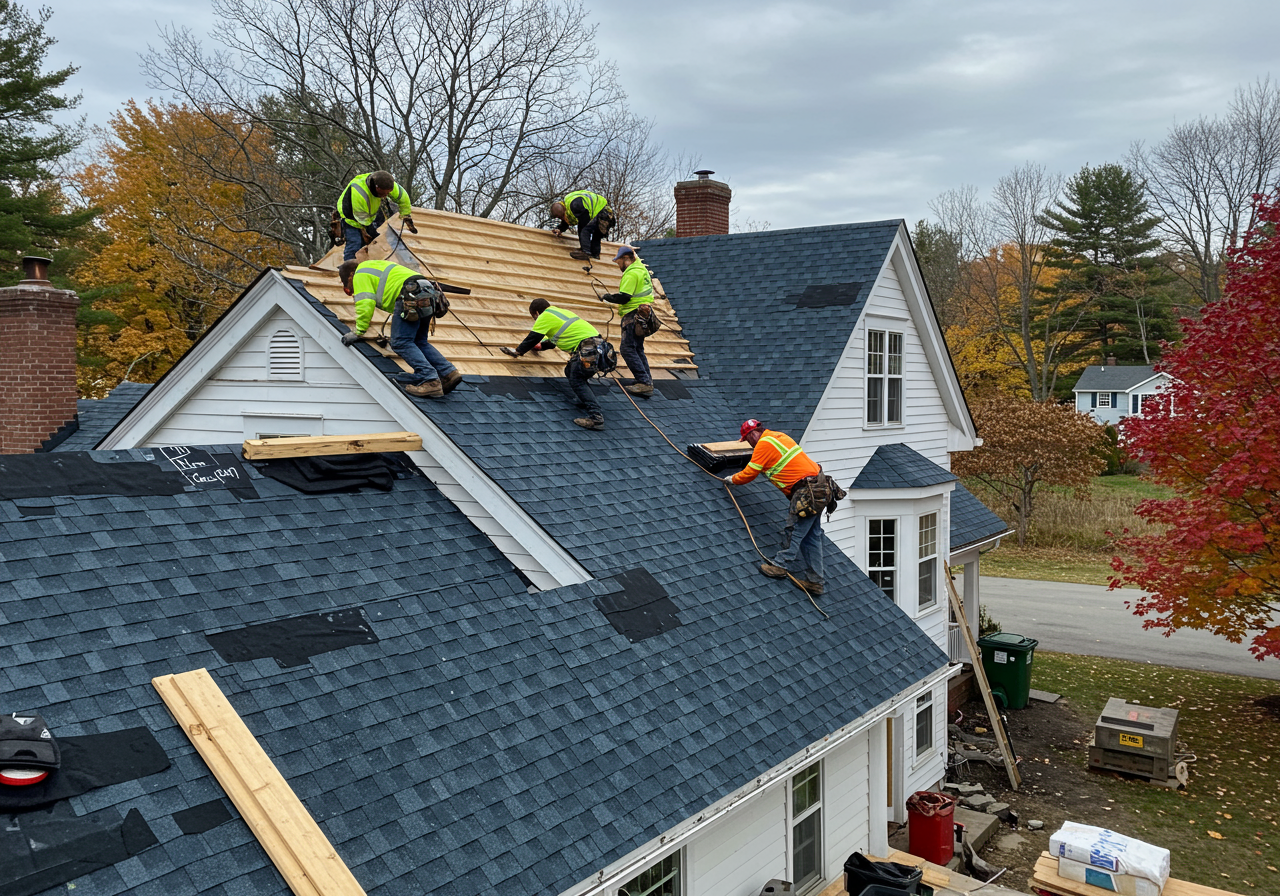
Professional roof replacement in Stratford, Connecticut
A well-coordinated crew working efficiently on a Stratford home
Why Stratford's Local Factors Shift the Timeline
Living on the Connecticut coast means we deal with variables that contractors in, say, Ohio, don't even think about. In Stratford, we have to account for the Long Island Sound's temperamental moisture and the specific rigors of the Fairfield County building codes.
The Permit Bottleneck
You can't just start hammering. The Town of Stratford Building Department (over on Main Street) is generally efficient, but they aren't instantaneous. I tell homeowners to budget at least 7 business days for the paperwork to clear. If a contractor says they can "start tomorrow" and hasn't mentioned a permit, they might be planning to bypass the town entirely. That is a massive red flag. A lack of permit doesn't just risk a "stop-work" order—it can void your manufacturer's warranty.
Coastal Wind Requirements
Because we're in a high-wind zone, the installation process takes slightly longer. According to FEMA's hurricane mitigation guide, proper fastening in coastal areas often requires a 6-nail pattern rather than the standard 4-nail pattern used further inland. That's 50% more nails per shingle. Across an entire roof, that's thousands of extra strikes. It adds maybe 3–4 hours to the total project, but it's the difference between your roof staying on during a Nor'easter or ending up in your neighbor's yard.
The Anatomy of a 48-Hour Replacement
If you want to know if your contractor is on track, you need to know what the "standard" flow looks like. I've sat on enough Stratford porches with a clipboard to know that a well-run job follows a very specific rhythm.
Day 1: The Controlled Chaos
The first day is the loudest and messiest. This is the "Tear-Off" phase. A 30-square roof will generate roughly 3 to 4 tons of waste.
- 7:30 AM: Crew arrival and property protection (tarping the bushes and moving the patio furniture).
- 9:00 AM: The roof is stripped to the wood.
- 1:00 PM: Deck inspection. (This is where the "oh no" moments happen—we'll get to that).
- 3:00 PM: Installation of the "underlayment" (the waterproof barrier).
By the end of Day 1, your house should be "dried in." This means even if it pours overnight, your attic stays dry. If a crew leaves your house with exposed wood and a 30% chance of rain, you've hired the wrong people.
Day 2: The Precision Work
Day 2 is about the shingles, the flashing, and the ridge vents. This is quieter but requires more focus.
- Morning: Shingle installation starts at the eaves and moves up.
- Mid-day: Flashing work around the chimney and valleys. This is the most common failure point, so it shouldn't be rushed.
- Late Afternoon: The "Magnetic Sweep." The crew should spend at least an hour running magnets through your grass to catch the thousands of nails that inevitably fell.
Average Replacement Time by Home Style (Days)
The "Rotten Plywood" Factor: When the Clock Stops
Here is the conversation I dread for homeowners. The shingles come off, and the foreman calls you over to look at a section of the roof deck that looks like a soggy Saltine cracker.
In Stratford, especially in older homes near the historic district, we see a lot of "delamination." This is when the layers of the plywood start to peel apart due to poor attic ventilation. If your contractor finds five sheets of rotten wood, your timeline just grew. They have to cut out the old stuff, nail in the new, and ensure everything is flush.
The Cost of a Delay
According to the Department of Energy's roofing guides, a roof that isn't properly ventilated will fail 40% faster. If your contractor finds rot, let them fix it. Don't push them to "just shingle over it" to save a day. You'll be paying for it five years from now when the shingles start to buckle.
I assisted a homeowner last year who insisted on skipping the deck repair because they had a graduation party scheduled for that weekend. Big mistake. The new shingles looked "wavy" within months, and they ended up paying $2,800 to have that section redone later.
The Tarp Trap
How to Vet a Contractor's Timeline Before You Sign
Before you put pen to paper, you need to be the one asking the hard questions. Don't just look at the bottom line; look at the labor commitment. A $10,000 bid from a guy with two helpers is a much worse deal than an $11,500 bid from a crew of eight who will be out of your hair in 36 hours.
The Negotiation Script
Use these exact lines when you're interviewing pros:
- "How many people will be on the roof on Day 1?" (Look for 5+ for a standard home).
- "What is your 'weather-delay' policy? If it rains Tuesday, am I first on the list for Wednesday?"
- "Will you have a dedicated project manager on-site, or just the crew?"
- "Show me the line item for plywood replacement—what is the 'per sheet' cost if you find rot?"
I always tell people to get the cash price in writing and compare the projected "man-hours." If Contractor A says 40 man-hours and Contractor B says 80, someone is either over-estimating or planning to rush the flashing.
Check the Local Track Record
Don't just take their word for it. Check what other Stratford residents have said about their punctuality. In a town this size, reputations for "ghosting" homeowners spread fast. If three people say the contractor left a dumpster in their driveway for two weeks, believe them.
"The fastest roof isn't the one with the most hammers; it's the one with the best logistics. If the shingles show up late, the whole week is ruined."
The March 2026 Outlook for Stratford Roofing
As we head into the spring "mud season," roofing activity in Connecticut spikes. Everyone wants their winter damage fixed before the April showers. This means crew schedules are tighter than ever. If you're booking now, you're competing for those prime 48-hour windows.
Remember, a roof isn't just a pile of shingles; it's a system. From the ice and water shield to the ridge vent, every piece needs to be installed with care. Speed is a byproduct of expertise, not a goal in itself. If you want a realistic look at how the numbers and timing shake out for your specific roofline, our blog library has deeper dives into material-specific labor requirements.
Get Your Free Roof Quote
Enter your zip code to get started
In the end, your goal is to get that new roof on without your house becoming a local landmark for "work in progress." Be firm on the timeline, be clear on the crew size, and never—ever—pay the full balance until that magnetic sweep is finished and the permit is closed out.

About Dana Jackson
Verified ExpertDana Jackson is a Homeowner Advocate & Cost Analyst who helps Connecticut families navigate the financial aspects of roofing projects. She specializes in finding the best value and avoiding common pricing pitfalls.