Key Takeaways
- Madison's coastal location requires 6-nail fastening patterns (not standard 4-nail) for 130mph wind resistance.
- Low-ball quotes often omit critical ice and water shield coverage, leading to $9,000+ repair bills within 4 years.
- Manufacturer certifications (like Platinum Preferred) are the only way to get 25+ year labor warranties backed by the manufacturer.
- Always verify contractor insurance directly with the agent—never accept photocopied certificates from a truck folder.
I remember standing on a driveway off Liberty Street last January, looking at a Colonial that had just lost half its shingle courses in a standard winter blow. The homeowner was shell-shocked. He'd hired a "great guy" from two towns over who gave him a "handshake deal" and a price that was $5,000 lower than the nearest competitor. Here's the reality: that "deal" didn't include a leak barrier in the valleys or the 6-nail fastening pattern required for Madison's high-wind zones. Now, he was looking at a $9,430 repair bill just four years after a full replacement. In this business, the most expensive roof you'll ever buy is the one you have to pay for twice.
1. The Coastal Fastening Pattern Requirement
In Madison, we aren't just dealing with rain; we're dealing with salt-heavy air and wind gusts that whip off the Long Island Sound. Most "standard" shingle installations use a 4-nail per shingle pattern. That's fine for inland Ohio, but here in New Haven County, it's a recipe for disaster.
Professional crews should be utilizing a high-wind fastening schedule—typically 6 nails per shingle—to bump the wind resistance up to 130 mph. I've seen manufacturer reps from GAF and CertainTeed deny warranty claims because the shingles were "under-nailed." If your contractor isn't specifying the number of fasteners per shingle in their quote, they're cutting corners to save on labor and material costs. Every time I walk a job site, I check the "strike zone"—the narrow line where the nail must hit to engage both shingle layers. If they miss that line (which happens often with rushed, unverified crews), the shingle's wind rating drops by 40% instantly.
2. The Ice and Water Shield Omission
January in Connecticut is a brutal reminder of why "Ice and Water Shield" isn't an optional upgrade—it's a necessity. Most low-ball quotes include the bare minimum of 3 feet of leak barrier at the eaves. However, on Madison's many steep-pitched or complex Victorian rooflines, that's rarely enough.
The building code is one thing, but performance is another. I always recommend two courses (6 feet) of a high-temp self-adhering membrane, especially in valleys and around chimneys. This prevents the freeze-thaw cycle from pushing water under your shingles during a February ice dam event. When you verify their contractor's license, ask specifically about their flashing and underlayment standards. If they say "we use standard felt," walk away. Modern synthetic underlayments are 20 times stronger than traditional felt and won't tear during the installation process.
The Cost of Cutting Corners (Madison, CT Average)
3. Why Manufacturer Designations Trump "Years in Business"
You'll see "20 years of experience" on every truck in New Haven County. The truth? That number is often a combination of the owner's age and his cousin's time spent painting houses. What actually matters is their manufacturer certification level.
Companies like Owens Corning or GAF only grant their highest-tier certifications (like Platinum Preferred or Master Elite) to the top 2-3% of contractors. Why does this matter to you? Because it's the only way to get a "Golden Pledge" or "Platinum" warranty that covers both materials and workmanship for 25+ years, backed by the manufacturer itself. If the contractor goes out of business, the manufacturer still honors the labor warranty. I've seen too many Madison families left high and dry when a local chuck-in-a-truck disappears after a bad winter.
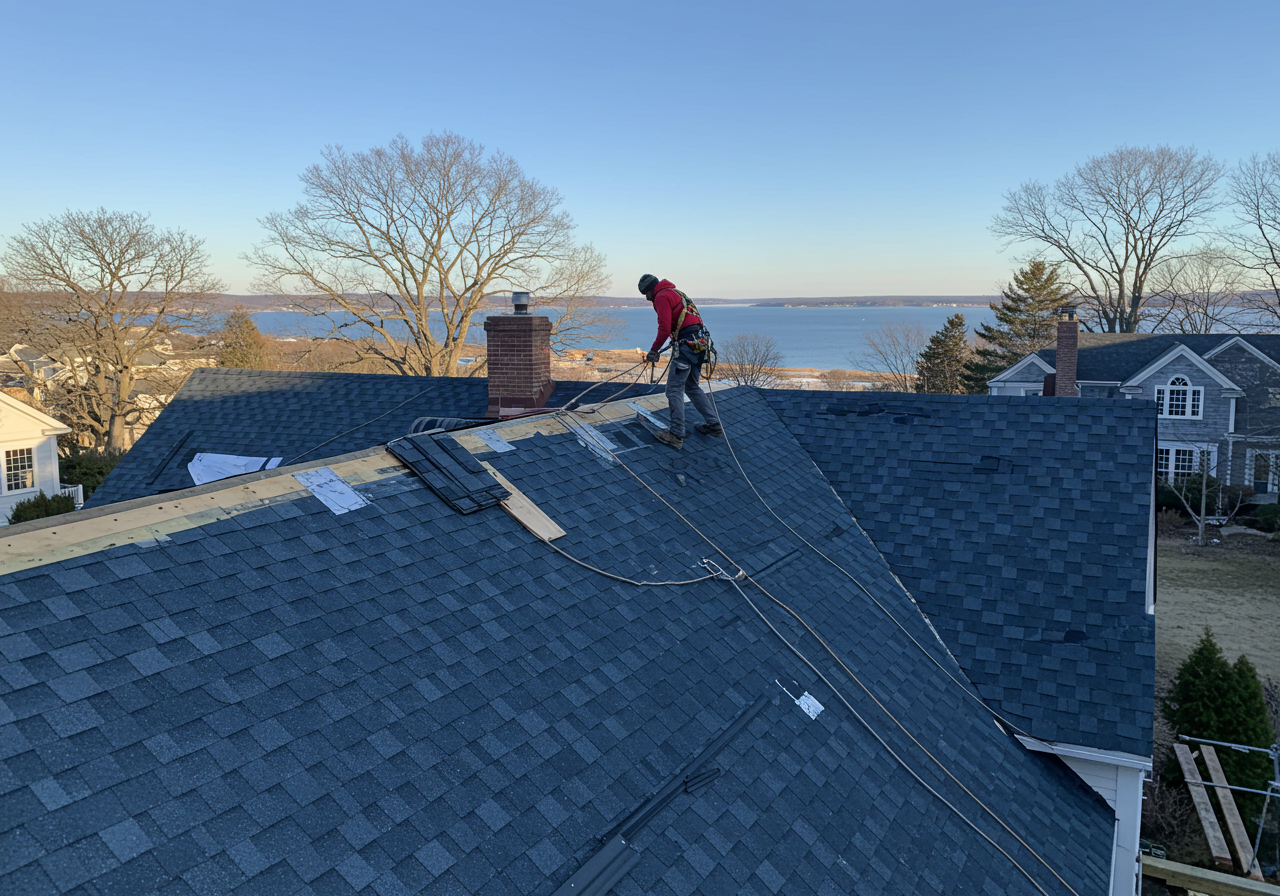
Madison Coastal Roofing Requirements
Proper fastening patterns and ice and water shield coverage are critical for homes near the Long Island Sound.
4. The Hidden Risk of Safety Non-Compliance
Look, roofing is dangerous. On a 10/12 pitch roof—common in our historic neighborhoods—a fall is life-altering. If you see a crew on your roof without harnesses, ropes, or anchors, you aren't just watching a "brave" crew; you're watching a massive liability.
According to OSHA fall protection standards, any worker higher than 6 feet must have fall protection. Professional contractors build the cost of safety equipment and training into their bids. If a quote is suspiciously low, they are likely skipping these protocols. If a worker gets injured on your property and the contractor doesn't have proper workers' comp (which is different from general liability), that worker's lawyer might look at your homeowner's insurance policy to cover the six-figure medical bills.
Insurance Verification Required
5. Navigating Madison's Building Permits and Inspections
Madison's building department is thorough—and for good reason. I've dealt with inspectors who will climb a ladder to verify the drip edge is installed over the underlayment at the rakes and under it at the eaves. It sounds like a small detail, but it's the #1 cause of fascia rot.
A red flag is a contractor who asks you to pull the permit. This usually means they aren't registered with the state or are trying to avoid being the "responsible party" for the work. A legitimate professional handles the paperwork, schedules the mid-roof inspection, and ensures the final sign-off is recorded with the town. If you're unsure how the process should look, our blog library has several deep dives into the Connecticut permitting maze.
"The permit isn't just a tax; it's your third-party verification that the contractor didn't 'forget' the most expensive components of your roof system."
6. Financing and Federal Assistance Realities
By January 2026, many homeowners are looking for ways to offset the rising cost of materials. While some contractors offer "0% interest" for 12 months, you need to read the fine print. Often, the contractor is paying a "dealer fee" of 10-15% to the bank to offer you that rate—and they've already baked that 15% into your project price.
For those looking for more traditional assistance, especially for energy-efficient upgrades like cool-roof shingles or improved attic ventilation, you should check the USA.gov home repair assistance portal for potential federal grants or low-interest loans. We often see Madison residents qualifying for specific New Haven County weatherization programs that can shave a few thousand off the total investment.
7. The Social Proof That Actually Matters
Don't just look at the 5-star rating on a screen. In a town like Madison, the best reference is a roof that has survived at least three nor'easters. I tell my clients to ask for the address of a job the contractor did five years ago—not last week.
Drive by that house. Is the ridge vent still straight? Are there streaks on the shingles (a sign of cheap, non-algae-resistant granules)? Before you sign, see what other CT homeowners experienced with the crews you're considering. A real professional will have a list of Madison residents who are willing to vouch for their clean-up process—because finding nails in your driveway six months later is a headache nobody needs.
Get Your Free Roof Quote
Enter your zip code to get started
Conclusion
Choosing a contractor in Madison isn't about finding the lowest number on a piece of paper; it's about finding the highest level of accountability. Ensure your quote includes a 6-nail coastal fastening pattern, a minimum of 6 feet of ice and water shield, and a manufacturer-backed labor warranty. By taking these steps, you're protecting your home's equity from the unique challenges of our Connecticut coastline. If you're ready to stop guessing and start comparing vetted professionals, ZikQuote can bridge that gap for you.
FAQ

About Daniel Roberts
Verified ExpertDaniel Roberts is a Senior Roofing Consultant with over 15 years of experience in the New England residential construction industry. He specializes in storm damage assessment and energy-efficient roofing systems.