
Key Takeaways
- Structural Integrity: Natural slate can weigh up to 1,500 lbs per square, often requiring structural reinforcement for older Greenwich homes.
- 100-Year Lifespan: While the initial cost is high, natural slate easily outlasts three generations of asphalt shingles if maintained properly.
- The 'Slipper' Problem: Improperly fastened slates (using the wrong nails) are the #1 cause of 'sliding' tiles during Connecticut nor'easters.
- Synthetic Alternatives: Modern composites offer the slate look at 25% of the weight, making them ideal for homes not built for heavy stone.
Greenwich homeowners face a critical roofing challenge that most contractors won't mention until the scaffolding is already up. It isn't just about the aesthetics of a Round Hill Road estate; it's about the physics of three hundred pounds of Vermont stone hanging over your head during a January freeze. I've walked hundreds of Fairfield County properties, and the story is often the same: people fall in love with the timeless look of natural slate but ignore the brutal reality of Connecticut's freeze-thaw cycles. Slate is arguably the most durable material on the planet, yet I've seen it fail spectacularly when the installation ignores our specific coastal climate. If you're considering this "forever roof," you need to understand that in Greenwich, the weight of the material is often a bigger threat than the weather itself.
The Massive Weight: Is Your Greenwich Home Built for Stone?
The biggest hurdle for slate in Fairfield County isn't the price—it's gravity. I remember a gorgeous Tudor near Binney Park where the owner wanted to swap out old cedar shakes for heavy black slate. We had to bring in a structural engineer because the existing rafters were only 2x6s. If they had proceeded without reinforcement, the first heavy snow load would have likely pancaked the attic.
Natural slate weighs between 800 and 1,500 pounds per "square" (a 10x10 area). Compare that to asphalt, which sits around 230 pounds. When you add a foot of wet Connecticut snow on top of that, you're looking at immense pressure on your home's bones.
Structural Checks and Balance
Before you even look at a stone sample, you need a professional to verify your load-bearing walls. It's not just about the roof deck; it's about how that weight transfers down to the foundation. But don't let that scare you off—most of the historic estates in the Back Country were built specifically for this load. The problem usually arises in mid-century renovations where slate is added as an "upgrade" without a second thought for the framing.
The Fastener Failure
In our humid, salty air near the Sound, the nails holding your slate matter as much as the stone itself. I've seen 80-year-old slate tiles that are perfectly fine, but they're sliding off the roof because the original contractor used galvanized nails that finally rusted through. In Greenwich, stainless steel or copper nails are the only acceptable choice. Anything else is a ticking time bomb.
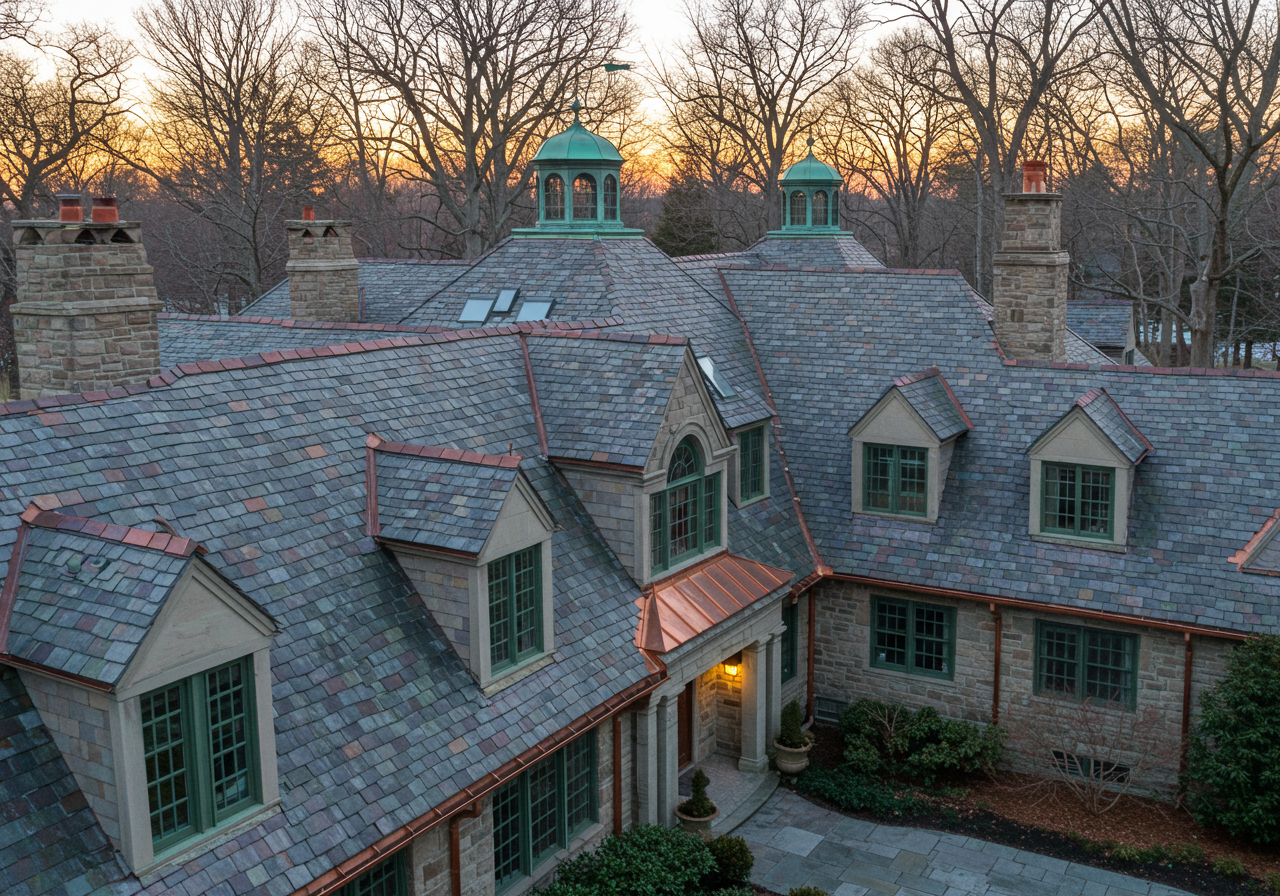
Slate Roofing in Greenwich
Understanding structural requirements and fastener quality is crucial for slate roof longevity in Connecticut's coastal climate.
The Cost of Forever: Greenwich Slate Pricing Realities
Let's talk numbers, because "expensive" is a relative term in the 06830 zip code. For a standard 3,000-square-foot home in Greenwich, a high-end natural slate installation can easily run $58,350 or more. That's a massive pill to swallow compared to a $14,000 asphalt job.
However, I always tell people to look at the "Cost Per Year." If an asphalt roof lasts 22 years and a slate roof lasts 100, the slate is actually the cheaper option for the long-term steward of the property. If the sticker shock has you questioning your budget, checking out our slate-inclusive cost tool can help you plan for the specific pitch and square footage of your home.
Roofing Material Lifespan Comparison
Natural Slate vs. Synthetic: Which Wins in Connecticut?
The debate in the Greenwich "Gold Coast" has shifted lately. While purists insist on quarried stone, many are moving toward synthetic (composite) slate. Composites are made from recycled polymers and rubber, and from the curb, they are almost indistinguishable from the real thing.
I recently inspected a home in Riverside that used a high-end synthetic. It survived a nasty hail storm that would have cracked natural slate tiles, and because it's much lighter, the installation was significantly faster. But, there is a trade-off in "soul" and ultimate longevity. Natural slate has a certain variegation and texture that no factory can perfectly replicate.
Natural Slate vs. Synthetic Composite
| Feature | Natural Slate | Synthetic Slate |
|---|---|---|
| Expected Lifespan | ||
| Weight (lbs/sq) | ||
| Fire Rating | ||
| Impact Resistance | ||
| Resale Value |
The Labor Crisis: Finding a True "Slater" in Fairfield County
One of the biggest problems with slate in Connecticut is that everyone claims they can do it, but very few actually can. Slating is a masonry craft, not just a roofing job. I've seen "contractors" walk across a slate roof with heavy boots, cracking dozens of tiles and creating leaks that didn't exist before they "fixed" it.
You want a crew that understands how to "ring" a slate (tapping it to hear the pitch, which tells you if it's cracked internally). You also want a crew that takes OSHA fall protection standards seriously, especially on a steep, slippery slate surface. A professional crew will use roof hooks and specialized ladders to ensure they never put direct pressure on the tiles.
"In 17 years of inspecting Greenwich roofs, I've found that 90% of slate leaks aren't from the stone failing—they're from flashings that were cut poorly by installers who usually only work with asphalt."
For many Fairfield County estates, committing to a full slate replacement is the only way to preserve the historic value of the property, but only if you have the right hands doing the work.
Weathering the Nor'easters: Ice Dams and Wind
Greenwich gets a unique mix of weather. We get the moisture from the Long Island Sound and the cold air dipping down from the Litchfield Hills. This creates the perfect environment for ice dams. Because slate is such a great insulator of cold, the snow on top stays frozen while the heat escaping your attic melts the bottom layer.
Looking back at the NWS storm archives, we can see how coastal wind gusts in Fairfield County test even the heaviest stones. While slate is heavy enough to resist blowing off, a loose tile can become a dangerous projectile in 60 mph winds. One cracked tile can lead to a localized leak during a January thaw, requiring immediate emergency response to prevent interior ceiling damage.
Did You Know?
Natural slate is actually waterproof stone, but the 'roof system' is only as good as the underlayment. In CT, we recommend a double-layer of ice and water shield at the eaves to prevent the dreaded backup of melting slush.
Frequently Asked Questions
Closing Advice for Greenwich Homeowners
If you live in a historic Greenwich home, slate is a legacy. It's an investment that says you care about the next century, not just the next decade. But don't let the beauty blind you to the technical requirements. Verify your structural capacity, insist on copper flashings, and never hire a roofer who doesn't own a slate hammer.
When done right, a slate roof is the last one you'll ever buy. If you're ready to see how the numbers look for your specific roofline, we can help you find a local specialist who knows the difference between a Vermont Sea Green and a Buckingham Black.
Get Your Free Roof Quote
Enter your zip code to get started