
Key Takeaways
- Ashford homeowners typically see roofing quotes range from $9,800 to $26,400 depending on material grade and roof complexity.
- "Hidden" mobilization fees are common in rural Tolland County due to the distance from major supply hubs in Hartford or Worcester.
- Always separate the "cash price" from "financed price" to reveal hidden dealer fees that can add 12% to 17% to your total cost.
- Connecticut building codes now strictly enforce ice and water shield requirements that can add $1,200 to a standard Ashford replacement.
"Most homeowners look at a roofing quote and see a single, daunting number, but that's like looking at a grocery receipt that only shows the total; you have no idea if you're being overcharged for the milk or the eggs." That's what a veteran building inspector over in Tolland told me last month while we were looking at a failed deck on a colonial near the Natchaug State Forest. He's right. In Ashford, we have a unique set of challenges—rural logistics, steep-pitched historic farmhouses, and a climate that swings from "mud season" slush to humid summer heat in the blink of an eye.
I've spent years auditing these contracts, and I'm tired of seeing neighbors sign away their savings because a salesperson used "bundled pricing" to hide a 40% profit margin. It's March 2026, and as the spring rain starts to find the weaknesses in your shingles, you're going to be flooded with "free estimates." But a free estimate is worthless if it isn't accurate. Most of them go wrong because they ignore the line-item reality of Ashford's specific building requirements. In this guide, I'm pulling back the curtain on the math. We're going to look at why your neighbor's quote was $12,000 while yours came in at $19,000, and how you can spot the fluff before you put pen to paper.
1. The Raw Material Math for Tolland County
The biggest variable in your cost breakdown is, unsurprisingly, what you're putting on the rafters. But here's where Ashford homeowners get tripped up: they compare "asphalt" to "asphalt" without looking at the weight. In our neck of the woods, a standard architectural shingle isn't just a shingle; it's a weather-defense system. I recently reviewed a contract for a homeowner on Route 44 who was quoted for "standard 30-year shingles." When we looked at the manufacturer specs, those shingles weren't rated for the 90mph wind gusts we can see during a nasty nor'easter.
For a typical 2,500-square-foot roof in Ashford, you aren't just buying shingles. You're buying "squares" (100 square feet). In 2026, high-quality architectural shingles are running between $115 and $145 per square just for the material. If you step up to something like a synthetic slate or a standing seam metal roof—which I'm seeing more of near the Ashford Lake area—those costs triple.
I always tell people: ask for the "waste factor" percentage. A standard roof has about 10% waste, but if you have a complex roof with a lot of valleys and dormers, a contractor might sneak in a 20% waste factor to pad the bill. I saw one guy try to charge a 22% waste factor on a simple ranch-style home. That's not a mistake; that's a vacation fund paid for by the homeowner. Demand to see the actual roof measurements (often done via satellite imagery now) and compare them to the material order.
Estimated Total Project Cost for 25-Square Ashford Roof (2026)
2. Labor Rates and the Rural Access Tax
Labor in Ashford is trickier than it is in Hartford or New Haven. Why? Because we're rural. Many of the top-tier crews are based 30 to 50 miles away. This leads to what I call the "Rural Access Tax." Contractors have to pay their crews for "windshield time," and that cost gets baked into your labor line item. Currently, labor for a standard shingle tear-off and replacement in Tolland County is hovering around $320 to $450 per square.
I remember helping a couple over near the Hole in the Wall Gang Camp. They received three quotes that were within $500 of each other, and a fourth that was $4,000 higher. When we looked closer, the high-bid contractor was charging a "remote mobilization fee." Here's the kicker: he was based in Ashford! He was literally charging a premium for a five-minute drive. This is why you must verify your contractor's location and license before you assume their pricing is fair.
Don't let them tell you that labor is "fixed." Labor is influenced by the pitch of your roof. If your home has a 12/12 pitch (meaning it rises 12 inches for every 12 inches it goes back), the crew has to use more safety equipment and move slower. That's a legitimate cost increase. But if you have a low-slope ranch and they're charging "steep-slope" rates, you're getting fleeced. Ask specifically: "What is your base labor rate per square, and what is the steepness surcharge?" If they can't answer that immediately, they're making up the numbers as they go.
3. The Code Compliance and Permit Trap
One of the most frequent ways a "cheap" quote turns into an expensive nightmare is the omission of local building codes. According to the International Code Council (ICC) standards, specific requirements for ice dams and roof deck integrity are not optional—they are the law. In Ashford, the building department is thorough. If your contractor "forgets" to include the cost of replacing rotted plywood or doesn't install the ice and water shield 24 inches inside the interior wall line, the inspector will fail the job.
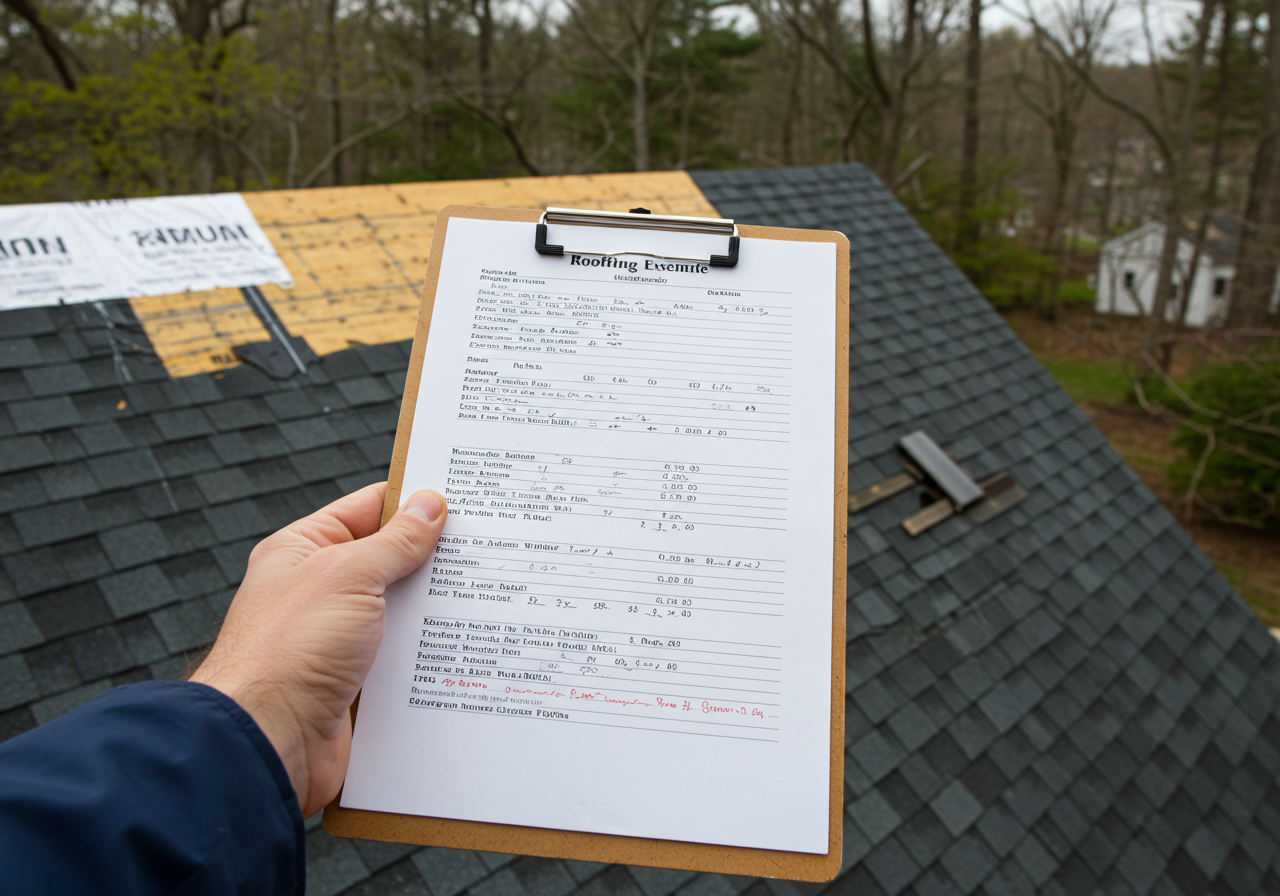
I've seen this play out a dozen times: a contractor gives a low-ball bid that doesn't include new drip edges or chimney flashing. Then, halfway through the job in the middle of a March drizzle, they "discover" that your flashing is shot. Now you're over a barrel. You have a hole in your roof, and they want an extra $2,800 to fix the flashing.
The permit fee in Ashford should sit on its own line item. Usually, it's based on the value of the work—roughly $15 to $20 per $1,000 of the project cost. If a contractor tells you to pull the permit yourself as a "homeowner-builder," run away. They are trying to avoid accountability and likely don't have the proper insurance. I always suggest that homeowners read our blog library for more details on how to handle permit disputes before they happen.
Did You Know?
Connecticut state code requires a second layer of ice and water shield in 'high-risk' zones, which includes much of the wind-swept hills in Ashford.
4. Hidden Components: Flashing, Venting, and Drip Edges
If you want to see if a contractor is honest, look at the "accessories" list. A roof isn't just shingles; it's a system of metal and membranes. One of the most common ways quotes go wrong is by reusing old flashing. I saw a project on Iron Mine Lane where the contractor tried to save $600 by using the 20-year-old copper flashing on a brand-new 50-year roof. It's like putting old tires on a brand-new truck. It makes zero sense and will lead to a leak within five years.
Here is the math you should look for:
- Chimney Flashing: Should be $450 - $900 depending on size.
- Ridge Vents: Expect $12 - $18 per linear foot.
- Drip Edge: About $2.50 - $4.00 per linear foot.
- Pipe Boots: $75 - $125 each.
I once worked with a homeowner who was confused why her "affordable" quote didn't include a ridge vent. The contractor told her the old "static" vents were fine. They weren't. Without proper airflow, the attic would hit 140 degrees in July, cooking the shingles from the inside out and voiding the manufacturer's warranty. Don't just take my word for it— see what other CT homeowners experienced when they skimped on ventilation versus those who did it right.
Correct Flashing Installation
A properly installed step-flashing system on an Ashford colonial, ensuring water is diverted away from the chimney masonry.
5. The Financing "0% Interest" Shell Game
This is my biggest pet peeve. We see it all over Tolland County: "0% interest for 24 months!" or "No payments until 2027!" Here is the reality: money isn't free. If a lender says 0%, ask who pays for it. The answer is the contractor, who pays a "dealer fee" to the finance company—often between 12% and 22% of the total project cost.
If you are a cash buyer, you should never pay the same price as a financed buyer. If a contractor quotes you $20,000 with 0% financing, tell them: "I want to see the cash price." Suddenly, that $20,000 quote might drop to $16,500. If you sign for the "0%," you are essentially pre-paying all that interest in a lump sum hidden inside the material and labor costs.
Always check if you qualify for energy-related credits instead. For instance, if you're installing certain types of energy-efficient shingles or solar-ready components, check the IRS Instructions for Form 5695. You might get more back from Uncle Sam than you'd save through a "teaser" financing rate. I've seen Ashford families save upwards of $2,000 just by using the right tax credits rather than high-interest "low monthly payment" plans.
Financing vs. Cash Breakdown
| Feature | Financed (0%) | Cash Payment |
|---|---|---|
| Includes Dealer Fees | ||
| Has Hidden Interest Costs | ||
| Allows Price Negotiation | ||
| Lower Total Cost |
6. Your "Show Me the Math" Negotiation Script
When you have two or three contractors in Ashford giving you estimates, don't just compare the bottom line. You need to perform a "line-item audit." Most people are afraid to negotiate because they think the contractor will do a bad job if they push on price. That's a myth. A professional contractor respects a homeowner who knows the numbers.
Here is the script I want you to use: "I've reviewed the quote, and I see a lump sum for 'Materials and Labor.' Can you break that down by square? I'd like to see the specific cost for the shingles, the underlayment, and the estimated man-hours." If they tell you "that's just how the software does it," tell them to find new software. You have every right to know if you're paying $600 for a permit that only costs $350.
I remember a guy in Westford who saved $1,800 just by pointing out that the contractor had billed for 30 squares of shingles when the satellite measurement only showed 26.5. The contractor "realized he made a typo." Sure he did. Put the numbers on paper before you sign anything. If you're feeling overwhelmed by the technical jargon, I always recommend checking out the Better Business Bureau's guide to home improvement to ensure your contract includes a clear "Right to Rescind" and a specific completion date.
Never pay more than 10-25% as a down payment
As we move deeper into 2026, the cost of materials isn't getting any lower, but your ability to spot a bad deal is your best defense. A roof replacement in Ashford doesn't have to be a financial mystery. By demanding line-item clarity, verifying local code compliance, and avoiding the "0% interest" trap, you can ensure your home stays dry without draining your bank account.
Don't wait until the March "mud season" leaks become a June mold problem. If you're ready to see what the math actually looks like for your specific roofline, use a tool that connects you with people who are vetted and local. Getting a clear, honest starting point is half the battle.
Get Your Free Roof Quote
Enter your zip code to get started