
Key Takeaways
- 84% of roof leaks in Bristol homes are caused by flashing failures, not shingle problems.
- Chimney flashing requires a two-part system with reglet cuts—most contractors skip this critical step.
- A $450 flashing repair can prevent thousands in structural damage if caught early.
- March's freeze-thaw cycles in Hartford County are the ultimate test for improperly installed flashing.
The slushy mix we saw rolling through Bristol last Tuesday left a lot of homeowners scrambling for buckets. I spent most of Wednesday morning on rooftops near Rockwell Park, and the story was the same at every stop. People see a brown spot on the ceiling and assume they need a brand-new roof. The reality? Their shingles were often fine, but the thin strips of metal—the flashing—protecting the valleys and chimneys had completely surrendered to the elements.
The Flashing Reality
1. Why Chimney Flashing Is the Primary Culprit in Hartford County
If you live in one of the classic Cape Cods or colonials around Federal Hill, you've got a chimney. And if you have a chimney, you have a high-risk leak point. Most contractors in Bristol will try to "caulk and walk"—which just means they'll apply a bead of sealant and call it a day. But that caulk will crack within two seasons of Connecticut humidity.
A real pro uses a two-part system: step flashing (which goes under the shingles) and counter-flashing (which is embedded into the masonry). I've seen hundreds of jobs where the installer skipped the "reglet" cut—that's a 1-inch deep groove we saw into the brick to tuck the metal in. Without that cut, water eventually gets behind the metal, and you're looking at a slow-drip disaster. If you're worried about the health of your masonry transitions, getting a professional repair assessment is the only way to catch these gaps before they rot your roof deck.
2. The Math of Metal: Copper vs. Aluminum vs. Galvanized
When I'm drafting specs for a project, the choice of material is usually dictated by the home's age and the owner's budget. In Bristol, we see a lot of older homes where galvanized steel was the standard. The problem? Galvanized steel eventually rusts through. I've pulled up steel flashing from the 90s that looked like Swiss cheese.
For a permanent fix, I always lean toward copper, especially for valleys and chimney saddles. It's more expensive upfront, but it lasts 70+ years. If that's not in the cards, we use high-grade 0.032-inch aluminum with a baked-on Kynar finish.
Flashing Material Comparison
| Feature | Galvanized Steel | Aluminum (0.032) | Copper (16oz) |
|---|---|---|---|
| Long Lifespan (30+ years) | |||
| Rust Resistance | |||
| Soldering Possible | |||
| Affordable Cost |
3. The "Kick-Out" Flasher: The $20 Part That Saves $2,000
Here is something your average "storm chaser" contractor won't mention: kick-out flashing. This is a small, angled piece of metal installed where a roof edge meets a vertical sidewall. Its only job is to "kick" the water away from the siding and into the gutter.
I've inspected dozens of homes in the Chippens Hill area where the siding was literally rotting off the house because the original builder missed this one tiny detail. It's a $20 part, but installing it correctly during a repair can save you a fortune in siding and framing repairs. If you're trying to figure out if your current roof system is lacking these essentials, calculating the cost of a full upgrade might show you that a few strategic repairs are a much better investment.
4. How We Replace Flashing Without Tearing Off the Whole Roof
A lot of Bristol homeowners are terrified that a chimney leak means they need a $15,000 replacement. That's rarely the case if the shingles are less than 15 years old. We can perform a "surgical" replacement where we carefully remove two courses of shingles around the transition, replace the metal, and weave new shingles back in.
Remove existing shingles
Remove existing shingles 12 inches around the leak site to expose the deck.
Inspect the wood
Inspect the wood for rot or mold (replace sheathing if the moisture is over 19%).
Install ice and water shield
Install high-temp ice and water shield directly to the wood deck.
Fabricate and install flashing
Fabricate and install custom-bent metal flashing (copper or aluminum).
Interweave new shingles
Interweave new shingles with the flashing for a watertight seal.
5. Identifying the "Mystery Leak" in Your Bristol Home
Sometimes the leak isn't at the chimney or the wall. It's at the plumbing vent. Those rubber "boots" around your PVC pipes have a lifespan of about 10 to 12 years. The Connecticut sun (even in March!) dries out that rubber until it cracks.
I always tell my crews to carry a few 3-inch and 4-inch lead boots on the truck. Lead doesn't crack like rubber does. According to Department of Energy guidelines on roofing durability, choosing materials that match the lifespan of your shingles is the key to a "one-and-done" roof. If your shingles are good for 30 years, but your flashing is only good for 10, you've got a 20-year headache ahead of you.
6. The Hidden Cost of "Caulk-Only" Repairs
I see it all the time on Bristol's community Facebook groups: "I know a guy who can fix that leak for $100." That guy is going to climb up there with a tube of roofing cement (we call it "black jack") and smear it over the hole.
Here's the problem: roofing cement dries out and shrinks. When it shrinks, it pulls away from the metal, creating an even bigger gap than before. Plus, it's a nightmare to clean off when you finally decide to do the repair correctly. A proper repair involves mechanical fasteners and overlapping metal—not just chemicals. For those dealing with repeated failed "quick fixes," it might be time to see what a full, warranted replacement would look like to finally end the cycle of leaks.
7. Navigating Structural Concerns and Financing
If a flashing leak has been ignored for a few seasons, the damage often goes deeper than the shingles. I've seen rafters in older Bristol homes that looked like charcoal because of dry rot. When we get into structural repairs, the costs can escalate quickly.
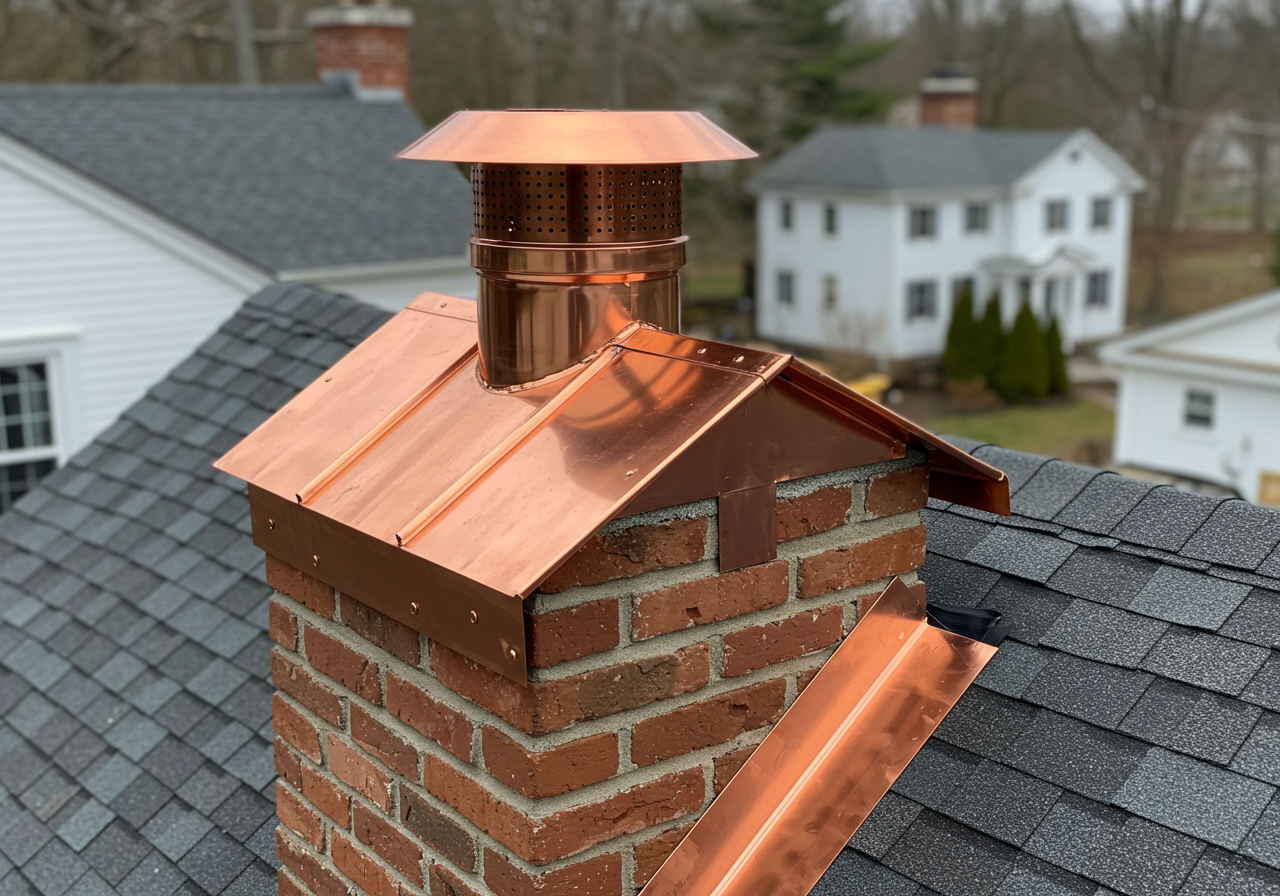
Close-up of copper step flashing being installed on a chimney
Properly layered metal flashing is the only way to ensure long-term protection against New England's freeze-thaw cycles.
If you find yourself facing an unexpected structural repair, there are resources available. The USA.gov home repair portal provides information on federal grants and loans for critical safety repairs. Don't let a small leak turn into a condemned room just because you're worried about the immediate price tag.
8. Why Bristol's March Weather is the Ultimate Flashing Test
March in Hartford County is brutal on metal. We get those days where it's 50 degrees at noon and 20 degrees by midnight. Metal expands and contracts at a different rate than wood and asphalt. If your flashing isn't installed with "slip joints" or enough overlap, that movement will eventually back the nails out.
According to FEMA's technical guides for low-slope and transitional roofing, the way we terminate the edges of our flashing determines if it can withstand the wind-driven rain we get in CT. I always make sure our valleys have a "W" crimp in the center—this breaks the water's momentum and prevents it from washing up under the shingles on the opposite side.
Get Your Free Roof Quote
Enter your zip code to get started
Keeping Your Bristol Home Dry This Season
At the end of the day, flashing is about 1% of your roof's surface area, but it's responsible for 90% of the problems I see. If you're noticing water stains near your chimney or where your garage meets the house, don't wait for the next nor'easter to act.
Start by checking your attic with a high-lumen flashlight during a rainstorm. If you see water tracking down a rafter, follow it up—it almost always leads back to a piece of metal that's given up the ghost. When you're ready to stop the drip, look for a contractor who talks about "reglets" and "gauges," not just "caulk."