
Key Takeaways
- Warranty Voidance: Most top-tier shingle manufacturers require certified installation to honor 50-year non-prorated warranties.
- Hidden Structural Costs: DIYers often overlook $1,200+ in necessary decking repairs that pros catch during the tear-off.
- Permit Hazards: Bethany building codes require specific ice and water shield layouts that many homeowners install incorrectly.
- Safety Liability: Falls from a typical 8/12 pitch roof in Bethany can result in medical costs that dwarf the savings of a professional crew.
After the heavy wind gusts we saw tear through the West River valley last week, my phone has been vibrating off the hook with Bethany homeowners asking the same question: "Can I just swap these shingles out myself?" It's a fair question. On paper, the math looks enticing. You see the line item for labor on a professional quote and think you can pocket that five-figure sum by spending a few Saturdays on a ladder.
But here is the reality I see every March when the spring thaw hits New Haven County: the "savings" from a DIY roof often evaporate faster than a light dusting of snow on a black asphalt shingle. In my 18 years inspecting Connecticut's housing stock, I have seen more botched homeowner repairs than I care to count. Usually, it's not for a lack of effort—it's a lack of technical precision that the manufacturers demand for their warranties to actually mean anything.
The False Economy of the "Weekend Warrior" Approach
Here is a number that might surprise you: $3,480. That is the average cost of materials for a 2,000-square-foot roof in Bethany if you buy them yourself at a big-box retailer. Compare that to a professional quote of $11,500, and it looks like a no-brainer. But I've walked roofs where the homeowner saved $7,000 on labor, only to have the entire system fail in 4 years because they used 1-inch nails instead of 1-1/4 inch galvanized coils.
In Bethany, where the elevation changes and the wind whips across the hills near Lake Dawson, the margin for error is razor-thin. If your shingle exposure is off by even a half-inch, you've created a leverage point for wind to get underneath. I recently inspected a home near the Litchfield turnpike where the owner had "replaced" a section himself. He used a pneumatic nailer but didn't adjust the PSI correctly. The nails were blowing right through the shingle mat. One storm later, half the new roof was in his neighbor's yard.
(Look, I get the appeal of doing it yourself, but roofing isn't just about nailing down boards; it's about managing water tension and wind lift.) When you factor in the cost of a dumpster rental (roughly $550 in New Haven County), the specialized tools like a shingle stripper, and the 80+ hours of back-breaking labor, that $7,000 "savings" starts to look more like a minimum wage job with a high risk of injury.
Roof Lifespan: DIY vs. Professional Installation
Deciphering the Bethany Permit and Building Code Maze
Bethany isn't like other towns. Our building department is diligent, and for good reason. According to local building codes, any residential roofing project involving more than two squares (200 sq. ft.) requires a permit. If you're doing this yourself, you are the one sitting in the town hall, filing the paperwork, and—crucially—scheduling the inspections.
One specific detail that DIYers consistently miss is the ice and water shield requirement. In our part of Connecticut, code dictates that this waterproof membrane must extend from the eave's edge to a point at least 24 inches inside the interior wall line. On many Bethany homes with wide overhangs, that means two courses of shield, not just one. I've seen homeowners fail inspection because they only ran one 36-inch strip, leaving their soffits vulnerable to the exact ice dams we see every February.
The Mid-Project Inspection Nightmare
If you're doing the work yourself, you have to stop when the old shingles are off and the underlayment is down. You can't lay the first shingle until the building inspector signs off on the decking and flashing. If a March rainstorm rolls in while you're waiting for that signature, you better have a $400 industrial tarp and some serious luck. When I manage a crew, we have a direct line to verify our contractor's license and insurance, which often streamlines the inspection process because the town knows our work meets the baseline.
Material Logistics: Why Your Pickup Truck Isn't Enough
I often see guys at the local hardware store loading 40 bundles of shingles into the back of a Ford F-150. Here's a bit of math they haven't done: a single bundle of architectural shingles weighs about 70-80 pounds. A 25-square roof (standard for Bethany) requires 75 bundles. That is 6,000 pounds of dead weight. You're not just risking your suspension; you're looking at four or five trips just to get the materials home.
A close-up of a roofing nail driven too deep into a charcoal shingle, showing the mat damage that causes leaks.
A single over-driven nail can void your entire manufacturer warranty and lead to localized leaks within the first 24 months.
Then there is the issue of "roof loading." Professionals use boom trucks to drop the shingles directly onto the ridge of the roof. If you're a DIYer, you are carrying those 80-pound bundles up a 24-foot extension ladder. One at a time. By the time you get the 75th bundle up there, your legs will be shaking so hard you won't be able to stand safely on a 6/12 pitch.
(I once saw a homeowner in New Haven County try to use a pulley system he rigged up—the rope snapped and sent $300 worth of shingles through his sliding glass door.) It's these logistical "hidden costs" that people forget to put in their spreadsheets.
The Warranty Trap: What Manufacturers Actually Require
This is the part that really burns me. Companies like GAF, Owens Corning, and CertainTeed make incredible products, but their "Limited Lifetime Warranties" are essentially contracts. If you don't follow the contract, they don't owe you a dime. Most of these manufacturers require a "complete system" to honor the full warranty. This means you must use their specific:
- Starter shingles
- Ice and water protector
- Synthetic underlayment
- Ridge vent
- Hip and ridge shingles
If you mix and match—say, GAF shingles with a generic underlayment from a bargain bin—you've just downgraded your 50-year protection to a 10-year "material only" warranty. As a consultant, I always tell homeowners that if you want to see what other CT homeowners experienced with these systems, look at how many professional installs are still standing 20 years later versus the DIY patches.
The 'System Plus' Advantage
According to the Department of Energy's roofing guide, proper attic ventilation is also a prerequisite for most warranties. If you nail down shingles but don't calculate your Net Free Venting Area (NFVA) correctly, the heat buildup in July will bake the shingles from the inside out. Manufacturers can tell when a roof has "cooked," and they will deny your claim faster than you can say "blistering."
Hidden Structural Realities of New Haven County Homes
Bethany has a lot of beautiful homes built in the 70s and 80s. When we tear off a roof in this area, we frequently find 3/8-inch plywood or, worse, old-fashioned plank decking with gaps. You cannot simply nail new shingles over 1/2-inch gaps in planking. The nails won't hold, and the shingles will eventually sag into the voids.
"In Bethany, the humidity from the surrounding woods means we find delaminated plywood on 40% of the homes we strip. A DIYer often ignores this to save time, but those soft spots will be leaks in three years."
A professional crew has the experience to feel a soft spot through their boots before they even tear the shingle off. They carry extra 4x8 sheets of CDX plywood on the truck. A DIYer, already exhausted from the tear-off, is tempted to just "nail over it" and hope for the best. That decision usually costs about $2,500 to fix later when the plywood finally gives way under a heavy New Haven County snow load.
Risk Assessment: Fall Protection and Safety Liability
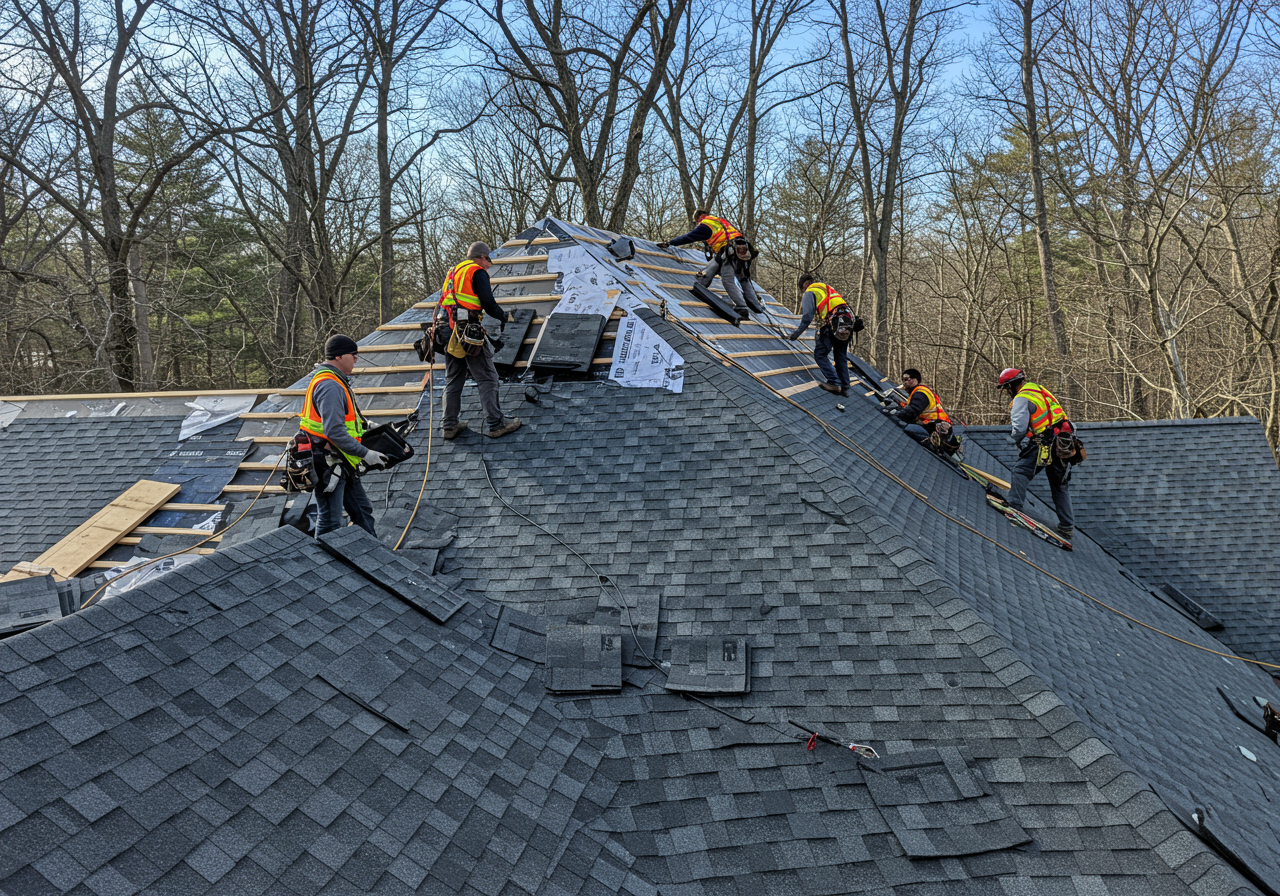
We need to talk about the "gravity tax." A standard roof in Bethany isn't a flat surface; many are steep gables or complex hips. OSHA requires fall protection for anyone working 6 feet or more above a lower level. Most homeowners don't own a roof bracket system, a safety harness, or a vertical lifeline.
(And no, your cousin holding the bottom of the ladder doesn't count as fall protection.)
If a professional is injured on your roof, their company's Workers' Comp insurance covers it. If a "friend" helping you for a case of beer falls off your roof, your homeowner's insurance might cover it—but they might also deny the claim if they find out you were performing "contractual-level work" without proper safety gear or permits. I've seen a $10,000 roofing "savings" turn into a $150,000 personal injury lawsuit.
DIY vs. Pro Safety Gear Investment
Comparing investment in safety equipment and training
Beyond the personal risk, there's the risk to the house. Dropping a bundle of shingles can crack your rafters if you hit the wrong spot. Accidentally stepping on a sky-light flashing can lead to a leak that ruins your kitchen ceiling. These are the stressors that don't show up on a YouTube tutorial.
When Does DIY Actually Make Sense? (Spoiler: Rarely)
Is there ever a time I'd tell a Bethany resident to go for it? Maybe for a detached garden shed or a small woodpile cover. Somewhere where a leak won't cause $20,000 in interior drywall and mold damage. But for your primary residence? The math just doesn't add up when you look at the total cost of ownership.
If you are determined to save money, the better path is to explore our deep-dive roofing guides to understand exactly what goes into a quote. Knowledge is your best bargaining chip, not a hammer and a prayer. By understanding the "why" behind the pricing—the insurance, the specialized flashing, the warranty registration—you can find a contractor who offers value without cutting the corners that lead to failure.
Did You Know?
92% of roofing leaks occur at the 'penetrations'—chimneys, vents, and valleys—not on the flat parts of the roof where DIYers spend most of their time.
In the end, a roof is a shield. In Bethany, that shield has to stand up to horizontal rain, heavy ice, and falling branches. My advice? Let a crew that does this 250 days a year handle the heights. You stay on the ground, keep your weekends, and sleep soundly knowing your 50-year warranty is actually worth the paper it's printed on.
Get Your Free Roof Quote
Enter your zip code to get started