I was walking my golden retriever near the Westbrook Town Beach last Tuesday when I ran into a neighbor, Ellen. She was staring up at her beautiful saltbox home, looking completely defeated. After that nasty wind gust we had earlier this month, she'd found a handful of shingles on her lawn—charcoal gray bits of her home's "armor" just lying there in the grass. She did what any of us would do: she called her insurance company.
The news wasn't good. They'd offered her a "nuisance payment" that wouldn't even cover the cost of a high-quality ladder, let alone a proper repair. Ellen's story is one I hear far too often along the Connecticut shoreline. We pay some of the highest premiums in the country because our homes take a beating from the Sound, yet when it's time for the insurer to step up, the process feels like it's designed to make us give up. It breaks my heart because a roof isn't just a line item on a spreadsheet; it's the crown of your home's design and its primary defense against everything 2026 throws at us.
Key Takeaways
- Connecticut's "Matching Law" can be your best friend when an insurer tries to offer a mismatched patch job that ruins your curb appeal.
- Filing a claim too late—especially after the winter-to-spring transition in Westbrook—is the number one reason for automatic denials.
- Documentation needs to be visual and professional; "I think it's leaking" won't stand up against an adjuster's scrutiny.
- Understanding the difference between ACV and RCV is the $12,642 gap between a partial fix and a total replacement.
The Shoreline Reality: Why Westbrook Claims Often Hit a Wall
Living in Westbrook means we get the best of the Middlesex County coast, but our roofs pay the price. The salt air and those persistent March winds create a unique type of wear that insurance companies love to label as "maintenance issues" rather than "storm damage." If you've ever noticed how the shingles on the Sound-facing side of a house look more weathered than the leeward side, you've seen the "shoreline tax" in action.
The biggest failure I see is homeowners waiting too long to inspect the damage. In our part of the state, we often assume a roof is fine until we see a brown spot on the ceiling. By then, the storm event that caused the problem might have happened eight months ago, and the insurance company will argue that the damage worsened because of "owner neglect."
A modern coastal home in Westbrook with light gray architectural shingles reflecting the morning sun near the water.
A quiet residential street in Westbrook, CT, with glimpses of the Long Island Sound in the background.
The "Sudden and Accidental" Hurdle
Insurance policies are typically written to cover events that are sudden. A tree limb falling during a nor'easter? That's sudden. Shingles slowly losing their granules over fifteen years of salt spray? That's "wear and tear." The trick is showing the adjuster that the specific failure you're looking at happened during a specific weather event.
Local Coastal Codes
Westbrook has specific requirements for wind resistance, especially for homes within a certain distance of the water. If your current roof doesn't meet the 2026 International Code Council building standards, your insurance company might only want to pay to bring it back to its old (and now illegal) state. You need a contractor who knows how to fight for "code upgrades."
ACV vs. RCV: The Financial Trap That Costs Thousands
Here is where the math gets painful. I once helped a couple near the Westbrook Outlets who thought they had "full coverage." When the estimate for their new roof came in at $18,430, the insurance check showed up for $6,200. Why? They had an ACV policy.
Understanding Your Payout Structure
| Feature | Actual Cash Value (ACV) | Replacement Cost Value (RCV) |
|---|---|---|
| Depreciation Applied | ||
| Reflects 2026 Labor Costs | ||
| Higher Monthly Premium | ||
| Out-of-Pocket Risk |
What is Actual Cash Value (ACV)?
Think of ACV like the Blue Book value of a used car. If your roof is 15 years old, the insurance company decides it has lost 75% of its value. They pay you for what a 15-year-old roof is worth—which isn't much. You're left to find the remaining $12,000+ out of your own pocket. It's a design disaster waiting to happen because most people end up picking the cheapest possible materials to bridge the gap.
Why Replacement Cost Value (RCV) is Essential
RCV is what I recommend to every friend who asks. It covers the actual cost to replace the roof today, regardless of how old the shingles were. You pay your deductible, and the insurer covers the rest. In a town like Westbrook, where home values are tied so closely to curb appeal, having an RCV policy is the only way to ensure your home doesn't lose its "look" after a storm.
Did You Know?
On many RCV policies, the insurance company holds back the 'depreciation' until you provide an invoice proving the work was actually completed. If you don't finish the job, you lose that money!
The Documentation Gap: Why "I Saw a Leak" Isn't Enough
If you want your claim to succeed, you have to think like an investigator. Adjusters in Middlesex County are overworked, especially after a big storm. They are looking for reasons to close a file quickly. If your evidence is a blurry photo of a wet spot in the attic, you're going to get a "denied" stamp.
I always tell people to keep a "Home Health Folder." Every March, take ten minutes to walk around your house and snap photos of the roof from the ground. Use your phone's zoom. Having "Before" photos from March 2025 makes a "Damage" photo from March 2026 much more powerful.
The Professional Inspection
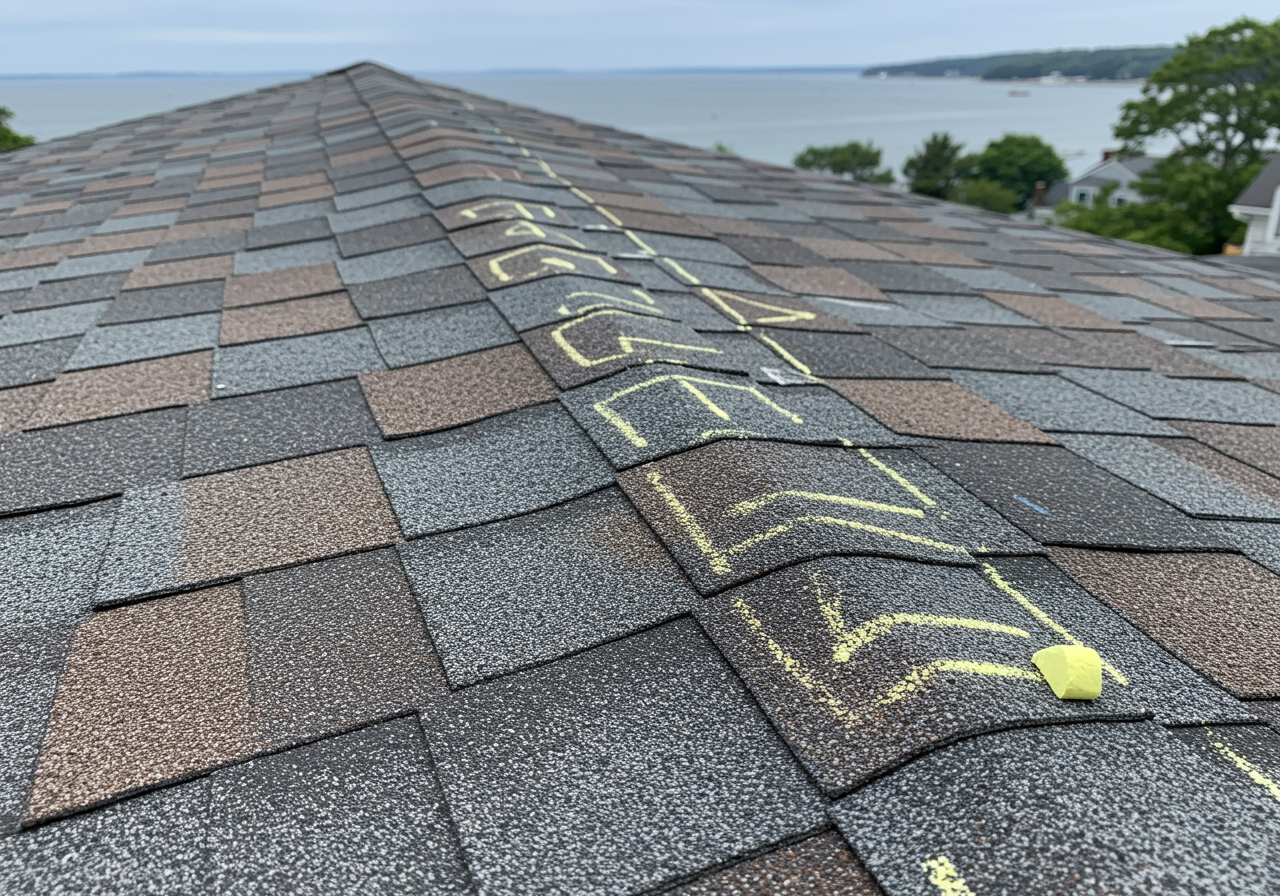
Don't get on a ladder yourself—it's dangerous and, frankly, you might miss the subtle signs of hail bruising or wind uplift. The best move is finding a contractor who actually shows up and knows how to document damage for an insurance company. They speak the language of "lifted tabs" and "creased shingles" that adjusters respect.
Creating a Paper Trail
Keep a log of when you first noticed the damage. Did a neighbor lose a tree? Was there a specific night the wind was rattling the shutters? Write it down. Your personal account, combined with a professional assessment, creates a narrative that's much harder to ignore.
Connecticut's "Matching Law": Your Secret Weapon for Curb Appeal
This is my favorite "Sheri Wilde Tip" because it connects design with law. Connecticut is one of the few states with a strong "matching law" (officially known as Section 38a-316e). It states that if an insurer is repairing a part of your roof, they must use materials that result in a "reasonably uniform appearance."
Imagine your home in the Grove Beach neighborhood. You have beautiful, weathered "driftwood" colored shingles. A storm ruins one slope of the roof. The insurance company says, "We'll just replace that one side." But that shingle color has been discontinued, or the new shingles are so much darker that your house looks like a patchwork quilt.
Fighting for the Full Replacement
Under CT law, if they can't find a match, they may be required to replace the entire roof to maintain that uniform look. I've seen this save homeowners $15,000. It's not just about the money; it's about making sure your roof line meets the sky in a way that looks intentional, not like a mistake.
When "Close Enough" Isn't Good Enough
Insurance companies will try to tell you that a "similar" color is fine. It isn't. If the texture or the shadow line is different, it affects your home's resale value. Don't be afraid to verify your contractor's license and ask them if they have experience with "matching law" disputes. It requires a specific type of negotiation.
The 'Reasonably Uniform' Standard
The Fine Print of Wear and Tear vs. Sudden Storm Damage
I recently looked at a roof in Westbrook where the owner was furious his claim was denied. When we got up there, the shingles were "balding"—they'd lost almost all their protective granules. The insurance company called it "end of life," and they were right.
It's a bitter pill to swallow, but insurance is for accidents, not for aging. However, there is a gray area where a storm can accelerate the death of an old roof. This is where you need to be careful with your wording.
Granule Loss vs. Hail Hits
A common mistake is claiming "hail damage" for a roof that is just shedding granules due to age. Hail leaves a very specific "bruise" on the shingle matting. If you try to claim age as damage, the insurance company might flag your house as a "high risk" and actually threaten to drop your coverage unless you replace the roof out of pocket.
Wind Uplift: The Silent Killer
Sometimes a roof looks fine from the ground, but the wind has broken the adhesive seal on the shingles. Once that seal is broken, the shingles flutter like a deck of cards. They might settle back down, but they'll never stick again. This is legitimate storm damage, even if no shingles flew off.
Identify the date of the weather event
Use local Westbrook weather archives to pinpoint when the damage occurred.
Contact a local roofing professional
Get a detailed damage assessment report from a contractor familiar with insurance claims.
Notify your insurance carrier
Open a claim and get a claim number immediately after discovering damage.
Meet the adjuster on-site
Ideally have your roofer present to point out hidden damage that might be missed.
Review the initial estimate
Check for 'line item' accuracy and matching law compliance before approving work.
Approve the work and ensure permits
Make sure all building permits are filed with the Town of Westbrook before work begins.
Navigating the Adjuster Meeting Without Losing Your Cool
The day the adjuster comes to your Westbrook home can be stressful. My advice? Be the "helpful host," not the "angry adversary." Offer them a bottle of water, let them know where the ladder access is, and then—this is important—let your roofing professional do the talking.
I've seen homeowners accidentally talk themselves out of a claim. They say things like, "Yeah, it's been leaking a little for a couple of years," thinking they are showing the severity. What they are actually doing is admitting to "long-term seepage," which is usually excluded from policies.
The Supplement Process
The first check you get from the insurance company is almost never the final one. In the industry, we call the extra money "supplements." Once the old shingles are torn off, your roofer might find rotten plywood or flashing issues that weren't visible before. A good contractor knows how to submit these "discoveries" to the insurance company for additional payment.
Dealing with Denials
If your claim is denied, don't panic. You have the right to a second inspection with a different adjuster. Sometimes, the first person was just having a bad day or was new to the shoreline climate. If you're really stuck, you might need to look into urgent repair help to prevent further interior damage while you fight the appeal.
"The secret to a successful claim isn't shouting the loudest; it's having the most detailed photos and a contractor who understands the CT building code better than the adjuster does."
Streamlining Your Westbrook Roof Recovery in 2026
We've come a long way from the days of waiting three weeks for a guy in a truck to drop off a handwritten quote. In 2026, the technology we have at our fingertips makes the start of this process so much easier. When you're already stressed about a leaking roof, the last thing you want is a "sales pitch" that lasts four hours in your living room.
That's why I'm such a fan of what we're doing here. You can get an instant quote tool that uses high-res satellite data to measure your roof's pitch and square footage without anyone even stepping on your grass. It gives you a baseline. When the insurance company says "Your roof is only 20 squares," and the satellite data says "Actually, it's 26 squares," you have the data to push back.
Choosing Your Partner Wisely
Don't just pick the roofer with the flashest ad. Check the BBB home improvement guidelines to see how they handle disputes. In Westbrook, word of mouth is everything. You want someone who has handled Shoreline claims specifically, as the paperwork for a house in Westbrook is different than one in, say, Hartford.
The ZikQuote Advantage
The beauty of a matching service is that it takes the "guesswork" out of vetting. Instead of cold-calling five different companies, you get matched with professionals who are already verified. It's about taking the power back in a situation where the insurance company usually holds all the cards.
Don't Fight the Insurance Company Alone
Get a professional, vetted estimate in seconds and see what your Westbrook roof replacement should actually cost.
No credit card required • Free to use
I always tell my readers: your roof is the "handshake" your house gives to the neighborhood. Whether you live in a classic Colonial or a modern waterfront build, the integrity of that roof defines your home's future. Don't let a poorly handled insurance claim force you into a "cheap" fix that you'll regret every time you pull into your driveway.
Take a deep breath. Document everything. And remember that in Connecticut, the law is on the side of the homeowner who does their homework. You've worked hard for your Westbrook home; make sure your insurance company works just as hard for you.
Get Your Free Roof Quote
Enter your zip code to get started
FAQ

About Sheri Wilde
Verified ExpertSheri Wilde is a Home Improvement Editor with a background in interior design and sustainable living. She helps Connecticut homeowners make informed decisions about their biggest investments.