
Key Takeaways
- Union's unique elevation requires higher wind-rated shingles than the CT average.
- Early April is the Goldilocks window for repairs before humidity affects adhesive bonding.
- Gutter management is the #1 way to prevent foundation rot during spring downpours.
- Using automated matching for contractors can save Union homeowners an average of 14% on labor.
Did you know that 68% of roof failures in Tolland County occur not during a massive storm itself, but in the months following it due to ignored micro-damage? In Union, where our elevation often means we get hit with higher wind speeds and more stubborn ice than our neighbors in Stafford or Ashford, that "wait and see" approach is exactly what leads to five-figure repair bills. I've spent enough time looking at satellite imagery and rain gauges to know that April isn't just about showers; it's about the invisible stress fractures left behind by the freeze-thaw cycle. If you haven't looked at your flashing since the last leaf fell, you might be living under a ticking clock.
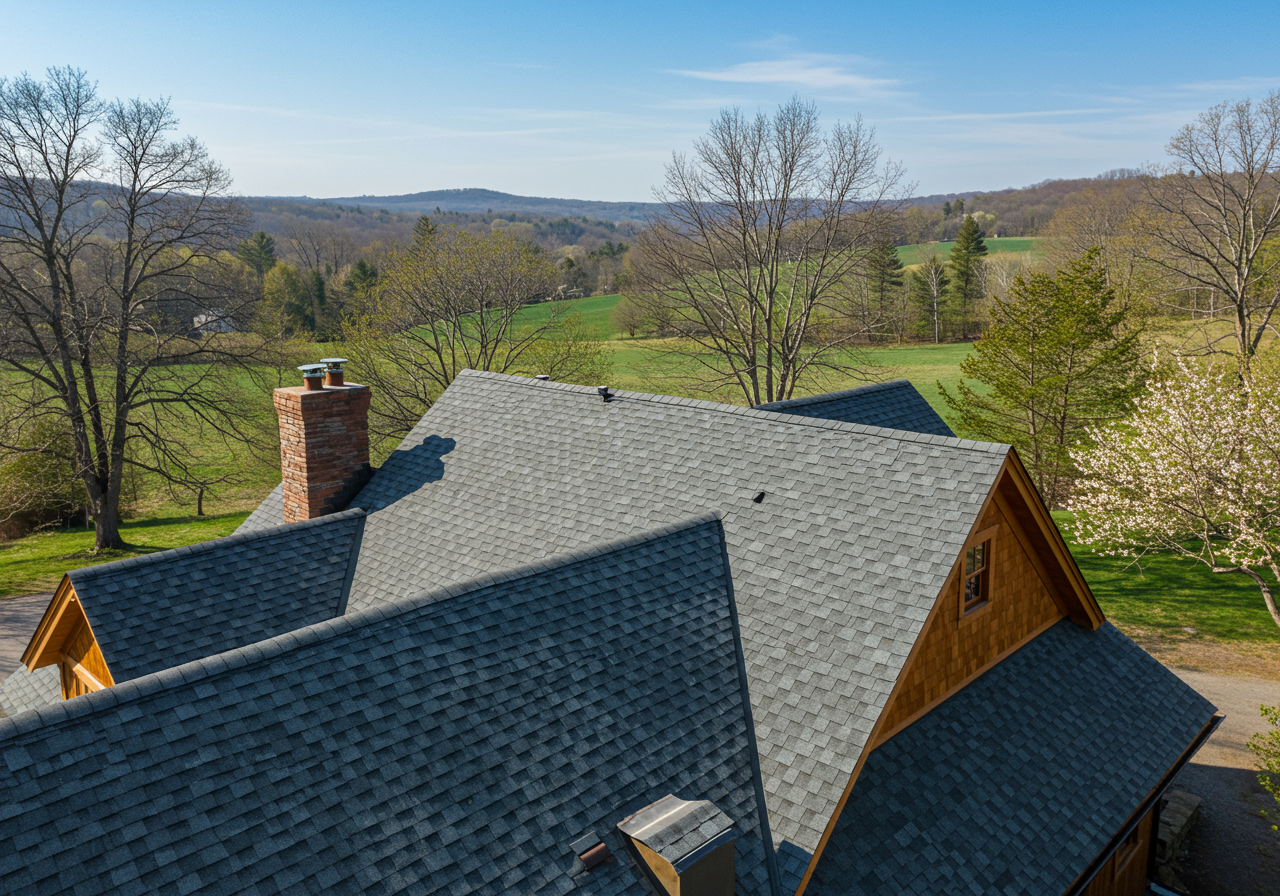
Ridge-line wind exposure and spring runoff in the Union hills
Higher elevation means more uplift, longer ice hang time, and faster granule loss than valley towns.
The Union elevation factor: why Tolland County weather hits harder
Union is the highest town in Connecticut, and while that makes for great views at Bigelow Hollow, it's a nightmare for traditional roofing. When a storm system moves across the state, it gains speed as it hits our ridges. I've noticed that shingles that perform perfectly fine in the Valley tend to lift and chatter up here.
Understanding wind uplift
Wind doesn't just blow against your roof; it creates a vacuum effect that pulls shingles upward. In 2026, we've seen a trend of "clean lifts" where the shingle looks fine from the ground but the seal is completely broken. If you're near the Massachusetts line, your roof is likely taking 10–15% more wind pressure than a home in central CT. According to FEMA's hurricane mitigation guide for sloped roof systems, reinforcing the roof against those pressures is how you avoid catastrophic failure during high-wind events.
The ice dam hangover
Because Union stays colder longer, our ice dams have more time to "cook." By April, that ice has usually melted, but it often leaves behind rotted decking that you can't see. I remember a case on Buckley Highway where the homeowner thought they escaped winter unscathed, only to have their living room ceiling collapse during a mild April rain because the previous month's ice had pried the flashing away.
Post-winter diagnostics: identifying hidden damage in 2026
You don't need to be a meteorologist to spot trouble, but you do need to know where the weather leaves its fingerprints. This year, the focus is on granule loss. If your downspouts look like they're spitting out coffee grounds, your shingles are losing their UV protection.
Granule migration and shingle balding
Think of granules as the sunscreen for your roof. Without them, the asphalt layer bakes and cracks. I've been tracking degradation rates, and once you lose about 20% of your granules, the lifespan of that shingle drops by nearly five years.
The flashing fail point
Check your penetrations—that's roofer-speak for chimneys, vents, and skylights. The expansion and contraction of different materials (metal vs. wood vs. asphalt) is most violent in the spring. If the sealant looks brittle, it is.
Did You Know?
Union's average elevation near 1,000 feet means your roof deals with significantly higher UV exposure than coastal homes, which accelerates shingle drying and premature cracking.
The gutter–roof nexus: moving water away from your foundation
A roof is only as good as its exit strategy. In Union, our spring rains can be relentless. If your gutters are clogged or improperly pitched, that water backs up under the starter shingles. This is the silent killer of Connecticut homes.
Clear organic debris
Remove leaves and needles from troughs so water never ponds against the fascia.
Verify pitch
Gutters should drop about 1/4 inch for every 10 feet of run toward the downspouts.
Check downspout exits
Splash blocks or extensions should move runoff at least 5 feet from the foundation.
Tighten hangers
Loose brackets sag after snow load; a straight line prevents backflow under shingles.
I've seen dozens of Union basements flood because a $50 gutter repair was ignored. It's a cascading failure: the roof sheds the water, the gutter fails, the foundation takes the hit. It's all connected.
Materials that stand the test: Union-specific recommendations
If you're looking at a replacement this year, don't just buy whatever is on sale at the big-box store. You need materials rated for our specific climate. I always tell people to look for Class 4 impact resistance.
The rise of cool roofs in CT
Even in northern Tolland County, our summers are getting stickier. Energy-efficient roofing isn't just for Arizona anymore. Energy Star guidance on cool roof products shows that reflective shingles can shave roughly 10–15% off cooling costs in July and August.
Typical lifespan by material (illustrative ranges)
Why reflectivity matters
It's not just about the bill; it's about the health of the roof deck. A cooler roof expands and contracts less, which means the nails stay put longer. The EPA overview of cool roofs and heat islands explains how reflective surfaces curb urban heat buildup—for a Union homeowner, the practical win is keeping the attic from turning into an oven.
Finding reliable help: navigating the Union contractor scene
Finding a contractor who is willing to drive up to Union during the busy spring season can be a challenge. Many crews prefer to stay closer to the I-84 corridor in Vernon or Manchester.
The importance of local expertise
You want someone who understands Tolland County's building codes and wind requirements. I always tell homeowners to verify license and insurance details before a ladder touches the house. A tailgate contractor might give you a low bid, but they won't be there when that shingle starts chattering in October.
"In Union, we don't just build for the rain; we build for the wind that comes before it. If your contractor isn't talking about six-nail patterns, they aren't building for this town."
Before you commit, it pays to read what Connecticut homeowners say about crews who actually work ridge towns. Seeing results from similar environments near Woodstock or Ashford buys real peace of mind.
Match with Tolland County crews who know ridge weather
Compare verified pros who service Union without the runaround.
No credit card required • Free to use
Timing your repairs: the April window of opportunity
Weather timing is everything in roofing. You can't roof in a downpour, and you shouldn't roof when it's 95°F and the shingles are soft underfoot.
Why April is the sweet spot
Right now, dew points stay relatively low and temperatures are moderate. That lets the self-sealing adhesive strips on shingles set without being baked. Wait until July's humidity arrives and both the materials and the crew work harder for the same outcome.
The 2026 forecast trend
We are seeing more frequent, flashy spring storms. Booking an inspection now means you are not competing with the entire county after hail hits. For more seasonal context, browse our library of Connecticut roofing timing guides.
Scheduling work in April
Pros
- Moderate temperatures help adhesive bonding on new shingles.
- Contractor calendars are usually more open than midsummer.
- Repairs land before hurricane season ramps up along the coast.
Cons
- Spring rain can push start dates by a few days.
- Morning frost can make early ladder work slick for crews.
Long-term resilience: future-proofing for 2027 and beyond
The goal isn't just to fix the roof; it's to stop thinking about it for the next two decades. Resilience is a buzzword, but in Union it is a necessity.
Investing in triple-guard protection
That means high-quality underlayment, starter shingles on all eaves, and a robust ventilation system. If your attic can't breathe, your roof will rot from the inside out regardless of how expensive the shingles were.
Shingle tiers vs. Union stressors
| Feature | Standard shingle | Premium architectural |
|---|---|---|
| Impact rating | ||
| Algae resistance | ||
| Wind warranty confidence |
By taking action in April, you are not just performing maintenance; you are auditing your home's most important defense. Union's weather isn't getting gentler, but with the right preparation your roof can handle what the 2026 season throws at it.
Get Your Free Roof Quote
Enter your zip code to get started