
Key Takeaways
- Ice dams are caused by heat escaping the living space, not by "clogged gutters."
- Connecticut building code now requires specific R-values (typically R-49 or higher) to prevent attic overheating.
- Proper ice and water shield membrane must extend at least 24 inches inside the interior wall line.
- Mechanical steaming is the only safe way to remove existing dams; hammers and salt pucks destroy shingle integrity.
Most homeowners in Andover believe a common lie: that ice dams are a "gutter problem." I've walked hundreds of roofs along Route 6 and Bunker Hill Road, and I can tell you that those frozen blockages hanging off your eaves have almost nothing to do with your aluminum troughs.
The reality is that an ice dam is a thermal failure, not a drainage one. When I see a house with three-foot icicles, I don't look at the gutters—I look at the attic insulation and the ventilation baffles. If your roofer tells you that "bigger gutters" will solve your winter leaking, they are either misinformed or trying to sell you a $2,000 band-aid that will fail the next time the mercury hits 28°F.
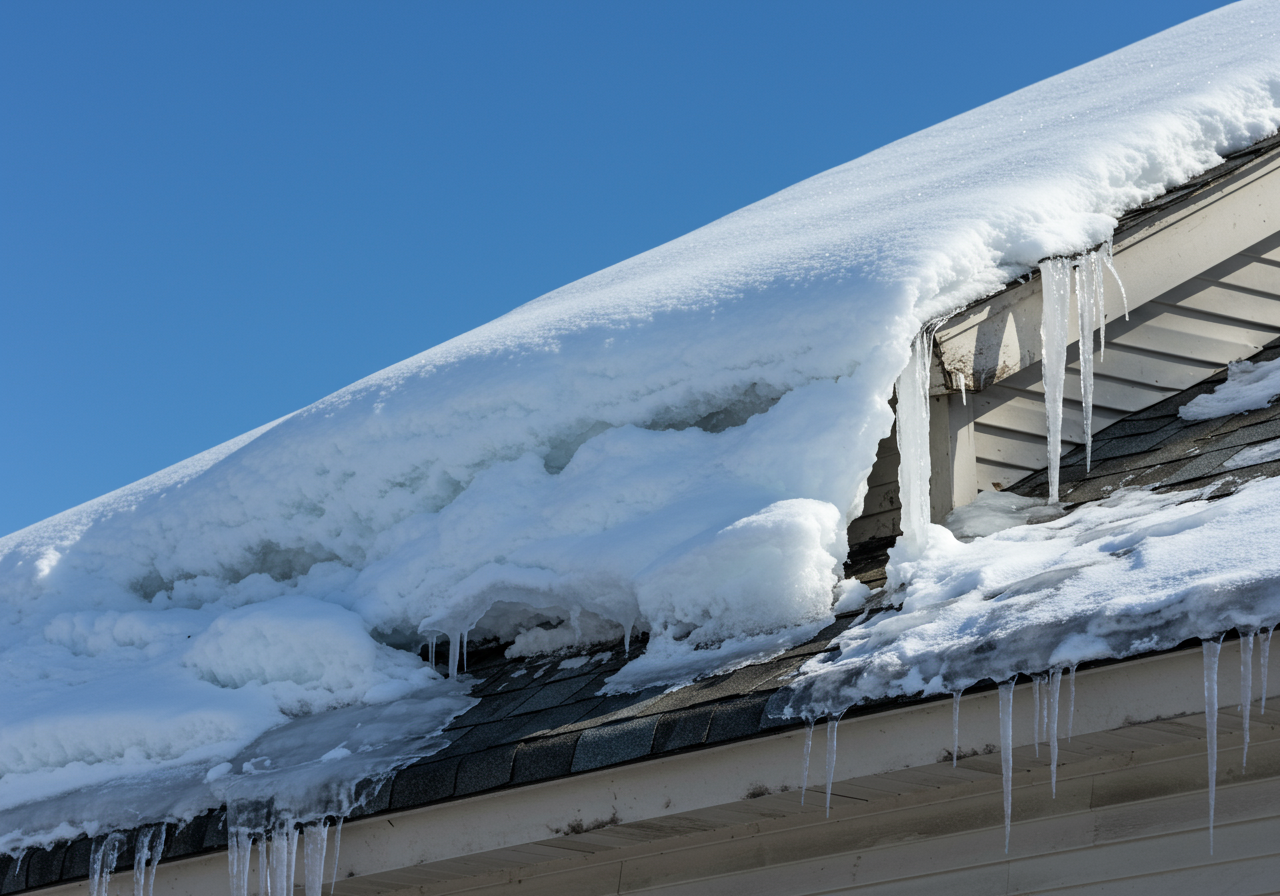
Ice dam formation on an Andover home
The visible ice buildup is just the symptom—the real problem is in the attic
The Thermodynamics of a 28°F Andover Morning
Right now in Andover, it's a crisp 28°F with clear skies. On paper, that sounds like a beautiful winter day. In the roofing world, it's the exact temperature where "freeze-thaw" cycles turn a minor insulation gap into a flooded kitchen.
Here is the math: Your roof deck needs to stay within a few degrees of the outside air temperature. If your attic is a cozy 50°F because of a leaky recessed light fixture or thin fiberglass batts, the snow on top of your shingles starts to melt from the bottom up. That water runs down the roof until it hits the eave—which is hanging out over the yard and is a true 28°F. The water flash-freezes, forms a ridge, and suddenly you have a pond sitting over your bedroom ceiling.
Why the Eave is the Enemy
The eave is the only part of your roof not warmed by the house. When I perform an inspection, I use an infrared camera to spot "hot spots" (usually near the ridge or around chimneys). In older Andover colonials, we often find that the insulation has been stuffed so tightly into the corners that it blocks the soffit vents. This chokes the airflow, traps heat, and practically invites ice to form.
The R-Value Reality
Most homes built in Tolland County before 2000 are severely under-insulated. I've seen attics with maybe six inches of old rockwool—roughly an R-19 value. Current standards suggest you need nearly triple that. If you aren't hitting that R-49 mark, you're essentially paying to heat the sky, and that heat is what's fueling your ice dam. You can check our technical blog library for more data on how thermal bridging affects different roof pitches in Connecticut.
Case Study: The Cape Cod Disaster on Route 6
Last February, I was called out to a Cape Cod-style home near Andover Lake. The owner was frantic; water was literally pouring through the window casing in their guest room. They had spent $800 the week before on a "pro" who hacked at the ice with a hatchet.
When I got into the knee walls (the small triangular spaces behind the upstairs walls), the problem was obvious. The contractor who did their last roof neglected to install air baffles. The insulation was touching the plywood roof deck, meaning there was zero "cold floor" under the shingles.
Never allow a contractor to use a hammer, pick, or shovel to remove ice.
Identifying the "Bypass"
In that Route 6 house, the "bypass" wasn't just the insulation. It was a bathroom fan venting directly into the attic instead of through the roof. That moist, 70°F air was hitting the cold roof deck and creating a localized melt zone. (Always make sure your exhaust fans are hard-piped to a dedicated roof vent, not just "pointed" toward a gable.)
Baffles and Airflow
We solved the issue by pulling back the insulation and installing high-density foam baffles. This created a 2-inch channel for cold air to move from the soffit up to the ridge. By the time we were done, the roof deck temperature dropped by 14 degrees, effectively killing the ice dam's power source. For homeowners looking to fund these kinds of energy-efficiency repairs, USA.gov provides resources for home improvement loans that can cover weatherization.
Perform a visual 'icicle check'
If they are only in one spot, you have a localized heat leak.
Measure your attic insulation depth
You want at least 15-18 inches of loose-fill cellulose or fiberglass.
Check soffit vents from the outside
Ensure they aren't painted shut or covered in bird nests.
Look for 'light leaks' in the attic
If you see light from the house below, heat is escaping there.
Consult a pro to verify your ridge-to-soffit ventilation ratio
Ensure it is balanced.
Materials That Actually Hold the Line
Look, even a perfectly ventilated attic can get an ice dam during a massive Connecticut nor'easter. That's where your "secondary water barrier" comes in. If I'm writing a spec for a home in Tolland County, I don't care what shingle you pick as much as I care about what's underneath it.
Beyond the Shingle
In Andover, the code says you need ice and water shield, but many "tailgate contractors" only run one 36-inch course. Because of our typical 12-inch overhangs, a single course only protects about 24 inches of the actual heated roof area. I always recommend two courses (6 feet total) to ensure the membrane extends well past the interior wall.
Ice Dam Protection Methods
| Feature | Roof Rakes | Heat Cables | Increased Insulation | Proper Ventilation |
|---|---|---|---|---|
| DIY Friendly? | ||||
| Long-Term Fix? | ||||
| Addresses Root Cause? |
Before hiring anyone, I always tell homeowners to verify their contractor's credentials to ensure they actually follow these manufacturer specs.
Flashing and Valleys
Valleys are the "gutters" of your roof deck. When snow piles up in a valley, it stays there longer. I prefer using a "closed-cut" valley with a double layer of high-temp ice and water shield (like GAF WeatherWatch) underneath. It's a bit more labor-intensive, but it's the difference between a dry ceiling and a $4,700 insurance claim.
Winter Maintenance: The "Do No Harm" Policy
If you're reading this while staring at a wall of ice on your gutters, don't panic. You have to be smart about how you handle it. At 28°F, the ice is rock hard. If you try to pry it off, you'll take the shingles with it.
The Steam Solution
The only professional way to mitigate a dam mid-winter is with a low-pressure steamer. It's like a pressure washer, but it runs at roughly 300°F and very low PSI (under 300). It cuts through the ice like a hot knife through butter without vibrating the roof or stripping granules. It's expensive—often $400 to $600 an hour—but it's cheaper than a new roof.
"A roof rake is a workout, not a solution. If you're pulling snow off your eaves every Tuesday, you're admitting your attic is failing to hold its heat."
Emergency Tactics
If you can't get a steamer out to Andover immediately, you can use a roof rake to clear the first 3-4 feet of snow from the eaves. This removes the "fuel" for the dam. However, be extremely careful. According to OSHA safety standards for residential work, working on snowy or icy roofs is incredibly hazardous. Stay on the ground. If you have a flat roof section or a low-slope addition, refer to FEMA's guide on low-slope roof protection for specific structural concerns during heavy snow loads.
Did You Know?
Ice weighs about 57 pounds per cubic foot. A large ice dam can easily put over 1,000 pounds of additional stress on your Andover home's fascia and rafters.
If you're tired of the "bucket brigade" every time it snows, it's time to stop looking at your gutters and start looking at your attic. A well-engineered roof system shouldn't need salt pucks or roof rakes to survive a Connecticut winter.
Get Your Free Roof Quote
Enter your zip code to get started
The key to a dry winter is a balanced system: high-performance insulation, unobstructed airflow, and a heavy-duty waterproof membrane. Don't just take my word for it—you can see what other Tolland County homeowners experienced when they finally upgraded their systems to handle our local climate.