
Key Takeaways
- The 3-Day Rule: While the physical install often takes 2-3 days for Easton-sized roofs (2,800+ sq. ft.), the administrative lead-up is usually 3-4 weeks.
- Complexity Surcharge: Steep pitches and multiple gables common in Fairfield County can add 15-20% to the labor timeline compared to a standard ranch.
- Permit Lag: Easton's local building department requires specific filings that can stall a "rush" project by 7-10 business days.
- Weather Buffers: March in Connecticut is fickle; always bake in a 48-hour "rain/wind" window to avoid mid-tear-off disasters.
"A roof isn't just a weekend DIY project; it's a 48-hour surgery on your biggest financial asset," says Mark V., a Fairfield County site supervisor I've worked with for over 12 years. In Easton, where we value our sprawling colonials and our quiet weekends, homeowners often fall into a predictable trap: assuming the "start date" on the contract is when the clock actually begins. It isn't. The mistake I see most often—and the one that costs you the most in stress and mid-project "change orders"—is failing to distinguish between the crew being on your shingles and the total project lifecycle. If you're planning a replacement for March 2026, you need to look at the calendar with a bit more skepticism.
The Reality of the "On-Roof" Clock
Look, I've seen the flyers promising a "New Roof in One Day!" In a neighborhood like ours, that's usually a red flag. Unless you live in a 900-square-foot cottage with zero dormers, a quality crew is going to need more than eight hours to do it right. I recently consulted for a family over near Sport Hill Road who were promised a 10-hour turnaround. By sunset on day one, half their plywood was exposed and the crew vanished because they hadn't accounted for the triple-layered shingles from a 1990s patch job.
For a standard 3,000-square-foot Easton home, the physical labor follows a very specific rhythm. You want a crew that respects the math of the install, not one racing against a stopwatch.
Day 1 (AM): Arrival, property protection
Plywood over windows, tarps over landscaping.
Day 1 (PM): Complete tear-off
Removal of old materials and inspection of the wooden decking.
Day 2 (AM): Installation of protective layers
Ice and water shields, underlayment, and flashing.
Day 2 (PM): Shingle application begins
Starting from the eaves and working upward.
Day 3 (AM): Completion of details
Ridge vents, chimney crickets, and final shingle courses.
Day 3 (PM): Final cleanup
Magnetic sweeping for nails and final debris haul-away.
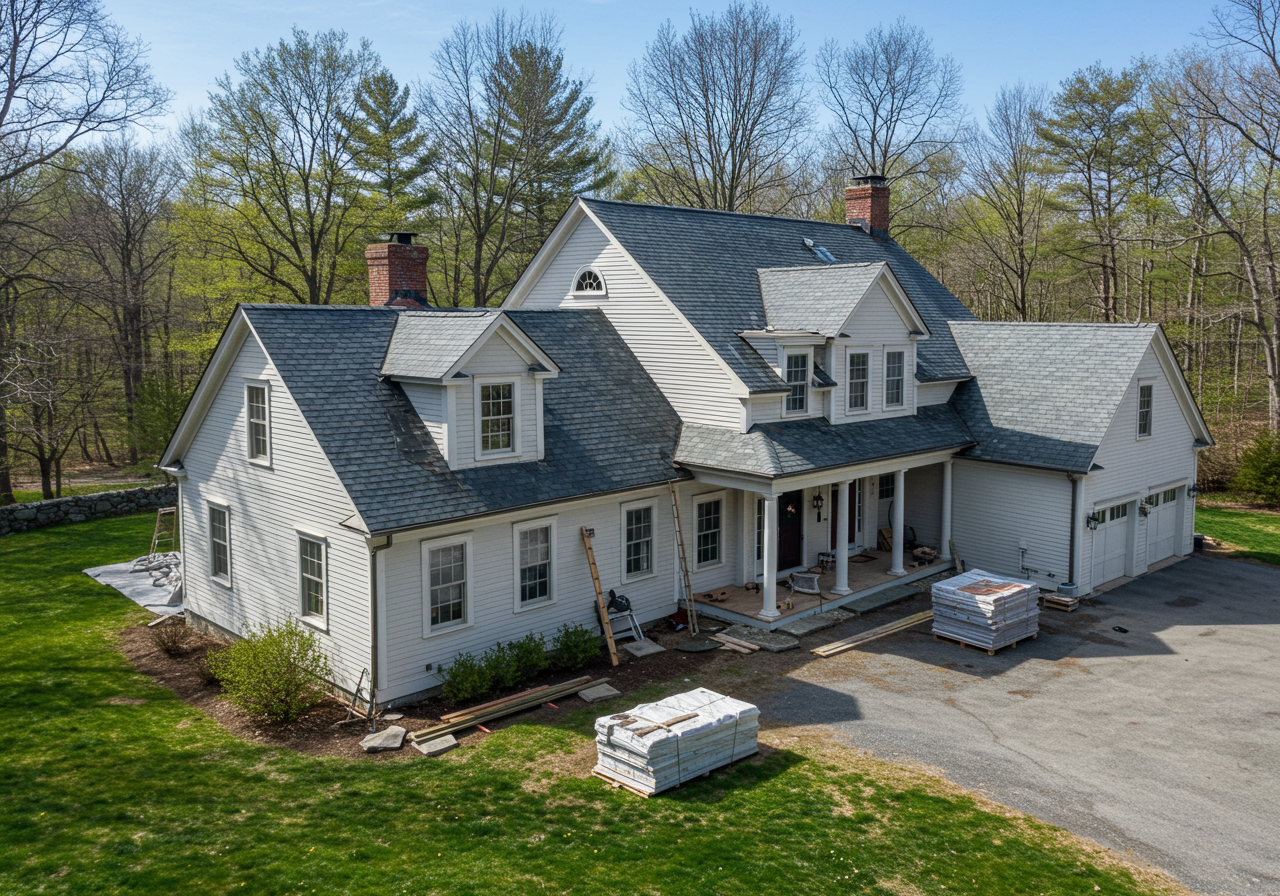
Roof replacement in progress in Easton, Connecticut
A professional crew working on a multi-day roof replacement project
Why Easton Architecture Changes the Math
We aren't talking about cookie-cutter developments here. Easton is known for its custom builds, steep rakes, and "Gold Coast" standards. When you verify your contractor's license, you need to ask specifically about their experience with high-pitch safety equipment.
A roof with a 12/12 pitch (that's a 45-degree angle) requires specialized scaffolding and slower footwork. According to FEMA's hurricane mitigation guide, proper attachment in high-wind zones like ours requires precise nailing patterns that simply cannot be rushed. If a contractor quotes the same timeframe for a flat roof as they do for your peaked Colonial, they aren't showing you the real math.
The March Factor: Weather and Materials
March 2026 in Connecticut is "shoulder season." It's a great time to beat the summer rush, but it comes with a caveat. Asphalt shingles have a "thermal sealing" temperature. If it's too cold, those shingles won't bond until the first warm week in April.
I always tell people to check for "Cool Roof" certifications during this phase. Research from Energy Star suggests that reflective roofing can significantly lower your cooling loads, but these materials sometimes require specific handling in cooler temperatures.
March Replacement Pros & Cons
Pros
- Contractor availability is higher before the June peak.
- Easier to spot leaks before heavy spring 'mud season' rains.
- Lower risk of heat-stroke related crew fatigue.
Cons
- Possible delays due to late-season frost or rain.
- Daylight hours are shorter, potentially adding a half-day to labor.
- Sealant strips may take longer to activate.
The Administrative "Black Hole"
Before a single nail is driven, there's a paper trail. I've had homeowners call me fuming because their "Monday start" got pushed to Thursday. Why? Usually, it's the permit or the material delivery. In Fairfield County, you don't just dump a ton of shingles on a driveway without a plan.
Make sure the permit fee sits on its own line item in your quote. If a contractor says they'll "work under the radar" without one to save time, walk away. That's a shortcut that will haunt you when you try to sell your home. For a deeper look at what a fair contract looks like, our blog library has several line-item breakdowns you can use as a checklist.
Dana's Pro Tip
Navigating the Final Stretch
The last 5% of the project usually takes 50% of your patience. This is the "punch list" phase—fixing a bent gutter, replacing a cracked siding plank, or finding those last few stray nails in the driveway. Don't just take my word for it; see what other CT homeowners experienced when they reached the finish line of their projects.
The goal isn't just a fast roof; it's a roof that lasts 30 years because it wasn't slapped together in a frantic 10-hour sprint. Get the numbers on paper, respect the Easton building codes, and give the process the time it deserves.
Ready for a timeline that actually holds up?
Get an instant, honest estimate from verified Easton contractors who know our local architecture.
No credit card required • Free to use
Get Your Free Roof Quote
Enter your zip code to get started