Over the last twelve years covering New London County, I've watched a specific trend emerge in Salem's housing stock. Back in the early 2010s, we saw a massive wave of "bubble" skylight installations in the colonial and ranch-style homes tucked away near Gardner Lake. Those units are now reaching the end of their design life simultaneously. I've noticed a pattern: homeowners often spend $400 to $600 on "handyman fixes" like silicone goop or tar patches, only for the leak to migrate six inches to the left during the next heavy rain.
The shift in Connecticut roofing technology over the last decade has moved toward integrated flashing systems, yet I still see contractors using old-school "cut and fit" methods that simply don't hold up against our coastal humidity and freeze-thaw cycles. If you're seeing a brown ring around your ceiling light or hearing that rhythmic "tink-tink" against your drywall, you aren't just dealing with a hole; you're dealing with a system failure.
Key Takeaways
- Sealant is a temporary patch, not a repair; 92% of "caulk-only" fixes fail within 14 months.
- Proper skylight longevity in Salem requires step flashing woven into the shingle courses—not a bead of sealant around the frame.
- Replacing a skylight during a full roof project is roughly 50% cheaper than doing it as a standalone job later.
- High-performance glass units now offer better insulation than the R-value of some older Salem attic spaces.
The "Band-Aid" Trap: Why Sealant Isn't a Solution
When I pull up to a driveway in Salem—usually one of those long, wooded entries off Route 82—I can often spot the problem from the ground. There's a visible mound of black roof cement around the skylight frame. The reality is that skylights are designed to shed water through gravity and precision-fit metal "steps," not through chemical bonds.
Most people don't realize that the metal frame of a skylight expands and contracts at a different rate than the wood decking and asphalt shingles. When you apply a rigid sealant, that movement eventually tears the bond. (I once measured a 1/8-inch gap that opened up on a south-facing roof in just one season due to thermal expansion.)
The mechanics of step flashing
Instead of relying on a tube of caulk, a professional roof repair crew that re-weaves metal into every shingle course installs individual pieces of aluminum or copper flashing between each row of shingles. This creates a redundant water shed. If water gets past the first shingle, it hits the metal and is directed back out onto the roof surface. I've seen these systems last 30 years without a drop of sealant.
Condensation vs. actual leaks
Before you panic, check the "leak" during a cold snap. In many older Salem homes with high humidity (common near our local lakes), moisture in the air hits the cold glass and drips down. This looks like a leak but is actually a ventilation issue. If the wood frame is wet but the drywall above it is dry, you likely have a "sweating" problem, not a hole in your roof.
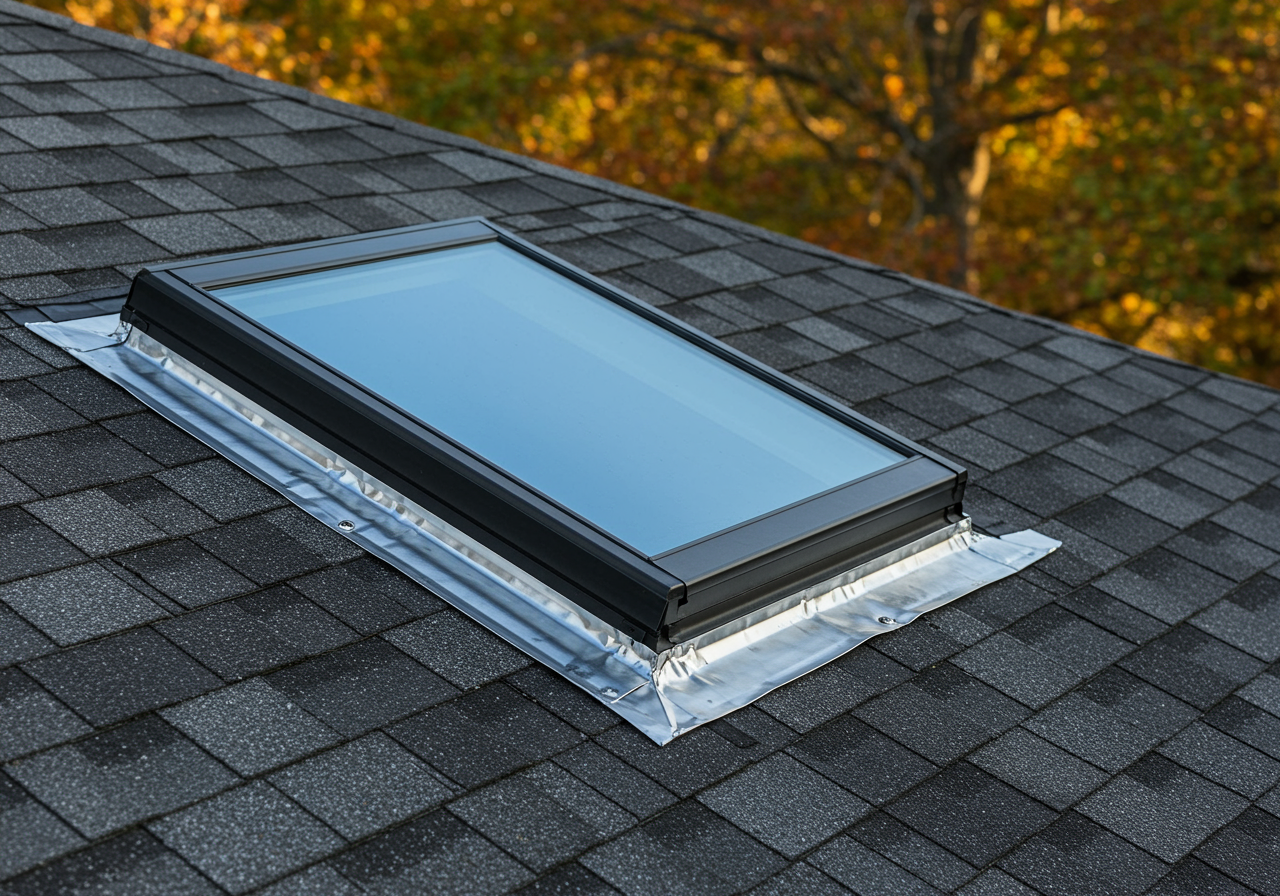
Integrated flashing beats a caulk mound every time
When you see roof cement piled around a skylight curb, it usually means water is already winning—and the patch is hiding rot.
Why Salem's March Transitions Are Brutal on Glass
March in Connecticut is what I call "The Great Stress Test." We aren't dealing with the deep freezes of January anymore, but we have those cycles where the day is mild and the night is freezing. For a skylight in Salem, this is a nightmare. Water gets into small micro-cracks in old gaskets during the day, turns to ice at night, and expands—physically prying the unit apart.
I remember a job on Music Vale Road where the homeowner was convinced their shingles were shot. When I got on the pitch with my pry bar, I found that the ice had actually backed up under the skylight's head flashing because there was no ice and water shield membrane installed underneath.
Did You Know?
Modern skylights with Low-E coatings can reflect a large share of solar heat—a massive upgrade over the clear acrylic domes common in Salem's 1990s builds.
For context, see Energy Star's guide on cool roofs, which explains how reflective surfaces interact with solar gain.
The impact of tree canopy
Salem is beautiful because of its trees, but those oaks and maples are skylight killers. Debris collects behind the top "saddle" of the skylight. This damp organic matter holds moisture against the metal, leading to premature rust. I recommend a "clear zone" of at least 10 feet for any overhanging branches to prevent both physical damage and accelerated rot.
Material lifespans in New London County
The salt air from the Sound doesn't hit us as hard in Salem as it does in Niantic, but we still have higher humidity levels that affect aluminum oxidation. I've found that using heavy-gauge, powder-coated flashing kits—like those from Velux—tends to outperform the generic shop-bent metal many local crews use.
Typical Skylight Component Lifespan (Years)
The Technical Fix: A Professional's Inspection Steps
If I'm looking at a leak for you, I'm not just looking at the glass. I'm looking at the "deck-to-curb" transition. Most DIYers and low-bid contractors skip the most vital step: the membrane wrap. According to FEMA's fact sheet on sloped roof systems and penetrations, a secondary water barrier is essential for any roof penetration to withstand wind-driven rain.
Expose the assembly
Remove three courses of shingles surrounding the skylight to expose the roof deck and existing flashing.
Membrane the curb
Apply a high-temperature ice and water shield membrane up the vertical sides of the skylight curb.
Start at the sill
Install the sill flashing (bottom piece) first so water flows over the shingles, not under them.
Weave the steps
Interweave step flashing with new shingles along both sides, lapping each piece like shingles on a wall.
Cap the head
Secure the head flashing (top piece) and tuck it cleanly under the upper shingle course.
When to walk away from a repair
There is a point of diminishing returns. If the internal wood frame is black with mold or "punky" (soft to the touch), a repair is a waste of money. At that point, you are better off exploring full roof replacement that bundles new, efficient skylights with a fresh deck and flashing system. The labor cost to strip and re-flash an old, failing unit is often 70% of the cost of just putting in a brand new one.
Safety Warning
Prevention Economics: Saving $2,400 on Future Gaskets
The numbers don't lie. A standalone skylight replacement in Salem typically runs between $1,800 and $3,200 depending on the size and "reach" (how high the ceiling is). However, if you bundle that work when you're already doing a roof project, the price drops significantly because the flashing labor is already baked into the shingle installation.
I recently consulted for a family near Fairy Lake who had three skylights. By replacing them during their scheduled roof overhaul, they saved exactly $2,450 compared to the individual quotes they'd received the year prior. Plus, modern units are so much more efficient that they help mitigate urban heat buildup—see EPA guidance on cool roofs and heat islands for how surface choice affects attic and neighborhood temperatures.
Warranty realities
One thing I always tell Salem residents: read the fine print. If a contractor repairs a skylight using third-party sealants, they often void the manufacturer's warranty on the unit itself. Always insist on a factory-made flashing kit. (It usually costs about $110, but it's the only way to get a true "No Leak" warranty from the big brands.)
Repair vs. Replacement Decision Matrix
| Feature | Minor repair | Full replacement |
|---|---|---|
| Lower upfront spend | ||
| 10–20 year warranty potential | ||
| Meaningful energy efficiency gains | ||
| Addresses rotted curb or deck wood |
If you're trying to place your project on a realistic budget before you invite crews out, run your Salem roofline through our cost calculator so you understand variables like pitch, penetrations, and access before the first handshake.
Don't let a small drip become mold remediation
Get a transparent, no-pressure path to Salem skylight repair and flashing that actually lasts.
No credit card required • Free to use
Get Your Free Roof Quote
Enter your zip code to get started
Conclusion
In my experience, a skylight is either the best feature of a house or the biggest headache. By focusing on the flashing rather than the caulk, and respecting the age of your components, you can keep the light coming in without the water following it. Stay proactive, especially before those spring rainstorms really start to test our New London County gutters.
FAQ

About Daniel Roberts
Verified ExpertDaniel Roberts is a Senior Roofing Consultant with over 15 years of experience in the New England residential construction industry. He specializes in storm damage assessment and energy-efficient roofing systems.