Key Takeaways
- Thermal Envelope Focus: A high-performance roof can reduce heating-related energy loss by up to 28% in older Sterling homes.
- Ventilation is Key: Proper intake and exhaust balancing prevents heat wash, where stagnant attic air degrades insulation R-value.
- ROI Comparison: Strategic roofing upgrades often provide a more stable long-term ROI than HVAC replacements when the existing roof deck is poorly insulated.
- Local Precision: Sterling's unique micro-climate requires specific ice dam protection to maintain the integrity of energy-efficient roofing systems.
Sterling homeowners are currently facing a silent financial leak that no amount of thermostat-fiddling can fix. You might think your soaring Eversource bill is strictly a utility pricing problem, but for many in the "Quiet Corner" of Windham County, the culprit is sitting right above your head. We see it constantly in Sterling: colonial and ranch-style homes where the heating system is working overtime to warm the neighborhood because the thermal envelope—the barrier between your living space and the outdoors—is fundamentally compromised.
The problem isn't just about "old roofs" or missing shingles. It is a systemic failure of the roofing assembly to retain thermal energy. When I walk through attics near Oneco or along Route 14A, I often find that the interaction between the roofing material, the ventilation, and the insulation is non-existent. Homeowners spend thousands on high-efficiency heat pumps or pellet stoves, yet they leave the "lid" of their house wide open. This disconnect results in a cycle of expensive mechanical upgrades that never quite deliver the promised comfort because the heat is escaping faster than it can be generated.
The Physics of the Sterling Thermal Envelope
To understand why your roof is the primary suspect in high heating costs, we have to talk about the stack effect. In a typical Sterling winter, warm air rises. If your roof assembly isn't designed to contain that air, it creates a vacuum that pulls cold air in through your basement and crawlspace. I've performed thermal imaging on dozens of homes in Windham County, and the results are almost always the same: bright purple streaks at the eaves where the cold is winning.
The reality is that your roof is more than just a rain shield. It is a complex layer of components that must work in unison. When I'm on a job site, I'm not just looking at shingle alignment; I'm checking the baffle depth. If your baffles are crushed, your insulation is effectively useless because it can't "breathe," and moisture starts to settle. In Sterling, where humidity can fluctuate wildly, that moisture reduces the R-value of fiberglass batts by nearly 35% before you even realize there's a problem.
The Myth of "Just Adding Insulation"
Many people think they can solve heating issues by just blowing more cellulose into the attic. While the Department of Energy's insulation guidance for homes outlines recommended levels for Connecticut, insulation alone is a band-aid if the roof deck is leaking air. If you don't address the roofing substrate and the air-sealing at the top plate, that new insulation just acts as a filter for the warm air escaping your home.
Why Sterling's "Quiet Corner" Layout Matters
Sterling has a lot of acreage and a lot of wind. Unlike the densely packed neighborhoods in Hartford, Sterling homes are often exposed on all sides. This means wind-driven cold air can penetrate the soffits more aggressively. I've found that Sterling roofs often require specialized edge-cell insulation—something most contractors skip—to ensure that the very edge of the house, where the wall meets the roof, isn't a massive thermal bridge.
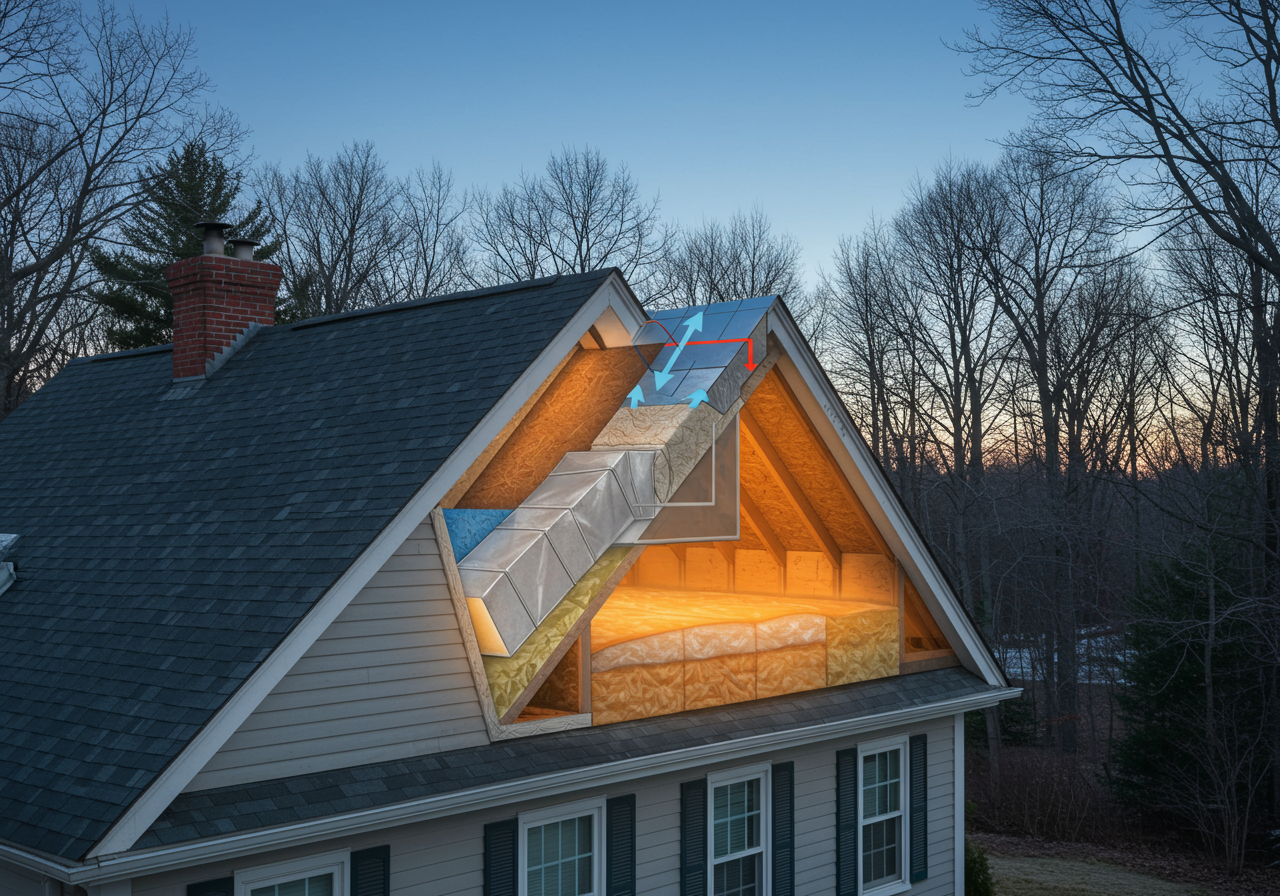
Sterling roof assembly and attic airflow
Balanced ventilation, baffles, and air sealing work together to keep heat in living spaces.
Roof Efficiency vs. HVAC: The Real Numbers
I often get asked if a homeowner should spend $14,000 on a new high-efficiency furnace or $18,000 on a performance roofing system. If your current roof is over 17 years old, the roof is almost always the better investment for energy savings. Why? Because a new furnace is just a more efficient way to create heat that you are still going to lose.
Most sales reps will gloss over the R-value delta between a standard shingle roof and a vented, radiant-barrier system, but the physics don't lie. When we install a system that includes reflective underlayments and high-density ridge venting, we are essentially creating a "thermos effect." I recently tracked a project in the Sterling Hill area where the homeowner saw a $112 monthly reduction in heating costs just by switching from a standard asphalt setup to a ventilated "cool roof" system with proper air sealing.
Calculating the Payback Period
If we look at the numbers, a standard HVAC upgrade might save you 15% on your fuel bill. A comprehensive roof and insulation synchronization can save 25% or more. Over a 20-year period (the typical lifespan of a mid-grade furnace), the roofing system actually pays for itself twice over through energy savings and the avoidance of ice dam repairs, which are a major hidden cost in Windham County.
Expert tip
Material Choice: Beyond the Standard Shingle
Not all shingles are created equal when it comes to the "Quiet Corner" winters. In Sterling, we deal with significant temperature swings that cause "thermal shock"—the rapid expansion and contraction of roofing materials. This movement can create micro-fissures in cheap shingles, allowing heat to bleed out.
I'm a big advocate for shingles that incorporate thermal-stable granules. Brands like GAF or Owens Corning have specific lines designed to reflect infrared radiation. While most people associate "cool roofs" with summer, the same technology helps maintain a stable attic temperature in the winter by preventing the "hot-spot" effect that leads to ice dams. According to EPA guidance on how cool roofs change roof surface temperature, these materials can meaningfully shift how your attic behaves across seasons—not just in July.
The Metal Roofing Alternative
If you're planning on staying in your Sterling home for more than 15 years, metal is the gold standard for energy efficiency. A standing-seam metal roof, installed with an integrated thermal break, is significantly better at retaining heat than asphalt. We use 24-gauge steel on most Sterling projects because it stands up to the heavy snow loads we get in eastern CT while providing an airtight seal that asphalt simply can't match.
Metal vs. Asphalt for Sterling Heating Efficiency
Pros
- Superior heat retention via thermal breaks
- 50+ year lifespan
- Easily integrates with solar
- Highly resistant to ice dams
Cons
- Higher upfront cost ($$$)
- Can be noisy if not insulated properly
- Limited local specialists who know metal
Compare roof-first vs. HVAC-first plans for your Sterling home
Get matched with contractors who model the attic-roof system—not just shingle color.
No credit card required • Free to use
Ventilation: The Secret Ingredient to Low Bills
Here is something most Sterling contractors won't tell you: your roof needs to be "cold" in the winter to keep your house "warm." It sounds like a contradiction, but it's the cornerstone of roofing science. If your attic is warm, it means heat has escaped from your living space. This warm attic air then melts the snow on your roof, which runs down to the cold eaves and freezes, creating an ice dam.
The ice dam isn't just a leak risk; it's a sign of massive energy waste. I've measured attic temperatures in Sterling where the air was 74°F while it was 20°F outside. That homeowner was effectively paying to heat their attic. By choosing a crew that sizes intake and exhaust the right way, you can install a balanced system of soffit and ridge vents that keeps the attic at a neutral temperature.
The 1:300 Rule
We follow the 1:300 rule religiously—1 square foot of ventilation for every 300 square feet of attic floor space. In many of the older homes near Sterling's town center, the original builders only provided about half that. When we go in and core-drill new intake vents, the impact on the heating bill is almost immediate. The air moves, the insulation stays dry, and the heat stays in the rooms where it belongs.
Why Baffles are Non-Negotiable
I've seen "pro" crews in Sterling just throw shingles up and ignore the eaves. If your insulation is stuffed into the corners of your attic, it's blocking the airflow. We use high-impact polystyrene baffles to create a dedicated channel for air. It's a $400 addition to a $15,000 job, but it's the difference between a roof that lasts 30 years and one that fails in 12.
Sterling's Local Climate: Windham County Challenges
Sterling sits in a bit of a weather "pocket." We get more snow than the coast and more wind than the valley. This means our roofs take a beating. When the wind kicks up across the open fields near the Rhode Island border, it creates "uplift" pressure. If your roof isn't properly fastened, that uplift creates tiny gaps where warm air escapes.
I always recommend a "six-nail" pattern for Sterling roofs, even if the manufacturer only requires four. Those two extra nails per shingle aren't just for wind resistance; they ensure a tighter seal that prevents thermal bypass. FEMA's sloped-roof system fact sheet emphasizes structural integrity in high-wind zones, and I treat that integrity as a direct part of energy performance.
Dealing with "Quiet Corner" Humidity
Our spring and fall in Sterling are notoriously damp. This humidity is the enemy of attic insulation. If your roofing system doesn't have an airtight vapor barrier, that moisture gets into your fiberglass or cellulose. Wet insulation has an R-value of nearly zero. I've pulled out batts of insulation in Sterling that felt like wet sponges. When you read what Connecticut homeowners say after whole-roof energy upgrades, the best outcomes are almost always tied to moisture control—not just new shingles.
Did You Know?
A single 1/4-inch gap in your attic's bypass can leak as much warm air as a window left open all winter. We use closed-cell spray foam to seal these thermal bypasses before any shingles are laid.
Long-Term ROI: The 15-Year Projection
When I sit down with a homeowner to look at the "all-in" cost of a roof, we look at the 15-year horizon. Energy prices in Connecticut have historically risen by about 3-5% annually. A roof that saves you 20% on your heating bill today will save you significantly more in 2035.
I recently modeled a typical 2,200-square-foot home in Sterling. By upgrading from a standard 3rd-generation asphalt roof to a high-performance system with R-60 attic insulation and a balanced ventilation array, the homeowner is projected to save over $18,400 in energy costs over the next 15 years. That essentially pays for the entire roof replacement.
Estimated 15-Year Energy Savings by Roof Type (Sterling, CT)
The ZikQuote Advantage for Sterling
Finding a contractor who actually knows how to calculate NFVA (Net Free Ventilating Area) is harder than it should be. Many guys just want to "rip and grip"—tear off the old shingles and slap on new ones. But in Sterling, that's a recipe for high bills and ice dams. We've vetted our network to ensure they understand the "whole-house" approach. If you want more technical breakdowns, our library of Connecticut roofing deep dives walks through specs, ventilation math, and material trade-offs.
Thermal audit
We identify exactly where heat is escaping using infrared technology.
Air sealing
We seal all attic bypasses (light fixtures, plumbing stacks) to stop the chimney effect.
Insulation upgrade
We bring the attic up to CT-recommended R-60 levels using moisture-resistant materials.
Ventilation balancing
We install a matched system of intake and exhaust vents to ensure constant, dry airflow.
High-reflectance shingle installation
We use shingles designed to stabilize roof deck temperatures year-round.
Get Your Free Roof Quote
Enter your zip code to get started
The reality is that your roof is the most important mechanical system in your Sterling home. It's not just about curb appeal; it's about your monthly overhead. If you're tired of seeing your hard-earned money vanish into the Windham County sky, it's time to look at your roof through a different lens. A properly engineered roof doesn't just cost money—it earns it back every time the furnace kicks on.
FAQ

About Daniel Roberts
Verified ExpertDaniel Roberts is a Senior Roofing Consultant with over 15 years of experience in the New England residential construction industry. He specializes in storm damage assessment and energy-efficient roofing systems.