
Key Takeaways
- The 32°F Danger Zone: Ice dams form most aggressively when the outside air is at the freezing mark but your attic is leaking heat at 45°F or higher.
- Sterling's Humidity Factor: With current humidity at 97%, moisture trapped in your attic from ice dam backups is significantly more likely to trigger mold growth in plywood decking.
- Prevention vs. Removal: Investing roughly $1,200 in proper air sealing and insulation can prevent a $4,800 emergency tear-off and interior ceiling repair.
- Local Geography: Sterling's higher elevation and wooded lots mean less sun exposure to melt ice naturally, making mechanical prevention essential.
Have you noticed that thick, glassy ridge of ice hugging the eaves of your Sterling home lately, or perhaps a few unsettling "ice daggers" hanging over the front porch? It is currently 32°F outside with a heavy 97% humidity—conditions that I call the "Perfect Storm" for ice damming in the Quiet Corner. While it feels like a standard March day in Windham County, that thermometer reading is actually the exact tipping point where snow on your roof begins to melt, trickle down, and refreeze into a structural nightmare. Are you prepared for the weight of several hundred pounds of ice pulling at your gutters?
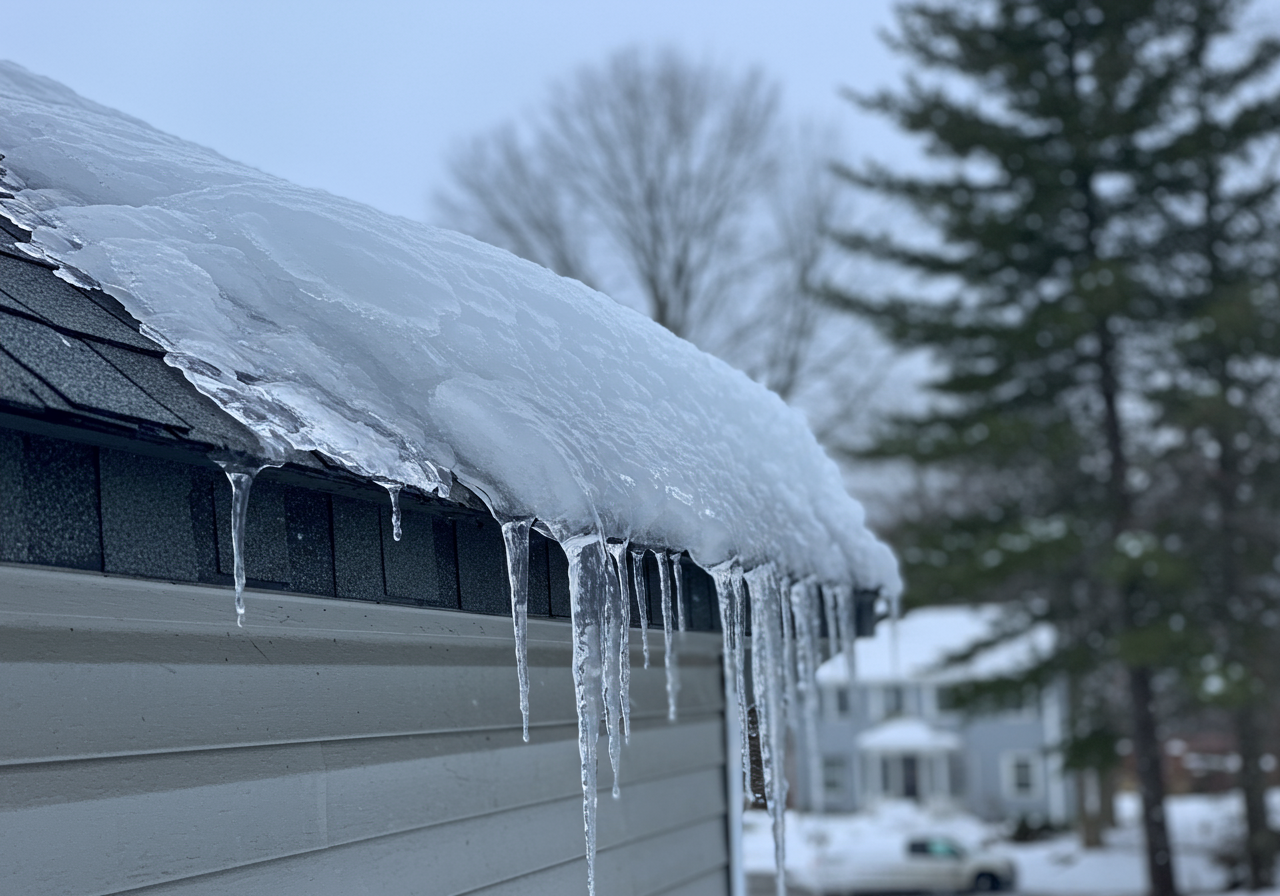
Ice Dam Formation on Sterling Home
The dangerous freeze-thaw cycle that costs Sterling homeowners thousands in roof damage.
1. The Physics of the Freeze-Thaw Cycle in the Quiet Corner
Sterling isn't like the shoreline; we get that stubborn, heavy snow that sits for weeks. When the mercury hits 32°F, as it has today, the snow on your roof acts like a giant down comforter. It traps the heat escaping from your living room. I remember a case back in the winter of 2015—right near Ekonk Hill Road—where a homeowner had three feet of snow on their roof. The bottom layer of that snow was melting because their attic was a balmy 55°F, but the runoff hit the cold gutters and froze solid.
This isn't just about ice; it's about the "hydrostatic pressure" that develops behind the dam. When that water pools up, it doesn't just sit there. It searches for a way out. Since it can't go over the ice ridge, it goes under your shingles. With the current 12 mph winds we're seeing, that moisture is being pushed even further up the roof slope, defying gravity and finding every tiny staple hole in your underlayment.
The Impact of 97% Humidity
Most folks ignore the humidity, but at 97%, the air is nearly saturated. This means any water that leaks into your attic through an ice dam isn't going to evaporate. It's going to soak into your R-30 fiberglass insulation, rendering it useless (wet insulation has almost zero R-value) and creating a petri dish for attic mold. I've seen Sterling attics where the rafters looked like they were growing fur just two weeks after a major icing event.
Identifying "Attic Bypasses"
The heat isn't just leaking through your ceiling joists; it's screaming through "bypasses." These are the hidden gaps around chimney flues, recessed lights, and plumbing stacks. In many of the older Colonials we see around Sterling, these bypasses account for up to 30% of your total heat loss. If you want to stop the dam, you have to stop the bypass.
Noah's Pro Tip
2. Mitigation Strategies: Comparing Short-Term Fixes to Long-Term Cures
When the water starts dripping through your bedroom ceiling, you don't have time for a "climate strategy." You need a fix. However, there is a massive difference between a "band-aid" and a "cure." I often see neighbors in Sterling out on their lawns with long-handled roof rakes. While raking the first three feet of snow off your eaves can help, it's a temporary measure that doesn't address the root cause.
Roof Raking (Short-Term Mitigation)
Pros
- Low cost DIY option
- Provides immediate relief for gutters
- Reduces weight on the eaves
Cons
- Can damage shingle granules
- Risk of falling ice or snow
- Doesn't stop the attic heat leak
The "Salt Puck" Myth
I have to address the "pantyhose filled with salt" trick. You've probably seen it on social media: fill a stocking with calcium chloride and toss it on the ice. Does it melt a channel? Yes. Does it also corrode your aluminum gutters and kill the perennials in your garden when it thaws? Absolutely. It's a desperate move for a desperate hour, but it's hard on your home's exterior.
Professional Steaming vs. Mechanical Hacking
If you have a massive dam, never—and I mean never—let someone up there with a hammer or a chainsaw. I've seen more roofs ruined by well-meaning contractors with mallets than by the ice itself. High-pressure steam is the only safe way to clear a dam. It's like a hot knife through butter, and it won't vibrate your shingles loose. When you're finding a local crew you can trust for this kind of work, ensure they specifically mention "low-pressure steaming" in their estimate.
Ice Dam Costs: Prevention vs. Emergency Removal
3. Structural Defense: Ventilation and Underlayment Requirements
The 12 mph wind we're feeling in Sterling right now is actually a blessing if your roof is ventilated correctly. Proper ventilation uses the "Venturi effect"—wind blowing over the ridge pull air out of the attic, which in turn pulls cold air in through the soffits. This keeps your roof deck at the same temperature as the outside air, preventing the snow from melting in the first place.
According to FEMA's low-slope and residential protection guidelines, the ratio of ventilation should be 1 square foot of net free vent area for every 150 square feet of attic floor. If your Sterling home was built before 1990, there's a high chance you're under-ventilated.
The Role of Ice and Water Shield
In Connecticut, building codes require an "Ice and Water Shield" (a self-adhering bituminous membrane) to be installed from the eave's edge to a point at least 24 inches inside the interior wall line. This is your last line of defense. It acts like a giant rubber gasket around the nails. If you're looking at a quote and the contractor isn't specifying a high-temperature ice shield, you're asking for trouble. Before you commit, I always suggest you see what other Windham County neighbors have experienced with different materials to ensure you're getting the "Sterling-proof" version.
"In Sterling, we see a lot of 'dead valleys' where two roof planes meet but have nowhere to drain. Without a double layer of ice and water shield and proper cricket installation, these spots become ice factories every March."
Managing 97% Humidity in the Attic
To combat the current high humidity, your attic needs to breathe. If your soffit vents are clogged with 20 years of blown-in insulation, that humid air is just sitting there, rotting your rafters. Every time I'm in a Quiet Corner attic, the first thing I check is whether the "baffles" are clear. If you haven't looked at yours lately, it's worth the 10 minutes with a flashlight.
Did You Know?
Did you know that a single family of four can release up to 2.5 gallons of water vapor into their home every day just through breathing and cooking? Without a vapor barrier, that moisture migrates straight into your attic, fueling ice dam damage.
4. The Financial and Safety Reality of Ice Dam Removal
Let's be honest: climbing a ladder in 32°F weather with 12 mph gusts is a recipe for a trip to Day Kimball Hospital. I've seen enough "ladder slides" in my time to know that ice dam removal is not a DIY job for the weekend warrior. Safety gear isn't just a suggestion; it's a requirement.
Professional crews should be following OSHA's residential fall protection standards, which include harnesses and anchored transition points. If you see a guy on your roof with sneakers and a shovel, tell him to get down. Your homeowner's insurance might not cover the liability if an uninsured "handyman" falls off your roof.
Financing Your Defense
If you've discovered that your roof is a sieve and your insulation is non-existent, the price tag can feel daunting. However, there are resources available. For critical repairs that affect the safety and habitability of your home, you can explore the USA.gov home repair assistance portal for federal grants or low-interest loans specifically designed for energy efficiency and weatherization.
FAQ
Your Sterling Action Plan
Don't wait for the puddle on your floor to take action. While the weather is hovering at 32°F, take a walk around your house. Look for those "ice daggers." If they are only in one spot, you have a localized heat leak. If they are everywhere, your attic is a "hot roof" and needs a total ventilation overhaul. To learn more about how different roofing materials handle the Windham County winters, feel free to explore our deep-dive archives.
Get Your Free Roof Quote
Enter your zip code to get started
In conclusion (oops, Noah doesn't say that!), look at it this way: Sterling's winters are beautiful, but they are opportunistic. They find the weak spots in our homes. By sealing those attic bypasses and ensuring your roof can breathe, you're not just stopping ice; you're protecting your biggest investment. Stay warm, stay off the ladders, and keep an eye on that barometer.