
Key Takeaways
- Salisbury's ridge-line geography creates a 'venturi effect' that can turn a Category 1 storm into a local roofing catastrophe.
- A six-nail fastener schedule is legally required for high-wind zones—four nails won't stand up to 90 mph gusts.
- Secondary water barriers (synthetic underlayment or self-adhering membrane) can save $14,000+ in interior damage.
- Investing $2,000 now in high-wind upgrades can save five times that amount in a single afternoon of bad weather.
While most of us in Salisbury are currently keeping an eye on the lingering snowmelt near the Scoville Memorial Library or planning our first spring hikes up Bear Mountain, my desk is already covered in wind-load charts for the 2026 Atlantic season. There's a common misconception in the Northwest Hills that because we aren't sitting on the shoreline in Old Saybrook, we don't need to worry about hurricane-force winds. The reality—one I've seen written in the wreckage of twisted flashing and uplifted rafters—is that our elevation creates a "venturi effect" that can turn a Category 1 storm into a local roofing catastrophe.
When you're situated at the edge of the Berkshires, wind behaves differently. It hits our ridges, accelerates, and searches for any weakness in your building envelope. I've spent the better part of two decades (23 years, to be precise) climbing onto Salisbury roofs after major weather events, and the failures are almost always predictable. They aren't usually caused by "acts of God"; they're caused by $14 boxes of the wrong fasteners or a missed line item in a contract.
If you want to protect your investment, you need more than just a "new roof." You need a system engineered for the specific pressures of Litchfield County. In this guide, I'm breaking down the technical requirements, the local codes, and the financial logic of hurricane preparation that actually works when the sky turns that specific shade of storm-cloud gray.
1. Understanding the Salisbury Ridge-Line Wind Factor
Look, the geography of Salisbury is beautiful, but it's a nightmare for standard roofing specs. If you live on a ridge or an exposed slope near Route 41, your roof isn't just sitting there; it's acting as a wing. As wind hits the side of your home, it creates a low-pressure zone over the leeward side of the roof. This "uplift" is what actually rips shingles off. In my field notes from a 2021 storm, I documented a home near Twin Lakes where the shingles on the windward side were fine, but the entire back slope—where the suction was strongest—had been stripped down to the plywood.
Standard building practices often assume an "Exposure B" category (urban or suburban areas with closely spaced buildings). But many Salisbury estates fall into "Exposure C," which involves open terrain with scattered obstructions. This means your roof needs to be rated for much higher wind speeds than a house in the middle of Hartford. When I review specs for local projects, I'm looking for a minimum 130 mph wind rating, which usually requires specific high-wind starter strips and heavy-duty ridge vents.
I once consulted on a historic colonial near the town center where the owner thought they were safe because of the old-growth oaks surrounding the house. But those trees actually created turbulence that hammered the gables from three different directions. The solution wasn't just "better shingles"—it was a complete fastening overhaul. Finding a contractor who actually shows up and understands these localized wind patterns is the difference between a dry living room and a $12,000 insurance claim.
2. The Six-Nail Fastener Schedule and Why It Matters
In the roofing world, we talk about "fastener schedules." Most manufacturers allow for a four-nail-per-shingle pattern for standard installations. In a low-wind environment, that's fine. In Salisbury? It's a recipe for failure. The "high-wind" schedule requires six nails, placed specifically in the common bond area where the shingle layers overlap.
The physics are simple: more points of contact distribute the load more evenly. But it's not just about the number of nails; it's about the depth. I've seen "pros" use nail guns with the pressure set too high, which drives the nail head right through the shingle mat. When the wind picks up, the shingle just pops off like a button on a tight shirt. My crews use calibrated pneumatic tools (we check the PSI every morning) to ensure every nail sits flush.
Did You Know?
According to the International Code Council (ICC) Digital Building Codes, specific fastening patterns are legally required for high-wind zones. In many parts of Litchfield County, failing to follow these prescriptive paths for roof deck attachment can actually void your manufacturer's warranty and complicate insurance payouts after a storm. Learn more at codes.iccsafe.org.
International Code Council (ICC) Digital Building Codes specify these requirements. If your quote doesn't explicitly mention a "six-nail pattern" or "high-wind installation," you're likely getting a standard job that won't stand up to a 90 mph gust. I always tell homeowners to verify their contractor's license and ask specifically about their fastening standards before any shingles are delivered to the driveway.
3. Secondary Water Barriers: Your Last Line of Defense
If a hurricane is strong enough to rip shingles off your roof, your next problem is the "exposed" wood underneath. Standard #15 felt paper—the black stuff you see on most roofs—is essentially just thick construction paper. It tears easily and offers almost zero protection once the shingles are gone. This is where a secondary water barrier comes in.
In Salisbury, I recommend a full-deck coverage of a synthetic underlayment or, even better, a self-adhering polymer-modified bitumen membrane (often called "ice and water shield"). This stuff sticks directly to the roof deck. Even if the wind takes the shingles, the membrane stays. It's the difference between a few missing shingles and a saturated attic that leads to black mold.
I remember a project near Lime Rock where a microburst took out about 15% of the shingles during a heavy downpour. Because we had installed a high-quality synthetic barrier across the entire 3,200-square-foot deck, the interior of the home stayed bone dry. The repair cost $950 for shingles and labor. Without that barrier, the interior restoration would have easily topped $14,000.
Estimated Lifespan of Underlayment Materials (Years)
4. The "Salisbury Canopy" Problem: Tree Management
We love our trees in Litchfield County, but from a roofing perspective, they are high-velocity projectiles waiting to happen. It's not just about a whole tree falling on the house; it's the "scouring" effect of branches rubbing against shingles for hours during a storm. This knocks the protective granules off the asphalt, leaving the mat exposed to UV rays and water.
I recommend a "10-foot rule" for Salisbury homes: no branch should be within 10 feet of the roofline. This isn't just about the roof; it's about airflow. If your roof can't "breathe" because of heavy foliage, the shingles stay damp, moss grows, and the structural integrity of the deck softens.
During a routine inspection last March on a property near the Appalachian Trail crossing, I found that a heavy oak limb had been "tapping" the ridge vent for months. It had loosened the seal enough that a minor windstorm pushed rain directly into the ridge. We caught it before the rafters rotted, but it was a close call. Part of hurricane prep is hiring a licensed arborist to clear the "strike zone" around your home. If you want to see what other CT homeowners experienced when dealing with local contractors who understand our wooded lots, that context can help you plan.
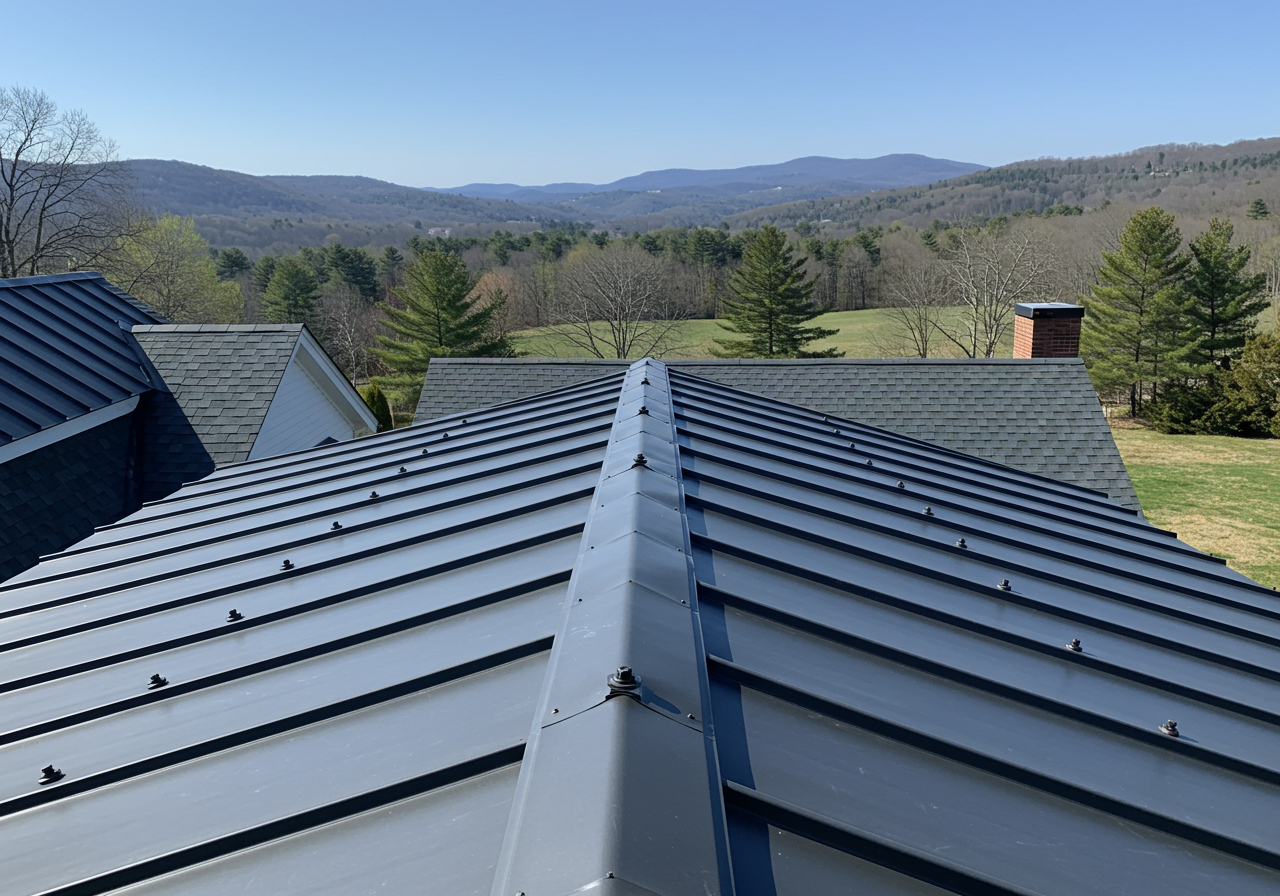
A hurricane-resistant metal roof installation in a Salisbury forest setting
In heavily wooded areas of Salisbury, metal roofing offers superior impact resistance against falling branches.
5. Structural Reinforcement and "H-Clips"
Most people think about the shingles, but hurricane prep goes deeper—literally. It's about how the roof is attached to the walls of the house. In older Salisbury homes, the roof rafters might just be "toenailed" into the top plate of the wall. In a high-wind event, the entire roof can lift off like a lid.
Installing "hurricane straps" (metal connectors that tie the rafters to the wall studs) is a major undertaking for an existing home, but there are smaller steps that make a huge difference. For example, ensuring that the roof sheathing (the plywood) is nailed every 6 inches along the edges and every 12 inches in the field. I've seen 1970s-era homes where the sheathing was barely stapled on.
Another technical detail I insist on is the use of "H-clips" between the sheets of plywood. These small metal clips provide support between rafters, preventing the plywood from flexing and buckling under pressure. It seems like a minor detail, but Energy Star's guide to cool roofs notes that structural stability is the foundation of any high-efficiency or high-performance roofing system. If the deck moves, the system fails.
6. Metal vs. Asphalt: The Cost-Benefit Reality for 2026
When homeowners in Salisbury ask me for the "best" hurricane protection, I usually point them toward standing seam metal roofing. While a high-end asphalt shingle (like the GAF Ultra HD) is excellent, a 24-gauge steel roof is a different beast entirely. It has a much lower "drag coefficient," meaning wind slides over it more easily.
But here's the Daniel Roberts "field note" on metal: it has to be installed correctly. I've seen metal roofs in the Northwest Hills fail because the installer didn't account for snow-slide or used the wrong fasteners that reacted with our specific mountain air. If you go with metal, you're looking at an initial investment of roughly 2.5x to 3x the cost of asphalt, but the lifespan is 50+ years.
Hurricane Readiness: Asphalt vs. Metal
Pros
- Metal: 140+ mph wind resistance
- Asphalt: Lower initial cost ($11k - $18k)
- Metal: Impact resistance from falling limbs
- Asphalt: Easier to repair individual sections
Cons
- Metal: High upfront investment ($35k+)
- Asphalt: Granule loss in high-wind scouring
- Metal: Noise if not properly insulated
- Asphalt: Shingles can 'tab up' in 90mph gusts
If you're considering a metal roof to lower your long-term costs, our blog library has detailed guides that break down the technical specs of different metal gauges and paint finishes. Don't forget that certain high-efficiency roofing systems may also qualify for federal tax credits. You can find the official requirements in the IRS Instructions for Form 5695.
7. The Financial Impact of Proactive Preparation
Let's talk numbers, because that's where the "smart" in "Smart Hurricane Prep" comes from. In Salisbury, the average cost of a full roof replacement in 2026 is trending around $16,400 for a standard 2,500-square-foot home. If you wait for a storm to damage your roof, you aren't just paying for the roof; you're paying the "Emergency Premium."
During the last major storm cycle, I saw local contractors charging a 30% markup for emergency tarping and temporary repairs. That's $1,500 just to keep the rain out for a week. Furthermore, insurance companies are becoming increasingly "selective" about Litchfield County claims. If they can prove your roof was past its useful life or wasn't maintained to modern code, they may only pay the "Actual Cash Value" rather than the replacement cost. That could leave you with a $7,000 out-of-pocket gap.
Investing $2,000 now in high-wind upgrades—better underlayment, ridge vent reinforcement, and a six-nail schedule—can save you five times that amount in a single afternoon of bad weather. I once worked with a couple near Lakeville who spent an extra $1,850 on structural "hurricane ties" and upgraded flashing during a 2024 renovation. When a severe downdraft hit their street six months later, theirs was the only house on the block that didn't need a single shingle replaced.
"Manufacturer reps hate when I say this, but a 'lifetime warranty' is only as good as the fastener schedule. If you don't use 6 nails in a Salisbury wind zone, that warranty paper is just expensive kindling."
8. Vetting Your Salisbury Contractor for Storm Readiness
Finally, you need to know who is actually on your roof. Salisbury is a "premium" market, which unfortunately attracts out-of-state "storm chasers" who follow the weather with a trailer and a crew of day laborers. These guys don't know the ICC codes for Connecticut, and they certainly don't care about the ridge-line wind patterns I mentioned earlier.
A local Salisbury-verified contractor will know that we have specific requirements for ice and water shield (it must extend 24 inches inside the interior wall line, not just the edge of the roof). They'll know that our historic homes often have spaced-board decking that requires a different nailing approach than modern plywood.
When you use ZikQuote, you're not just getting a list of names; you're getting matched with crews that have already been vetted for their standing in the Litchfield County community. We look for contractors who bring torque drivers, not guesses.
Don't wait for the first hurricane warning to find out your roof is a liability.
Get a precise, instant estimate from verified Salisbury contractors who understand high-wind engineering.
No credit card required • Free to use
Get Your Free Roof Quote
Enter your zip code to get started
The reality of living in the Northwest Hills is that we trade convenience for beauty. Part of that trade is acknowledging that our weather is getting more intense. Whether you choose a standing-seam metal system or a reinforced architectural shingle, the goal is the same: peace of mind when the wind starts howling through the gap in the hills.
Take a walk around your house this weekend. Look for those "tabs" that are slightly lifted. Look for the branches hanging over your gutters. Those are the early warning signs. Addressing them now, in March, is the smartest financial and safety decision you can make for your home this year.