
Key Takeaways
- Proper attic balancing can reduce seasonal cooling costs by up to 18% for typical Wallingford homes.
- Connecticut's Zone 5 climate requires a minimum insulation R-value of R-49, though R-60 is often recommended for maximum efficiency.
- A 'balanced system' requires a 50/50 split between intake (soffit) and exhaust (ridge) vents to prevent moisture buildup and mold.
- Investing in high-quality attic health can extend shingle life by 7 to 10 years by preventing heat-related 'cooking' from the inside out.
If you've taken a stroll through the Quinnipiac River Park lately or noticed the sun finally hitting the rooftops along North Main Street with a bit more intensity, you know that Wallingford is in that classic March transition. It's that odd time of year where one day you're cranking the heat to fight off a damp New Haven County chill, and the next, you're thinking about cracking a window. But while we're busy adjusting our thermostats, something much more important is happening just a few feet above our heads.
I've spent a lot of time looking at the rooflines of our local Colonials and Capes, and I've noticed a pattern. The homes that look the best from the curb—the ones without those tell-tale streaks or sagging shingles—usually have owners who understand a secret: your roof is only as good as the air moving underneath it. In Wallingford, where we deal with everything from humid summers to those biting "mud season" thaws, your attic ventilation and insulation aren't just "home systems." They are the lungs of your house.
The Physics of Your Roof (Why Airflow Matters in CT)
Most of us think of insulation as a blanket. We want it thick, cozy, and heavy. But imagine wearing a heavy wool coat while someone is also blowing a hair dryer under it. Without a way for that heat to escape, you're going to overheat fast. That's exactly what happens to your roof when the ventilation is off.
In our neck of the woods, we have a unique challenge. We aren't just fighting the cold; we're fighting the humidity that rolls in off the Sound. If your attic is sealed too tight, that moisture gets trapped. I remember visiting a friend near the Yalesville side of town last year who couldn't figure out why her second-floor ceiling had mysterious "ghosting" spots. It wasn't a roof leak from rain; it was condensation. Her attic was so poorly ventilated that the moisture from her morning showers and cooking was rising, hitting the cold underside of the roof deck, and raining back down onto her insulation.
The Intake and Exhaust Dance
To get it right, you need a balance. Air needs to come in low—usually through your soffits (those vents under the eaves)—and exit high through a ridge vent or gable vents. Think of it like a chimney effect. If you block the bottom, the smoke (or in this case, the hot, moist air) won't rise out the top.
Insulation Types: Finding the Sweet Spot for Wallingford Homes
When you start looking at insulation, it's easy to get buried in "alphabet soup." R-values, CCSPF, fiberglass batts—it's a lot. But for our specific Wallingford housing stock, which ranges from 1950s ranches to those gorgeous historic properties near Choate, the choice usually comes down to how the house was built.
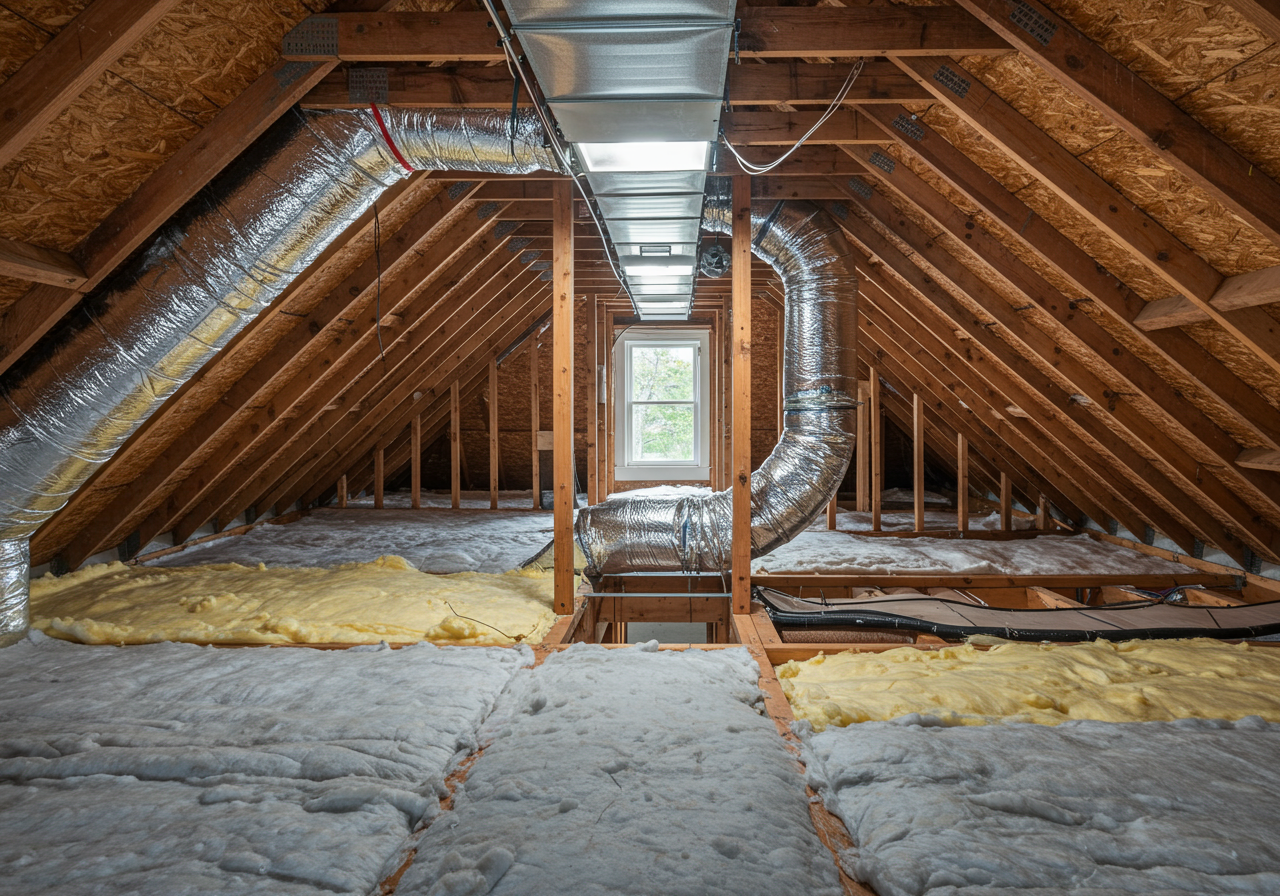
A cross-section of a residential attic showing thick cellulose insulation and a clear baffle leading to a soffit vent
Professional, educational view of attic insulation and ventilation in a traditional Connecticut home
Blown-In Cellulose vs. Fiberglass Batts
For most of the retrofits I see in our neighborhood, blown-in cellulose is the unsung hero. It's made of recycled paper treated with fire retardants, and it gets into all those tiny nooks and crannies that standard fiberglass batts miss. If you have an older home with irregular joist spacing—common in some of the pre-war houses near the center of town—blown-in is almost always the way to go.
Fiberglass batts are great for new construction where everything is perfectly square, but in an older home, they often leave "thermal bridges." These are tiny gaps where heat can escape, and believe me, heat is like a toddler—it will find the one exit you forgot to lock.
Attic Insulation Comparison for Zone 5 (CT)
| Feature | Blown-In Cellulose | Fiberglass Batts | Spray Foam |
|---|---|---|---|
| High R-Value (3.5+ per inch) | |||
| Excellent Air Sealing | |||
| DIY Installation Possible | |||
| Eco-Friendly Material |
R-Value per Inch: Blown-In Cellulose: 3.5 - 3.8 | Fiberglass Batts: 2.9 - 3.8 | Spray Foam: 6.0 - 7.0
Air Sealing Quality: Blown-In Cellulose: High | Fiberglass Batts: Low | Spray Foam: Excellent
DIY Friendly: Blown-In Cellulose: Medium | Fiberglass Batts: High | Spray Foam: Low
Eco-Friendly: Blown-In Cellulose: Yes | Fiberglass Batts: No | Spray Foam: No
Signs Your Attic is Failing the Efficiency Test
How do you know if you have a problem before the ceiling starts spotting? I always tell people to look at their roofs after a light snow or a heavy frost. If your neighbor's roof is covered in a beautiful, even white blanket and yours looks like a patchwork quilt of melting spots, you've got "heat leaks."
That heat escaping from your living room is melting the snow, which then runs down to the colder eaves and freezes. This is the birth of the dreaded ice dam. I've seen ice dams in Wallingford get so heavy they've literally ripped gutters off the fascia boards. It's a $12,000 problem that could have been fixed with $1,500 worth of insulation and a few baffles.
The "Wallingford Electric" Factor
We are lucky in town to have our own electric division (WED), and while our rates are often better than the rest of the state, nobody likes wasting money. If you notice your AC is running constantly in July just to keep the upstairs bedrooms at 72 degrees, your attic is likely acting like a giant radiator, pumping heat down through your ceiling. If you're curious about how your neighbors have handled these upgrades, you can see what other CT homeowners experienced when they finally addressed their attic airflow.
The Design Angle: How Vents Affect Your Curb Appeal
This is where I get a bit picky. As someone who loves the aesthetic of a well-maintained home, I hate seeing a beautiful roofline ruined by "turtle vents" (those plastic squares) popping up like mushrooms.
If you're doing a roof replacement, a ridge vent is the gold standard for design. It's almost invisible, sitting right at the peak of the roof. It follows the natural lines of the house and provides the most consistent exhaust. However, if you have a hip roof or a very short ridge, we might need to get creative.
Matching the Neighborhood Vibe
In some of our more traditional neighborhoods, gable vents—those decorative slats on the side of the house—can be a design feature. You can get them in shapes that complement your windows or siding. The trick is making sure they aren't just for show. I've seen contractors paint over them or, worse, homeowners block them from the inside because they felt a "draft." Don't do it! That draft is the sound of your house breathing.
"A roof isn't just a lid on a box; it's a managed environment. If you don't control the temperature and moisture inside that attic, the shingles on the outside don't stand a chance against Connecticut's seasons."
Step-by-Step: The Path to a Balanced Attic System
If you're ready to stop heating the great outdoors, you can't just throw more pink fluff up there and call it a day. It's a process. I've helped several families walk through this, and it usually looks something like this:
The Air Seal
Before adding insulation, you must seal gaps around pipes, chimneys, and light fixtures using spray foam or caulk. This stops the 'stack effect' from pulling air out of your home.
Install Baffles
Place foam channels (baffles) between rafters at the eaves. This ensures that your new insulation won't block the soffit vents, keeping the air path clear.
Layer the Insulation
Add your chosen material until you reach at least 17-20 inches of depth (for R-49 or higher). Layer it perpendicular to the joists if using batts to minimize gaps.
Verify Ventilation
Check that your ridge vent is clear and that you have enough intake at the bottom to create a continuous flow of air.
Local Regulations and Hiring Ethics in New Haven County
When you're looking for someone to do this work, please don't just hire the guy with the cheapest truck and a ladder. Connecticut has very specific consumer protections for a reason. According to the CT.gov Home Improvement Consumer Protection guidelines, any contractor doing more than $1,000 of work must be registered and provide a written contract.
I've heard horror stories about "blow-and-go" insulation crews who move so fast they cover up the soffit vents. Two years later, the homeowner has a mold forest in their attic. It's why I always tell my friends to verify their contractor's license and standing before any money changes hands.
Safety First
Also, keep an eye on safety. If you see a crew walking a steep roof in Wallingford without harnesses or proper tie-offs, that's a red flag. Professional crews follow OSHA fall protection standards not just because it's the law, but because it shows they value their workers and your property. If they're cutting corners on safety, they're likely cutting corners on your baffles, too.
Long-term ROI: What Your 2026 Upgrade Really Saves
Let's talk numbers, because at the end of the day, your house is an investment. In 2026, the cost of materials has stabilized a bit, but labor remains a premium. However, the ROI on attic work is one of the highest in the home improvement world.
The ROI of a Healthy Attic
Most Wallingford homes I've looked at see a full "payback" on their insulation and venting costs within 4 to 6 years through energy savings alone. That doesn't even account for the increased resale value. When a home inspector crawls into your attic and sees a clean, dry, well-insulated space, it signals to a buyer that the home has been meticulously cared for.
If you're curious about how your current roof is holding up after our recent weather, checking the NWS Historical Storm Events Database can give you an idea of the wind and hail stress your specific area has faced recently. It might be the push you need to get a pro up there for a look.
Final Thoughts for Wallingford Homeowners
As we move deeper into 2026, the "smart home" trend is moving beyond just thermostats and light bulbs; it's moving into building science. A smart home is one that doesn't fight against its environment. By getting your attic air and insulation right, you're making your Wallingford home more resilient, more comfortable, and a whole lot cheaper to run.
If you're feeling overwhelmed by the technical specs, don't sweat it. Most of us didn't grow up knowing the difference between a soffit and a fascia. The best first step is always education. If you want to dive deeper into the technical side of shingles and airflow, our blog library has plenty of guides that break down the jargon into plain English.
Ready to see how your attic stacks up?
Get an instant, automated roof and attic estimate tailored for your Wallingford home today.
No credit card required • Free to use
Get Your Free Roof Quote
Enter your zip code to get started