
Key Takeaways
- 86% of Westbrook roof leaks are caused by flashing or pipe boot failure, not shingle age.
- Early detection can save thousands—a $350 pipe boot repair prevents $2,400+ in ceiling damage.
- Most leaks are localized fixes that don't require a full roof replacement.
- Proper attic ventilation prevents 'fake leaks' from condensation buildup.
You're standing in your hallway on a Tuesday night, staring at a nickel-sized yellow ring on the ceiling. It's been raining steadily over the Westbrook Outlets all afternoon, and now that rhythm is being matched by a persistent drip-drop inside your linen closet. Your first instinct is probably to panic and assume the entire deck needs to be stripped. But here is the reality: about 70% of the leak calls I've inspected near the Patchogue River weren't caused by "old shingles." They were caused by localized component failures that—if caught early—don't require a total roof replacement.
1. The Pipe Boot Perish: A $350 Maintenance Reality
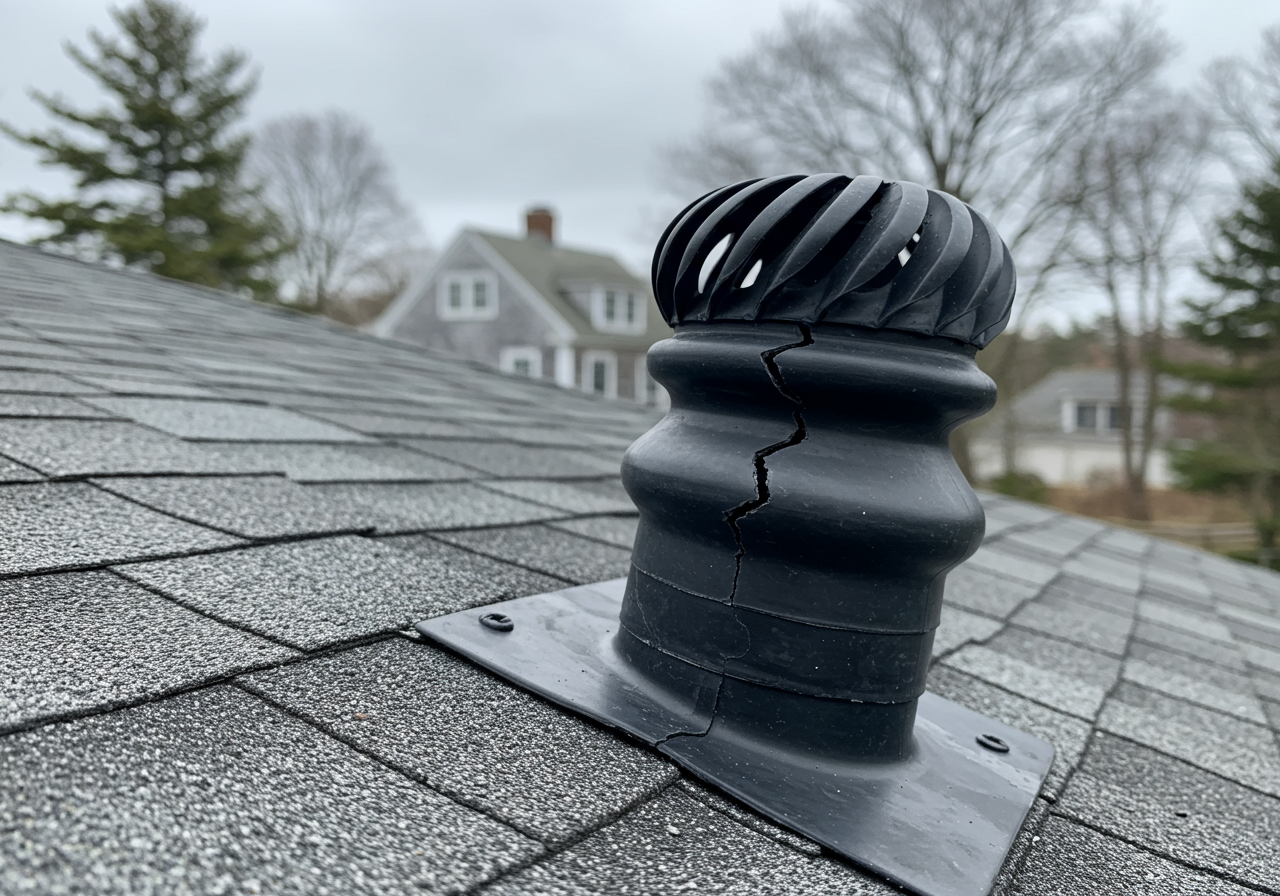
The most frequent offender I see in Middlesex County is the plumbing vent boot. These are the rubber seals that slide over the PVC pipes sticking out of your roof. In our coastal environment, the constant cycle of salt air and UV exposure causes that rubber to crack and pull away from the pipe in about 8 to 11 years.
When that seal breaks, water runs right down the outside of the pipe and into your attic insulation. I recently looked at a home near Middle Beach Road where a $5 rubber gasket had caused nearly $2,400 in ceiling damage because the homeowner ignored it for two seasons. Replacing a boot is a surgical fix—we pop the surrounding shingles, slide on a new high-grade silicone boot (which lasts significantly longer than the standard neoprene), and reseal the area. It's a 45-minute job that saves your house.
2. Step Flashing Failures Near Dormers and Walls
If you see a leak appearing on a ceiling that sits directly below where a second story meets a first-story roof, you've got a flashing problem. Step flashing consists of individual L-shaped pieces of metal tucked under every shingle course. If the original installer "short-cut" the job by using one long piece of metal—known as continuous flashing—it will eventually buckle and leak as the house shifts.
Look, a properly flashed wall shouldn't rely on a bead of caulk. If I see a contractor reaching for a tube of "roof cement" to fix a wall leak, I know they're just putting a Band-Aid on an arterial bleed. The only real fix is to remove the siding, install new 4x4-inch aluminum step tins, and integrate them with a high-quality ice and water shield. It's more labor-intensive, but it's the only way to ensure the 60 mph winds coming off the Sound don't push water uphill.
Pro Tip
3. The Shoreline Gutter Backflow Issue
Westbrook is beautiful, but the oaks and maples that line our streets are a roof's worst enemy. When gutters fill with debris, water can't exit the downspouts fast enough during a heavy Middlesex County downpour. That water doesn't just spill over the front; it "wicks" backward.
According to FEMA's hurricane mitigation strategies, properly functioning drainage is critical for preventing eave damage during high-wind events. When water stays trapped at the roof's edge, it rots the fascia board and the plywood decking. I've seen cases where the first 12 inches of a roof were completely soft, even though the rest of the shingles were in great shape. Installing a "drip edge" that extends at least 2 inches into the gutter can help, but nothing beats a twice-a-year cleaning.
4. Chimney Counter-Flashing and Masonry Cracks
Your chimney is essentially a giant hole in your roof. Keeping it dry requires a two-part metal system: the base flashing (under the shingles) and the counter-flashing (cut into the brick mortar). Over time, the mortar joints in these old Westbrook chimneys crumble. Water gets behind the metal and bypasses the roof entirely.
I often suggest homeowners check their firebox for dampness or white "efflorescence" on the bricks. If the masonry is the issue, a roofer can't fix it with shingles. You need a mason to repoint the brickwork or apply a silane-based water repellent. If you're unsure about the quality of work you're seeing, I'd suggest you see what other CT homeowners experienced when dealing with complex chimney-roof transitions.
Chimney flashing inspection in Westbrook
Proper counter-flashing installation prevents water intrusion
5. The "Fake" Leak: Attic Condensation
Sometimes, the roof isn't actually leaking from the outside. I call this the "internal leak." If your attic doesn't have enough intake and exhaust ventilation, the warm, moist air from your showers and cooking gets trapped. In the winter and early spring, that moisture hits the cold underside of your roof deck and turns into frost. When it thaws, it drips.
The Department of Energy's attic insulation guide emphasizes that a "balanced" system—where intake air at the soffits equals exhaust air at the ridge—is vital for the health of your shingles. Without this balance, your shingles literally "cook" from the inside out, causing them to curl and lose their protective granules prematurely. If your attic feels like a sauna in July, your roof is already dying.
Estimated Westbrook Repair vs. Replacement Costs (2026)
6. Skylight Seal Degradation: The 12-Year Itch
I love skylights for the natural light they bring into coastal homes, but they are notorious for leaking after the 12-year mark. The seals between the glass and the frame eventually dry out. But more often, the leak is actually in the flashing kit surrounding the unit.
Modern Velux or Wasco units come with dedicated flashing kits that are incredibly reliable if installed by someone who follows the manual. But many older Westbrook homes have "custom-flashed" skylights that rely on excessive amounts of caulk. If yours is leaking, the math usually favors a full replacement of the unit rather than a "reseal." A new energy-efficient skylight can actually help with heat gain—check out EPA's cool roof research for more on how modern materials manage temperature.
7. Missing Shingles and Wind Damage
March in Westbrook often brings lingering gusts that can hit 50+ mph. If your shingles weren't installed with the correct "nailing pattern"—meaning the nails were placed too high on the shingle—they have no structural integrity against uplift. One missing shingle is an open door for water.
Did You Know?
Did you know that a single missing shingle can allow over 5 gallons of water into your roof deck during a 1-inch rainstorm? That's enough to saturate two sheets of plywood and three batts of fiberglass insulation.
If you find a shingle on your lawn after a storm, don't just throw it away. Look at the back. If the nail holes are clean, the nail "pulled through," which usually points to an installation error. If you want to see if your shingles are still under warranty, browsing our roofing blog library can give you a head start on the technical specs of different manufacturers.
8. Navigating the Repair Process in Westbrook
Finding a leak is only half the battle; finding a contractor who won't vanish after the first rain is the other half. When you're vetting a pro, ask for their CT Home Improvement Contractor (HIC) license and specifically ask if they provide a "workmanship warranty" on repairs. Most companies will warranty a full roof, but few have the confidence to warranty a localized repair.
Identify the leak location
Measure from the nearest interior walls to pinpoint the source.
Inspect the attic
Look for water trails on the rafters—water often travels away from the source.
Check all roof penetrations
Examine pipes, vents, and chimneys within 10 feet of the suspect area.
Verify credentials
Check the contractor's insurance and local Westbrook references.
Get a written estimate
Ensure it specifies exactly which components (flashing, boots, etc.) are being replaced.
I always recommend that you verify your contractor's credentials before they ever set foot on a ladder. A little due diligence in the beginning prevents a lot of headaches when the next nor'easter rolls through Middlesex County.
Get Your Free Roof Quote
Enter your zip code to get started