
Key Takeaways
- Hurricane-rated shingles alone don't make your roof storm-proof—the whole system matters.
- Bethany's ridge topography creates 'topographic speed-up,' meaning wind can hit ridge-top homes at 90+ mph when base winds are 70 mph.
- A 6-nail pattern with ring-shank nails doubles wind resistance compared to standard 4-nail fastening.
- Full deck coverage with a secondary water barrier keeps your home dry even when shingles fail.
Contrary to what the salesman in the shiny truck told you last summer, "hurricane-rated" shingles are not a magical shield that makes your home invincible. I've seen plenty of brand-new roofs in Bethany—homes right off Route 63—strewn across the lawn after a moderate wind event because the installer relied on the box label rather than the physics of uplift. The myth that a new roof is automatically a "storm-proof" roof is one of the most dangerous misconceptions I encounter in New Haven County.
The reality is that a roof is a system of interconnected components, and in a town like Bethany, where the elevation changes can create nasty localized wind gusts, that system is only as strong as its weakest fastener. We aren't just dealing with rain; we're dealing with the pressure differentials that want to literally peel your plywood off the rafters. If you think your standard 15-year-old asphalt shingles are ready for a major Category 2 or 3 event, you're betting against the house. And as someone who has spent two decades measuring the pull-out strength of roofing nails after Nor'easters, I can tell you the house usually wins.
In this guide, I'm going to break down the technical realities of hardening your home. We'll look at why Bethany's specific geography makes your roof more vulnerable than a house in, say, downtown New Haven, and what specific mechanical upgrades (not just "better shingles") will actually keep your ceiling dry when the next big one hits.
The Bethany Ridge Effect and Wind Uplift Pressure
Look, Bethany isn't the shoreline, but in some ways, our wind risks are more complex. Because we have significant elevation changes and wooded ridges, we deal with something called "topographic speed-up." As wind hits a ridge—like those surrounding Lake Bethany—it compresses and accelerates. This means a 70 mph wind at the base of a hill can hit a ridge-top home at 90 mph or more.
When that wind hits your roof, it doesn't just push against it; it creates a vacuum on the leeward side. This is "uplift pressure." I've walked roofs in New Haven County after major storms where the shingles were perfectly intact, but the entire roof deck had lifted two inches off the gable end because the framing wasn't strapped down. Most Bethany homes built before the mid-1990s lack the modern hurricane straps required by current Connecticut building and consumer protection codes.
The problem starts at the eaves. If wind can get under the edge of your roofing material, it acts like a lever. I've measured cases where just a quarter-inch of overhang beyond the drip edge created enough leverage to tear away three courses of shingles in a single gust. In March, as we look toward the upcoming hurricane season, checking these edge details is the single most important diagnostic step you can take. If your drip edge is flimsy or improperly fastened (nails spaced more than 12 inches apart), you're already at risk.
Did You Know?
The 'Corner Zone' of your roof experiences up to 2.5 times more wind pressure than the center. This is why most storm failures start at the edges of the roof near the gutters or the rake.
The Technical Failure of Standard Fastening Patterns
One of my biggest pet peeves in this industry is the "speed over precision" mentality. Most manufacturer specifications for architectural shingles (like the GAF Timberline series or Owens Corning Duration) allow for a 4-nail pattern for "normal" conditions. But Connecticut is rarely "normal." To achieve a 130 mph wind warranty, you almost always need a 6-nail pattern and a very specific placement of the starter shingle.
I recently inspected a home near the Woodbridge line where the shingles had "unzipped" during a high-wind event. Upon closer inspection (and I keep a digital caliper in my kit for this), the nails were driven just 3/4 of an inch too high. They missed the "common bond" area where the two layers of the shingle overlap. When the wind got under the shingle, it didn't have the structural integrity to hold, and it tore right over the nail heads.
Staples Are a Deal-Breaker
For Bethany homeowners, I always recommend ring-shank nails. These have small ridges along the shaft that grip the wood fibers of the roof deck. They are roughly 30% harder to pull out than smooth-shank nails. If you are evaluating total replacement costs for your home, ask if the estimate includes 6-nail fastening with ring-shank galvanized steel. It adds maybe $200 to the total material cost of an average Bethany home but doubles the wind resistance of the shingle layer.
Secondary Water Barriers: Your Last Line of Defense
Here's a scenario I see every year: A hurricane hits, a few shingles blow off, and the homeowner thinks, "No big deal, I'll fix it next week." Then the rain starts. Without shingles, standard felt paper (underlayment) will leak within minutes. In a high-wind event, that felt paper usually tears right off with the shingles, leaving your plywood deck exposed.
This is where a Secondary Water Barrier (SWB) comes in. In my field notes, I've documented homes that lost 40% of their shingles but stayed 100% dry inside because they had a self-adhering, rubberized membrane (often called "Ice and Water Shield") covering the entire deck.
Underlayment Performance in Hurricane Conditions
| Feature | Standard Felt Paper | Synthetic Underlayment | Full Membrane (SWB) |
|---|---|---|---|
| Wind Resistance | |||
| Waterproof Life (Exposed) | |||
| Self-Sealing Around Nails | |||
| Cost Impact |
In Bethany, the building code requires Ice and Water shield at the eaves (usually 3 to 6 feet up), but for true hurricane prep, I advocate for "full deck coverage." It effectively turns your roof into a giant rubber gasket. If the shingles fail, the house stays dry. If you are currently dealing with a compromised roof, looking into emergency repair solutions that include these high-performance membranes is the best way to stop the bleeding before the next storm cycle.
Impact-Rated Shingles: Are They Worth the Premium?
When we talk about hurricanes, we aren't just talking about wind; we're talking about flying debris. Bethany is heavily wooded. During a storm, it's not just the wind you worry about—it's the 3-inch oak branch traveling at 60 mph. Standard shingles will crack or "bruise" upon impact, leading to granular loss and eventual leaks.
UL 2218 Class 4 impact-rated shingles are designed to withstand this. To get this rating, manufacturers drop a 2-inch steel ball onto the shingle from 20 feet up. If the shingle doesn't crack, it passes. Brands like CertainTeed (NorthGate) or Malarkey (Legacy) use SBS-modified bitumen, which is essentially "rubberized" asphalt. It's flexible. Instead of cracking like a saltine cracker, it bounces back like a rubber mat.
I've found that for Bethany residents, the ROI on Class 4 shingles isn't just in the durability—it's in the insurance premiums. Many CT insurers offer a 10% to 15% discount on the wind portion of your policy if you can prove you've installed a Class 4 roof. Over the 20-year life of the roof, that discount can often pay for the upgrade itself.
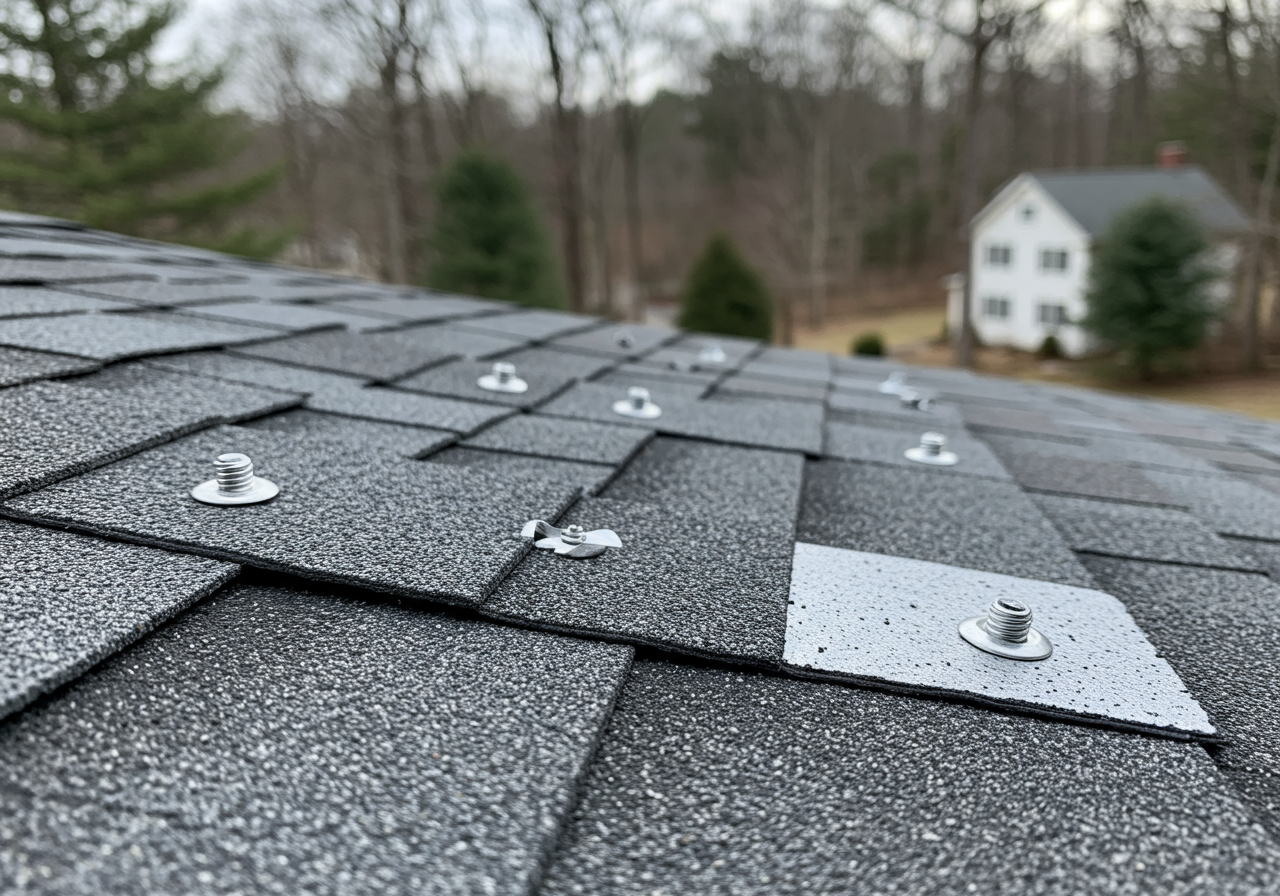
High-performance architectural shingle with 6-nail pattern
Close-up showing reinforced nail zone and proper fastener placement on a Bethany home
Strengthening the Roof-to-Wall Connection
If you want to move beyond just "roofing" and into "structural hardening," we have to talk about how the roof attaches to the house. Most older homes in New Haven County rely on "toenailing"—driving a few nails at an angle through the rafter into the top of the wall. In a hurricane, this is the first point of failure. The wind creates enough lift to pull the entire roof structure off the walls.
In Bethany, I've seen this happen specifically on detached garages and older colonial-style homes. The solution is the installation of hurricane clips or straps. These are galvanized steel connectors that wrap over the rafter and nail into the wall studs.
Access the attic
Clear insulation away from the eaves/soffit area where rafters meet the walls.
Inspect for toe-nails
Check for existing toe-nails and any signs of wood rot or daylight through the gap.
Install hurricane ties
Install H2.5A or similar hurricane ties, ensuring 2.5-inch galvanized nails are driven into both the rafter and the top plate of the wall.
Repeat for every rafter
Partial reinforcement can actually create uneven pressure points during a storm.
Seal gaps
Seal any gaps with fire-rated expanding foam to prevent 'wind-washing' of your insulation.
This is a labor-intensive project, but if you are already planning a full-scale roof hardening, doing it from the outside while the plywood is off is significantly cheaper than doing it from a cramped attic. I've seen homeowners save $3,000 in labor costs by timing their structural strapping with their roof replacement.
Vetting Contractors for Storm-Resistant Installs
Look, a roof is only as good as the guy holding the nail gun. You can buy the most expensive shingles in the world, but if the crew is "high-nailing" or skipping the starter strips, you've wasted your money. In Bethany, where we don't have a dedicated municipal building inspector on every single job site 24/7, you have to be your own advocate.
First, verify that your contractor is actually licensed in the state. You can do this in thirty seconds by checking the CT eLicense database. If they aren't on that list, stop talking to them. Period. I've heard every excuse in the book—"the license is in my partner's name," "we're just waiting on the renewal"—don't buy it.
Second, check their standing with the Better Business Bureau. You aren't just looking for a "5-star" rating; you're looking at how they handle complaints. Do they respond? Do they fix mistakes? A contractor who stands by their work during a minor leak is the one you want when a hurricane hits.
I always tell my clients to ask for the "High Wind Installation Manual" for the specific shingle brand being used. If the foreman looks at you like you have three heads, that's a red flag. A pro will know exactly what the 130 mph requirements are.
DIY vs. Professional Storm Hardening
Pros
- Significant labor savings on minor repairs
- Ability to inspect your own attic connections
- Full control over material quality
Cons
- Risk of voiding manufacturer warranties
- Dangerous heights on Bethany's typical 8/12 pitch roofs
- Lack of specialized pneumatic tools for consistent fastener depth
The March 2026 Outlook: Why Preparation Starts Now
We are currently in that "shoulder season" in Bethany. The snow is mostly gone, but the heavy humidity of summer hasn't arrived yet. This is the ideal time for a roof inspection. Why? Because asphalt shingles need heat to "seal." The adhesive strips on shingles are heat-activated. If you wait until October to replace your roof, and a late-season hurricane hits before we've had enough warm days to melt those adhesive strips together, your "new" roof will blow off just as easily as an old one.
By taking care of these upgrades now—in March or April—you ensure that by the time June 1st (the start of hurricane season) rolls around, your roof has had plenty of sun to bond into a single, monolithic sheet.
I've looked through my field notes from the last five years, and the most successful storm survivors in New Haven County all had one thing in common: they didn't wait for a "Warning" on the news to act. They treated their roof like a piece of machinery that needs annual tuning. Whether it's clearing the debris from the "valleys" (the areas where two roof slopes meet) or tightening the fasteners on their chimney flashing, small moves now prevent $20,000 headaches later.
Get Your Free Roof Quote
Enter your zip code to get started
The Bottom Line for Bethany Homeowners
Hardening a roof for hurricane season isn't about buying a specific product; it's about a commitment to technical standards. It's about the difference between a 4-nail and a 6-nail pattern, the use of ring-shank fasteners, and the installation of a secondary water barrier that protects your home when the primary layer fails.
In Bethany, our geography demands more from our homes. We aren't protected by the dense urban canopy of New Haven or the flat terrain of the shoreline. We are on the ridges, and the wind knows it. If you're unsure where your roof stands, don't guess. Get up in the attic with a flashlight, look for daylight, check your rafters for hurricane straps, and make a plan. A few thousand dollars in upgrades today is the best insurance policy you'll ever buy.
Want a roof that actually stands up to a Nor'easter?
Get an instant, data-backed estimate and match with Bethany's top-rated storm-hardening specialists today.
No credit card required • Free to use