
Key Takeaways
- Hail damage in Manchester is often invisible from the ground, manifesting as bruises rather than holes.
- Professional inspections catch granular loss that leads to premature shingle failure during CT's humid summers.
- The window for insurance claims is limited; waiting for a leak usually means paying out of pocket.
- March is the optimal time for an assessment before the heavy spring rain cycle begins.
Picture this: you're standing in your driveway on a Tuesday evening near Case Mountain. A sudden March storm just rattled the windows with what sounded like a handful of gravel hitting the siding. The clouds break, the sun peeks out over the Manchester skyline, and everything looks... fine. Your shingles aren't on the lawn, and there's no water dripping into the attic. You go back to making dinner, thinking you dodged a bullet. But up on that roof, a silent clock has started ticking. In my years of tracking Hartford County weather patterns, I've seen this exact "non-event" turn into a $14,000 headache three years down the road because a homeowner missed the microscopic fractures in their asphalt matting.
The Hidden Nature of Hail Damage in Hartford County
When a hailstone hits a roof in Manchester, it doesn't always crack the shingle like a piece of glass. Instead, think of it like a bruise on an apple. On the surface, it might just look like a small dark spot. However, underneath that spot, the fiberglass matting has been crushed. I've climbed enough ladders in the Buckland Hills area to tell you that what looks like a minor scuff is actually the death knell for that shingle's waterproofing.
Why Asphalt Shingles Hide Bruising
Asphalt shingles rely on a layer of ceramic-coated granules to protect them from UV rays. When hail strikes, it knocks these granules loose. You might see them piling up in your gutters—a classic Manchester red flag. Without those granules, the sun bakes the exposed bitumen, causing it to become brittle and crack. I once inspected a colonial near Wickham Park where the owner swore the roof was fine; we found 22 distinct hits per square that were invisible from the sidewalk but glaringly obvious under a magnifying glass.
The Impact of Connecticut Humidity
Our local climate doesn't play nice with damaged roofs. Once that bruise is there, the freeze-thaw cycles of a Connecticut March expand the micro-cracks. Moisture seeps in, freezes, and pushes the asphalt apart. By the time July's humidity hits, the shingle is bleeding oils and losing its structural integrity.
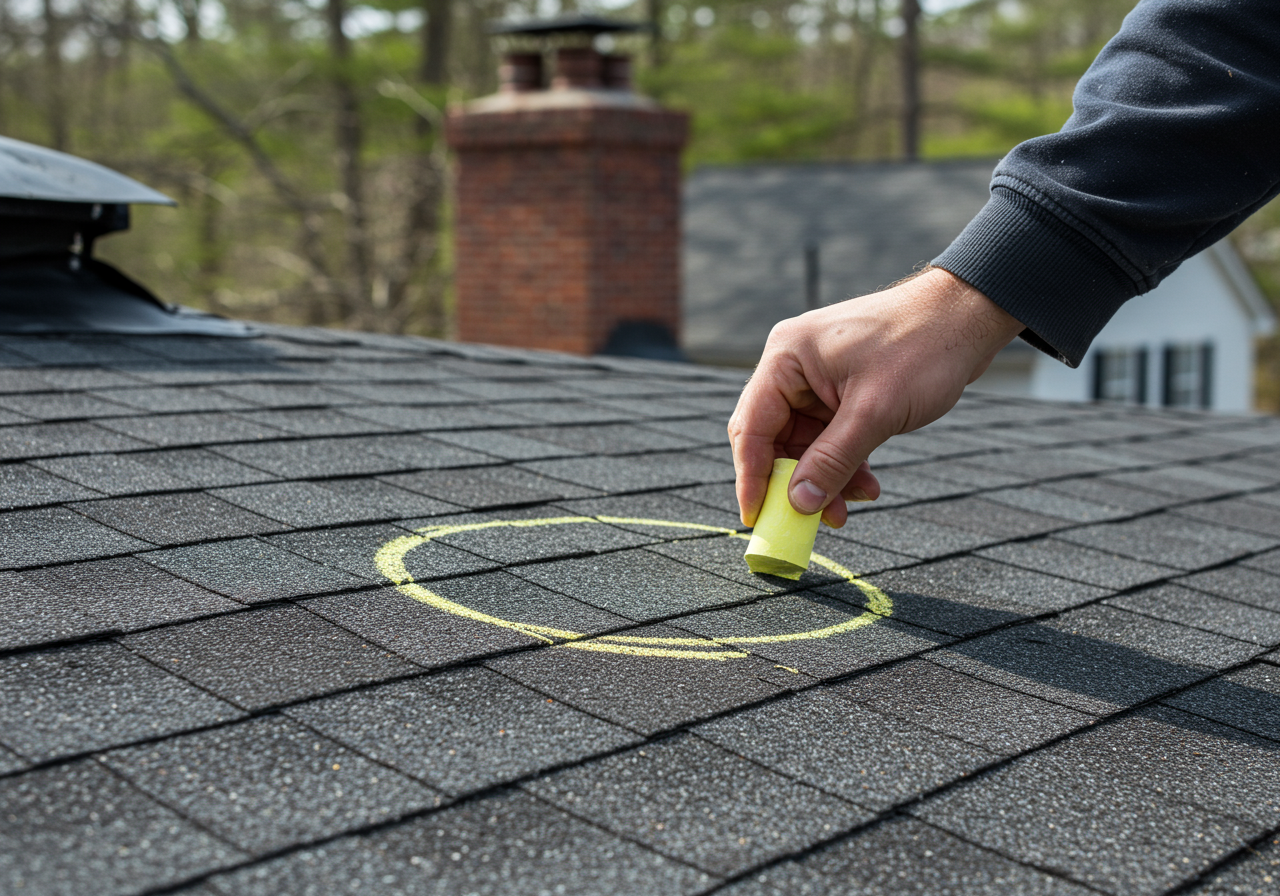
Hail-related roof inspection in Manchester, CT
Granule loss and mat bruising are often only visible up close on the roof, not from the curb.
Professional vs. DIY Inspection: A Comparison
I get it—everybody has a ladder in their garage and a pair of binoculars. But there is a massive gulf between looking at the roof and inspecting the roof. I've seen homeowners miss critical signs because they were looking for the wrong thing. They expect to see jagged holes, but the real danger in Hartford County is functional damage—the kind that doesn't leak today but guarantees a leak tomorrow.
Safety Risks and Technical Nuances
Climbing onto a roof, especially one with a steep pitch like many of our older Manchester Victorians, is inherently dangerous. Beyond the fall risk, a professional knows where to walk to avoid causing more damage. According to OSHA guidance on residential fall protection, professional crews use harnesses and tie-offs that the average homeowner simply doesn't have in the shed.
DIY vs. Professional Hail Inspection
| Feature | Homeowner DIY | Pro inspector |
|---|---|---|
| Granular analysis | ||
| Safety equipment | ||
| Insurance-ready documentation | ||
| Structural / attic check |
The Insurance Reality
The trick is matching with a crew that shows up on time and documents hail damage the way adjusters expect. Most carriers won't build a file from blurry cell phone photos. They want storm correlation, hit density, and a professional opinion on how much service life the shingles have left.
The Impact of Timing: Why March Inspections Matter
Timing is everything in the roofing world. I always tell my neighbors in Manchester: don't wait for the April showers to tell you that your March hail storm caused damage. By then, you're competing with every other homeowner in the state for a contractor's time.
Preparing for Spring Rains
A damaged roof is a vulnerable roof. If you have bruised shingles, the heavy, wind-driven rains we get in late spring will find those weak spots. I remember a particularly nasty stretch of weather a few years back where a series of thunderstorms turned minor hail dents into full-blown ceiling leaks within three weeks. If you catch it in March, you have the lead time to get a crew out there before the schedule fills up.
Don't wait for a drip
Seasonal Labor Availability
In Manchester, roofing crews start getting slammed once the temperature stays consistently above 50°F. By getting your inspection done now, you're at the front of the line. If you're already seeing stains after a storm, 24/7 emergency roofing help can stabilize the situation before rot spreads through the deck.
Repair vs. Replacement After a Manchester Storm
Just because you have hail damage doesn't mean you need a whole new roof. This is where a lot of people get nervous. They think an inspection is just a sales pitch for a $20,000 replacement. In reality, a localized repair can often extend the life of your roof by another 7 to 10 years, provided the damage hasn't compromised the entire surface.
Assessing Longevity and Value
If your roof is already 18 years old and takes a heavy hail hit, the math usually favors replacement. However, if you have a newer architectural shingle roof that's only 5 years old, a few strategic repairs are much more cost-effective. We look at hit density—usually if there are more than 8–10 hits per 100 square feet, insurance starts talking about a full replacement.
Average lifespan: repaired vs. untreated hail damage
Assessing Material Durability
Not all shingles handle hail the same way. I've noticed that some of the older 3-tab shingles used in Manchester's mid-century developments fail much faster than modern Class 4 impact-resistant shingles. When you're comparing materials, FEMA's overview of roof systems and protection is a solid starting point for what holds up when debris and ice are in play—not just sun and rain.
Did You Know?
Hailstones can exceed 100 mph at impact, carrying enough kinetic energy to crack concrete tiles—never mind standard asphalt shingles.
Navigating the Insurance Claim Maze
This is where the headache usually begins for Manchester homeowners. Adjusters aren't looking for "it looks bad"; they want evidence that the loss clears the threshold spelled out in your policy.
Documentation and Local Requirements
You need a paper trail: storm date (I keep a running log of hail events in Hartford County if you need a reference), photos, test-square counts, and notes on directional damage. After catastrophic weather, federal repair assistance programs may be available—but only if inspections prove the damage was tied to a qualifying event, not deferred maintenance.
The Inspection Process
When a pro comes out, they should follow a specific sequence. If they just walk around the yard with a clipboard, send them packing. A real inspection is hands-on from the gutters to the attic.
Ground-level perimeter sweep
Check gutters and downspouts for granule deposits, and scan siding corners for hail spatter that lines up with roof exposure.
On-roof test squares
Mark representative 10' × 10' areas to count hits per square—this is where functional damage shows up even when shingles look 'fine.'
Flashing and penetrations
Chimney counter-flashing, boots, and wall transitions often take collateral damage during hail that shingles hide.
Attic daylight and stains
Pinholes of light and darkened decking tell you if moisture is already past the shingle layer.
Digital report package
High-resolution photos, captions, and a written narrative tuned for carrier review—not a one-page checklist.
Once you have findings in hand, pull instant estimates from vetted Connecticut contractors so you can line up repairs before the next round of storms.
Get Your Free Roof Quote
Enter your zip code to get started
I've watched enough Manchester winters turn into springs to know that a little proactivity goes a long way. Don't let a silent storm sit on your roof until it becomes a loud, expensive problem in your living room.