
Key Takeaways
- Cedar roofs offer unmatched natural texture and 'shadow lines' that asphalt can't replicate, but require specialized installation and maintenance.
- The initial cost gap between cedar and asphalt is significant ($16,400+), but cedar's longer lifespan (30-40 years vs 17-24 years) can close that gap over time.
- Cedar requires professional cleaning every 5-7 years to prevent moss and rot, especially in Chaplin's shaded, humid conditions.
- Fire-rated treated cedar shakes can help mitigate insurance premium increases, but wood roofs still typically cost more to insure than asphalt.
Have you ever pulled into your driveway after a long day and felt like your roof was just... missing something? Maybe you've spent a Saturday morning at Diana's Pool or driving past the historic homes on Route 198, admiring that silvered, textured look of a natural wood roof, and wondered if it would work for your own place. It's a question I hear a lot from neighbors in the Quiet Corner. We want that rugged, Windham County aesthetic, but we also don't want to hand over our entire retirement fund just to keep the rain out. Choosing between cedar shake and the modern "alternative"—high-end asphalt shingles—is really a conversation about how you want your home to age alongside the landscape.
I've spent the better part of 16 years looking at roof lines through the lens of curb appeal. While a lot of contractors will just throw a price sheet at you, I think it's more about the "vibe" of the house. A colonial farmhouse near Chaplin Elementary looks fundamentally different under wood than it does under flat asphalt. But here's the thing: beauty has a maintenance schedule. In this guide, we're going to look at the numbers, the moss, and the "silvering" process to see which material actually makes sense for your budget and your Saturday afternoons.
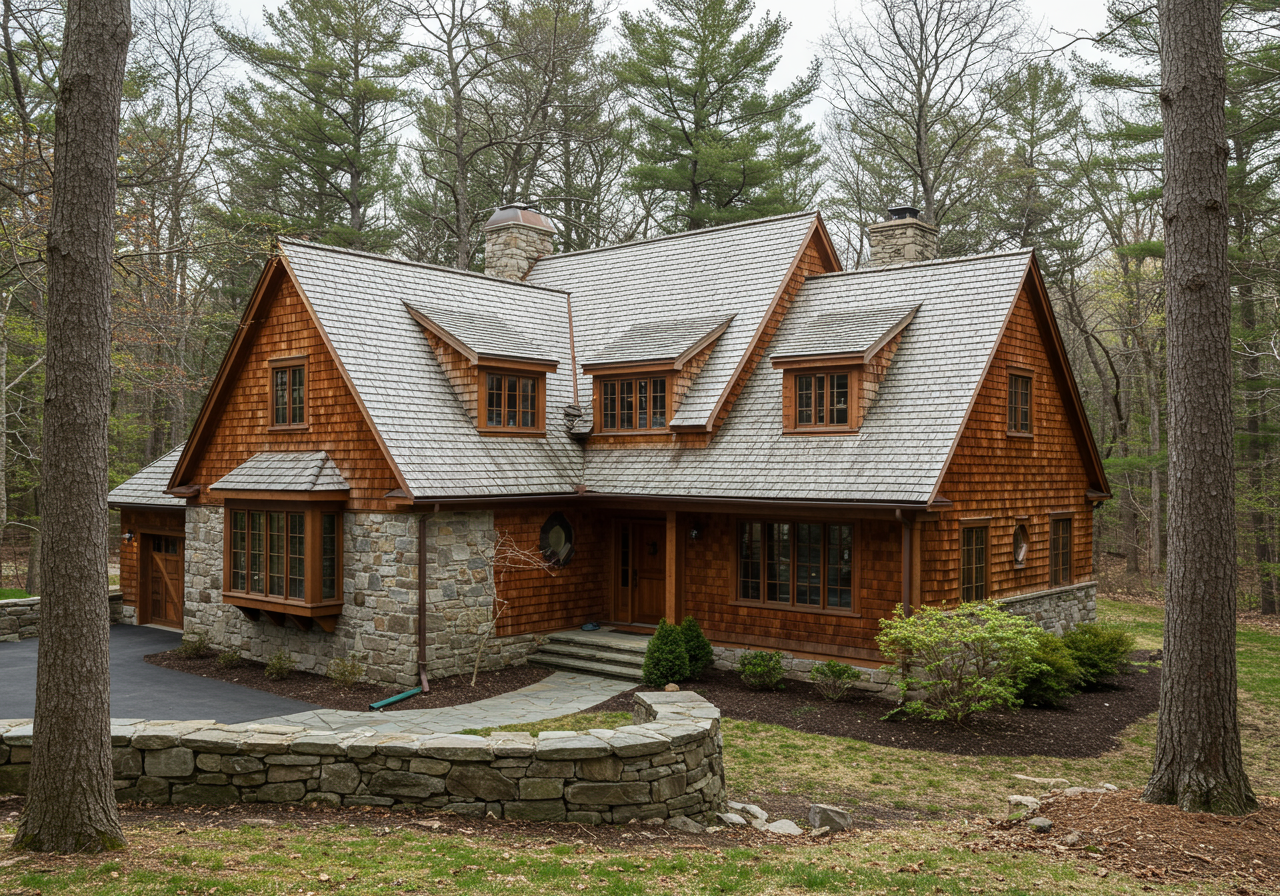
Cedar shake vs. asphalt roofing comparison in Chaplin
Comparing the natural texture of cedar shakes with modern asphalt shingles
1. The Design Language: Why Cedar Fits the Quiet Corner
When we talk about Chaplin, we're talking about a very specific aesthetic. We have deep woods, rolling hills, and a lot of history. Cedar shakes (the thicker, hand-split version) or shingles (the thinner, sawn version) offer a shadow line that asphalt just can't replicate. Each piece of wood has a slightly different grain, meaning your roof isn't just a flat color; it's a mosaic. I remember helping a friend over on Tower Hill Road who was torn between a dark gray asphalt and Western Red Cedar. We stood at the curb for twenty minutes, and I told her: "Asphalt is a uniform. Cedar is a tailored suit."
The way cedar ages is its biggest selling point for design-conscious homeowners. It starts out as a warm, honey-gold color, but within about 12 to 18 months in our Connecticut climate, it transitions into a soft, silvery gray. This "weathered" look is exactly what gives those Cape Cods and Colonials their timeless feel. However, if you choose asphalt, what you see on day one is what you'll see in year ten. For many, that consistency is a relief. For others, it's a bit sterile.
Cedar vs. Asphalt: The Visual & Functional Trade-off
Pros
- Unmatched natural texture and 'shadow lines'
- Natural insulation properties (wood is a great thermal break)
- Increases home value for historic or high-end properties
- Biodegradable and eco-friendly at the end of its life
Cons
- Significantly higher initial labor and material costs
- Susceptible to moss and mold in shaded Chaplin lots
- Higher insurance premiums in some Connecticut zip codes
- Requires specialized contractors for proper installation
If you're leaning toward the wood look but are worried about the "matching" process, it's vital to find vetted contractors who understand local wood rot issues rather than just hiring a general shingle layer. Wood requires "breathing" room, and the installation technique is entirely different from nailing down a synthetic mat.
2. The Maintenance Reality: Moss, Moisture, and the Shade Factor
If your home is tucked under a canopy of oaks or maples—as many are in the more wooded parts of Chaplin—you have to talk about moisture. Cedar is a living, organic material. It breathes. It absorbs water and then releases it. In the "Quiet Corner," our humidity levels and heavy shade can turn a beautiful wood roof into a science experiment if you aren't careful.
I've seen cedar roofs that were "set it and forget it" projects, and by year seven, they had actual ferns growing in the valleys. Asphalt shingles are treated with copper or zinc granules to fight algae, but with cedar, you are the algae-fighter. You'll need to commit to a professional cleaning and topical treatment every 5 to 7 years. This isn't just a power wash (actually, never power wash your cedar!); it's a gentle chemical treatment that kills fungal spores and restores the wood's pH balance.
Did You Know?
A cedar roof can actually breathe 15% better than asphalt, naturally shedding heat in the summer, which can slightly lower your cooling needs if your attic is properly vented.
One thing I always tell people during my "roof-side chats" is that wind is another factor. According to FEMA's guidelines for sloped roof wind resistance, the way a material is fastened determines its survival in a storm. Cedar shakes are heavy and, when installed with the right stainless steel fasteners, are incredibly wind-resistant. But if a branch falls during one of our March nor'easters, replacing a single cedar shake is a craft, whereas swapping an asphalt shingle is a 10-minute fix. If you ever find yourself in a pinch after a storm, having a local emergency storm response team on speed dial is a must for wood-roof owners.
3. Breaking Down the $16,400 Investment Gap
Let's talk turkey. Or rather, let's talk shingles. For a standard 2,500-square-foot roof in Chaplin, the price gap between these two materials is significant. You aren't just paying for the wood; you're paying for the specialized labor. Each shake is often laid by hand with a layer of felt paper interlaid between rows—a process called "shake felt interlayment." This is what keeps the roof waterproof while allowing the wood to expand and contract.
Typically, an architectural asphalt roof might run you somewhere between $12,400 and $18,700 depending on the grade. For that same roof in Western Red Cedar? You're likely looking at a range of $31,200 to $48,900. It's a bitter pill to swallow upfront. However, we have to look at the "cost per year." If that asphalt roof lasts 18 years, and the cedar roof (with proper care) lasts 32 years, the gap starts to close.
Estimated Lifespan in Windham County (Years)
Weathered silver cedar shakes on a rustic Connecticut home
The 'silvering' process of cedar shakes provides a natural aesthetic that asphalt struggles to mimic.
When you're looking at these numbers, don't just guess. The best way to see the reality for your specific home is to get a specialized estimate that takes your roof's pitch and complexity into account. A roof with six dormers and three chimneys is going to be exponentially more expensive in cedar than a simple "up-and-over" gable roof.
4. Energy Efficiency and Fire Safety Concerns
Here is where the conversation gets a bit technical, but bear with me because it affects your wallet every month. Wood is a natural insulator. While asphalt shingles tend to absorb heat and radiate it into your attic, cedar acts as a thermal barrier. Research featured in EPA research on thermal performance highlights how material mass affects home temperatures. In my experience, homeowners in Chaplin with cedar roofs often report that their upstairs bedrooms stay about 4 to 6 degrees cooler in the peak of July compared to when they had dark asphalt.
But we have to address the elephant in the room: fire. Wood burns. It's a fact. In some parts of the country, wood roofs are almost uninsurable. In Connecticut, we aren't at the same wildfire risk level as the West Coast, but insurance companies still take notice. Most modern cedar shakes sold in Chaplin are "pressure-treated fire retardant" (Class B or Class A). If you go with cedar, make sure your contractor provides the certification for these treatments, or your homeowner's insurance premium might give you a heart attack.
The 'Grade' Matters
Beyond the safety, there's the "green" factor. Asphalt shingles are petroleum-based and usually end up in a landfill. Cedar is biodegradable. If you're trying to keep your Chaplin home as eco-friendly as possible, wood is the clear winner. You can even find Energy Star's guide on efficiency to see how different "cool" asphalt options compare if you decide wood is too much of a stretch for the budget.
5. The Final Verdict: Is Cedar Right for Your Chaplin Home?
So, where does that leave us? I always tell my clients that a roof is 50% protection and 50% personality. If you live in a historic neighborhood or a custom-built home where the architecture is the star of the show, asphalt can sometimes feel like putting plastic hubcaps on a classic car. It works, but it doesn't sing.
On the flip side, if you're planning on moving in five years, you will likely never recoup the $30,000+ investment of a cedar roof. Asphalt is the "safe" choice—it's predictable, easy to repair, and every buyer understands it. But if this is your "forever home" near the Natchaug State Forest, and you love the idea of your house "growing" and changing colors with the seasons, cedar is a soul-satisfying choice.
"In Chaplin, we see a lot of homes where the roof is 40% of the visible exterior. When you have that much surface area, the material choice isn't just a utility—it's the primary color and texture of the property."
Before you make a final call, take a walk around your property. Look at the trees, look at the sun exposure on the north side of your roof, and think about your willingness to hire a cleaner every few years. If you want the look without the work, there are some incredible synthetic "faux-cedar" options made of polymer that are hitting the market in 2026, though they come with their own high price tags. Whatever you choose, make sure it's a decision you'll be happy to see every time you pull into your driveway.
Get Your Free Roof Quote
Enter your zip code to get started