Imagine you're standing in your driveway on a crisp February morning in Woodbridge, looking up at a roof that's seen better days. You've heard the buzz about "green" roofing—solar shingles, recycled composites, maybe even a living roof—and it sounds great in a brochure. But then you remember the ice dam that nearly took out your gutters two years ago, or the way the summer sun turns your upstairs bedrooms into a sauna near West Rock Ridge. You want to do the right thing for the planet, but you mostly want a roof that doesn't leak when the slush starts piling up.
I've spent a lot of time looking at satellite imagery of New Haven County, and the trend is clear: Woodbridge homeowners are moving toward sustainability, but many are falling into the "greenwashing" trap. They're buying products designed for Southern California that just can't hack it in the Northeast. Here's the reality of what works—and what doesn't—in our specific corner of Connecticut.
Key Takeaways
- Connecticut's freeze-thaw cycles cause 40% of roof failures in 'green' materials not designed for our climate.
- Recycled polymer shingles offer 50-year lifespans compared to 20-25 years for standard asphalt.
- Cool roofs can save 18% on cooling costs but require proper attic insulation to avoid ice dams.
- The 'green' premium of 25-40% often pays for itself by year 14 through energy savings and durability.
The Problem: High-Performance Claims vs. Connecticut Reality
The biggest hurdle for green roofing in Woodbridge isn't the cost; it's the climate. We live in a region where the "dew point" is more than just a weather stat—it's a constant threat to roof deck integrity. Many "sustainable" materials are marketed as being breathable or lightweight, which is fantastic until you hit a February freeze-thaw cycle.
I recently looked at a home near Beecher Road where the owners had installed a trendy, imported "eco-tile" made from compressed organic fibers. On paper, it was carbon-neutral. In reality, the high humidity we get in the spring caused the tiles to swell, leading to a massive failure in the flashing. When we talk about sustainability in CT, we have to talk about durability first. A "green" roof that needs to be replaced in 12 years isn't sustainable—it's a landfill contribution waiting to happen.
Before you commit to a specific material, it's vital to ensure the crew installing it actually knows how to handle it. I always tell my neighbors to verify their contractor's license and check their experience with non-traditional materials. A mistake in the underlayment of a green roof is way more expensive than a mistake on a standard asphalt shingle job.
The "Cool Roof" Fallacy in the Northeast
In the roofing world, everyone talks about "Cool Roofs"—materials designed to reflect sunlight. This is great for a warehouse in Phoenix, but in Woodbridge, we have a "heating penalty." If your roof reflects too much sun in the winter, your attic stays colder, which can actually encourage ice damming.
Cool Roofs in Woodbridge
Pros
- Significant reduction in summer cooling bills
- Extends shingle life by reducing thermal shock
- Often qualifies for local energy rebates
Cons
- Can increase winter heating costs slightly
- Higher risk of ice dams if attic insulation is poor
- Reflective glare can annoy neighbors in hilly areas
The solution isn't to avoid cool roofing, but to pair it with high-R-value attic insulation. I've seen homeowners save about 18% on their annual energy bills by using a "cool" shingle, but only when they also addressed the airflow in their soffits. If you just slap white shingles on a poorly ventilated colonial, you're going to have issues. You can find more deep dives on this in our blog library, where we break down the science of attic ventilation.
Recycled Polymer Shingles: The 50-Year Winner
If there's one green trend I'm actually excited about for 2026, it's recycled polymer (synthetic) shingles. These are often made from post-consumer plastics and rubber, and they are nearly indestructible. While a standard asphalt roof in Woodbridge might give you 20 to 25 years, these synthetics are easily clearing the 50-year mark.
Expected Lifespan in New Haven County (Years)
But here's the kicker: they look exactly like slate or cedar shake. I was driving past a beautiful property near the JCC of Greater New Haven last month and couldn't tell the difference from the curb. The weight is also a huge plus. Natural slate is heavy enough to require structural reinforcement on many Woodbridge homes. These recycled versions give you the "green" points and the aesthetic without the need for extra rafters.
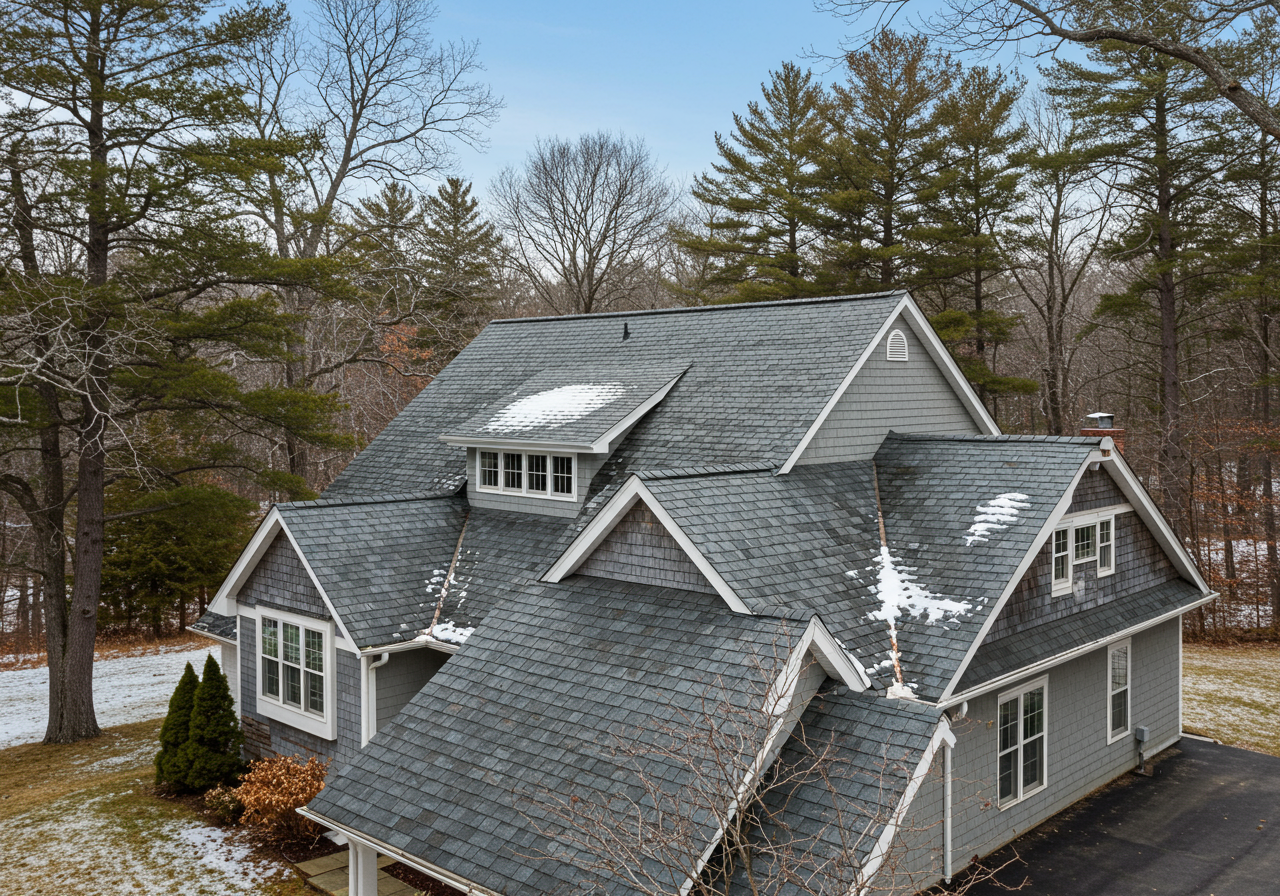
Sustainable Roofing Materials in Woodbridge
Recycled polymer shingles that mimic natural slate while offering superior durability in Connecticut's climate.
The Solar Shingle Revolution in Wooded Neighborhoods
Woodbridge is famous for its trees. We love our oaks and maples, but they are the natural enemy of traditional solar panels. The trend in 2026 is moving away from those big, bulky racks toward integrated solar shingles. These are built directly into the roof surface.
The "problem" I see most often is homeowners over-investing in solar on North-facing slopes or under heavy canopy. I've reviewed data where a Woodbridge home only saw a 40% efficiency rate compared to the manufacturer's promise because of afternoon shade from a neighbor's tree. If you're going solar, you need a contractor who understands CT's specific sun angles. Also, make sure they are following OSHA fall protection standards during the install; solar jobs are notoriously dangerous due to the slick surfaces.
Solution: The "Hybrid" Sustainability Strategy
So, how do you actually win this game? You go hybrid. Instead of chasing a 100% "organic" roof that might rot in our humidity, you focus on three pillars: reflection, recycled content, and local sourcing.
High-Reflectivity Underlayment
Use a synthetic underlayment that acts as a secondary water barrier and a radiant barrier.
Class 4 Impact Rated Shingles
These aren't just for hail. They are more durable against the falling branches we get during every Nor'easter.
Local Supply Chains
Buying materials manufactured in the Northeast means they were tested in our climate, not a lab in Florida.
"Sustainability isn't just about the material; it's about the lifespan. If you have to replace a 'green' roof twice as often as a traditional one, you've doubled your carbon footprint."
When you're looking at these options, keep Connecticut's consumer protection laws in mind. Any contract for these high-end materials should include specific warranty language regarding CT's weather extremes.
Navigating the Cost of "Green" in 2026
Let's talk dollars. Yes, a sustainable roof costs more upfront. In Woodbridge, I'm seeing a 25% to 40% premium for recycled synthetics or solar-ready systems. But you have to look at the "Avoided Cost."
If you're planning on staying in your home for more than 10 years, the math starts to swing in your favor. Between the energy savings and the fact that you won't be paying for a leak fix or shingle repair every time we get a windstorm, the "green" option often pays for itself by year 14.
The Woodbridge ROI
Future-Proofing: Preparing for New CT Mandates
The reality is that "green" is becoming the law, not just a choice. Connecticut is pushing for more energy-efficient building envelopes, and Woodbridge is often at the forefront of these local zoning shifts. By choosing a sustainable roof now, you're likely boosting your home's resale value for the 2030 market.
I always suggest getting a detailed breakdown of how a new roof system will handle heavy snow loads. According to FEMA's low-slope and residential guidelines, the way a roof sheds or holds snow is critical to its structural lifespan. Don't let a "green" designer talk you into a flat roof section without a serious drainage plan.
Get Your Free Roof Quote
Enter your zip code to get started
Conclusion
Green roofing in Woodbridge doesn't have to be a gamble. If you focus on recycled polymer materials that can handle our freeze-thaw cycles and pair them with proper insulation, you're making a smart long-term investment. Don't get distracted by the flashiest "eco" trends. Instead, look for durability, a solid warranty, and a contractor who doesn't disappear when the first blizzard hits. If you're ready to see how the numbers look for your specific roofline, ZikQuote can match you with local pros who actually understand the Woodbridge climate.
FAQ

About Noah Knight
Verified ExpertNoah Knight is a Connecticut Weather & Climate Specialist who helps homeowners understand how New England's unique weather patterns affect their roofing systems. He combines meteorological knowledge with practical home maintenance advice.