Many homeowners in Fairfield County operate under the dangerous assumption that a "new roof" is synonymous with a "hurricane-proof roof." I see it every March as people start their spring home improvement lists. They think because they paid $22,000 for architectural shingles three years ago, they're safe from the next big coastal blow.
Here is the cold, hard truth: the building code is a minimum, not a target. In Wilton, where our rolling hills and heavy tree canopy create localized wind tunnels, a roof installed to "minimum code" is often just an expensive kite waiting to take flight. I've reviewed enough post-storm line items to tell you that the $1,500 you "saved" by skipping enhanced fastening patterns will look like a rounding error when you're paying a $12,000 windstorm deductible later.
Key Takeaways
- Standard asphalt roofs rated for 60-90 mph fail at Category 2 hurricane speeds (up to 110 mph).
- Metal roofing offers 50+ year lifespan and 140+ mph wind resistance, but costs 2.5x more upfront.
- Synthetic slate provides historic aesthetic with 110-140 mph ratings and Class 4 impact resistance.
- A sealed-deck system with full-coverage Ice and Water Shield is the most cost-effective hurricane prep.
The Problem: Why "Standard" Fails in Fairfield County
The biggest issue we face in Wilton isn't just the wind; it's the combination of aging oak trees and high-velocity gusts that whip up from the Sound. Most standard asphalt roofs are rated for 60 to 90 mph. That sounds like a lot until you realize a Category 2 hurricane—which is a very real possibility for us—packs sustained winds up to 110 mph.
When a roof fails during a storm, it usually starts at the edges. If your contractor used a standard three-nail pattern instead of a six-nail "high wind" configuration, the shingles will peel like an orange. Once that first shingle goes, the seal is broken, and pressurized air gets underneath. I've seen entire roof decks lifted off homes near the Silvermine area because the uplift pressure wasn't accounted for during the install. It's not just about the shingles; it's about the physics of how your house holds onto its "hat."
Metal Roofing: The 50-Year "Armor" Alternative
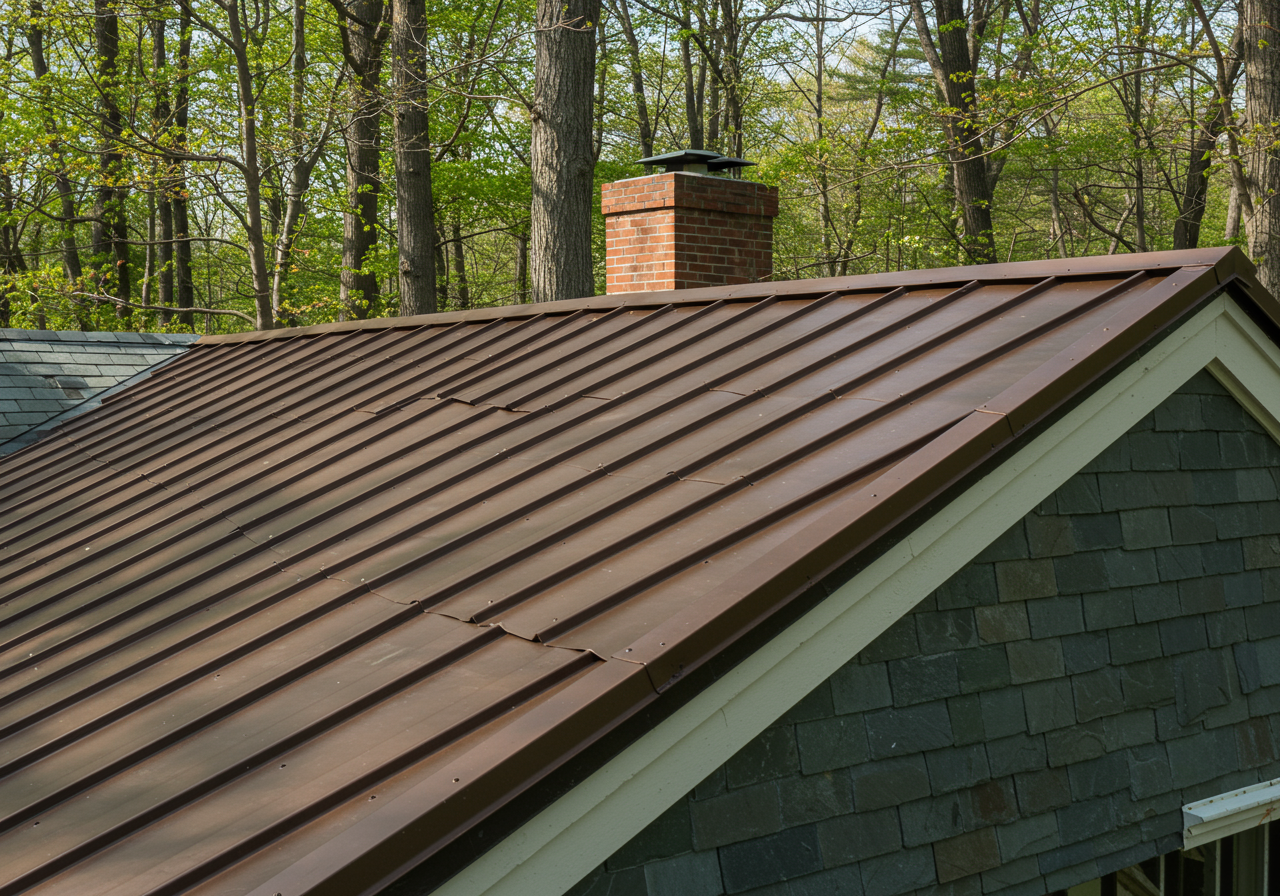
If you are looking for a true alternative to the "replace every 15 years" cycle, standing seam metal is the conversation we need to have. While it carries a steeper upfront price tag—often 2.5x the cost of asphalt—the wind resistance is unparalleled. Because the panels are interlocked and fastened with concealed clips that allow for thermal expansion, they can handle gusts that would shred a traditional roof.
I recently helped a homeowner on Hurlbutt Street compare quotes for a metal upgrade. We looked at the numbers: an $18,700 asphalt job vs. a $44,000 metal installation. It seems like a massive gap, but when you factor in that the metal roof won't need a $4,000 "emergency patch" every time a Nor'easter rolls through, the long-term roofing cost calculator starts to favor the metal. Plus, according to EPA data on cool roofs, these systems can significantly lower your July cooling bills, which are notoriously high in our corner of CT.
Synthetic Slate and Shake: Beauty Meets 140 MPH Ratings
Wilton loves its historic aesthetic. Many of the Colonials near the town center look best with wood shakes or heavy slate. The problem? Natural wood is a fire hazard and wind-weak, and real slate is so heavy it requires structural reinforcement that can cost $15,000 before a single tile is laid.
The alternative is synthetic (polymer) roofing. Brands like DaVinci or Brava offer products that look identical to hand-split cedar but carry a Class 4 impact rating and a 110-140 mph wind rating. If you're considering a full roof replacement to protect a high-value estate, synthetics give you the "Gold Coast" look without the "Gold Coast" maintenance headaches. I've seen these tiles survive falling branches that would have cracked real slate into a thousand pieces.
Wind Resistance by Material
The "Secondary Water Barrier" Strategy
If you aren't ready to jump to a $40,000 metal roof, you can still "hurricane-proof" your asphalt system. The secret isn't the shingle; it's the underlayment. In a standard install, contractors use felt paper. In a storm-ready install, we use a "self-adhering polymer-modified bitumen" (commonly called Ice and Water Shield) over the entire deck.
Full-Coverage Underlayment Installation
A contractor installing a full-coverage self-adhering underlayment on a steep-slope roof in Wilton
This creates a "sealed roof deck." Even if the wind rips every single shingle off your house, this sticky membrane stays glued to the plywood, keeping the rain out of your attic. According to FEMA's hurricane mitigation guidelines, this single step is the most cost-effective way to prevent catastrophic interior water damage. It adds about $1,200 to $3,000 to the job, but it's the difference between a "bad day" and "moving into a hotel for six months."
Fasteners and Drip Edges: The Line-Item Math
When you get an estimate, I want you to look at the hardware. Most Wilton contractors will bid for 1-inch galvanized nails. For hurricane prep, you want 1.25-inch ring-shank nails. These have little ridges (like a screw) that bite into the wood and refuse to let go.
Contractor Quote Red Flag
Also, check the drip edge. In Wilton, wind often pushes rain up and under the edges of your roof. A heavy-gauge, T-style drip edge fastened every 4 inches (rather than the standard 12 inches) keeps the perimeter secure. If the edges hold, the roof holds. I've had homeowners ask me, "Dana, does $400 for extra nails really matter?" My answer is always: "Ask the guy whose roof is currently in his neighbor's swimming pool."
The "Windstorm Deductible" Financial Trap
Here's the part that hits the wallet. Many insurance companies in Fairfield County have moved to a percentage-based deductible for named storms. If your Wilton home is insured for $1.2 million and you have a 2% windstorm deductible, you are on the hook for the first $24,000 of repairs.
If you spend $3,000 now on professional roof repairs to reinforce your flashing and secure loose shingles, you are essentially buying an insurance policy for your insurance policy. I always tell my clients to "show me the math" on their homeowners' policy before deciding how much to invest in storm prep. If your deductible is high, your "prep budget" should be equally robust.
"We see the most failures in Wilton not from the wind itself, but from the 'peel effect' where a poorly secured gutter or drip edge gives the wind a finger-hold to rip the system apart."
Step-by-Step: Your March Prep Checklist
Don't wait until there's a tropical storm warning on News 12 to think about your roof. March is the perfect time for a "dry run" inspection. The air is clear, the snow has melted, and the contractors aren't yet slammed with summer installs.
Binocular Check
Stand in your yard and look for 'tabs' that are lifting or curling at the corners.
Gutter Tension
Grab your gutters (carefully) and see if they wiggle. Loose gutters act like crowbars against your roof edge in high winds.
Attic Inspection
Look for light leaking through the ridge vent or water stains on the rafters.
Tree Clearance
Hire an arborist to prune any limb within 10 feet of your roofline; in a hurricane, those limbs become battering rams.
Contractor Audit
Get a professional to verify your shingle's wind warranty—many are void if the roof wasn't ventilated according to Energy Star standards.
If you're feeling overwhelmed by the technical jargon, remember that the goal isn't perfection; it's resilience. Investing in a verified local contractor who understands the unique wind loads of Fairfield County is the best way to ensure your home stays dry.
Get Your Free Roof Quote
Enter your zip code to get started
Conclusion
Preparing your Wilton roof for a hurricane isn't about buying the most expensive shingle on the market; it's about the "boring" details—the nails, the underlayment, and the perimeter attachments. Whether you choose the high-tech durability of a standing seam metal roof or simply decide to upgrade your asphalt installation to a sealed-deck system, the math consistently shows that prevention is cheaper than a restoration. Don't let a "minimum code" roof protect your maximum investment. Put the numbers on paper, check your deductible, and make the upgrades before the sky turns gray.
FAQ

About Dana Jackson
Verified ExpertDana Jackson is a Homeowner Advocate & Cost Analyst who helps Connecticut families navigate the financial aspects of roofing projects. She specializes in finding the best value and avoiding common pricing pitfalls.