After that last heavy blow rattled the shutters along Route 32 and sent branches tumbling near the Fenton River, my phone started buzzing. It's always the same story: a Willington homeowner looks up, doesn't see a gaping hole or shingles scattered across the lawn, and assumes they dodged a bullet. But wind is a subtle thief. It doesn't always announce its arrival by stripping your roof bare; more often, it just "un-zips" the protection you paid for, leaving you with a ticking financial time bomb.
I've spent a lot of time looking at repair invoices from Tolland County, and I can tell you that the difference between a $600 maintenance fix and a $15,000 "oh-no" moment usually comes down to whether you caught the damage before the next rain hits. Most local contractors are too busy chasing full replacements to explain the nuance of wind lift. They want the big insurance claim, not the small repair. Let's pull back the curtain on what's actually happening up there and how much it should cost you to fix it.
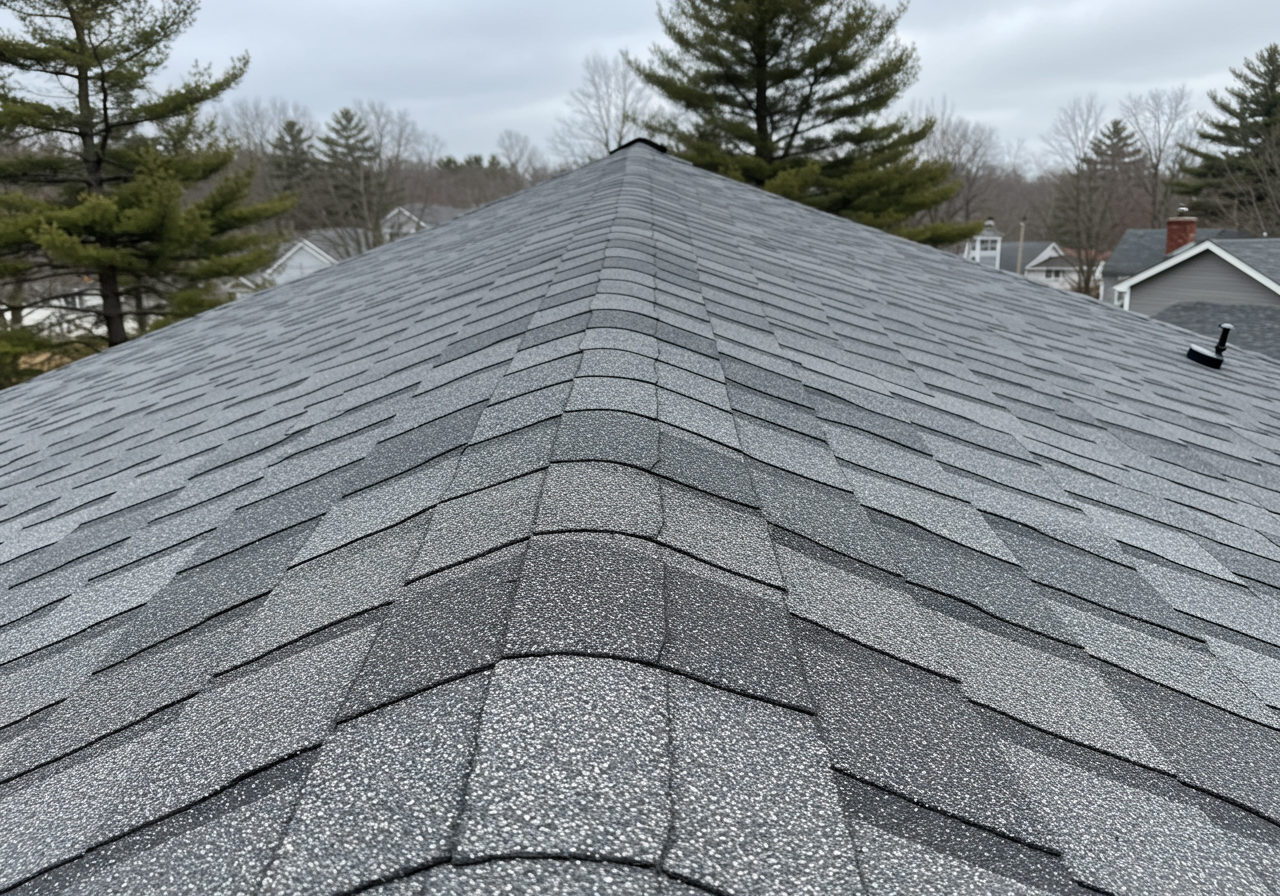
Identifying Wind Creases
A close-up of an asphalt shingle showing the distinct horizontal 'stress line' caused by wind lifting the tab and snapping the fiberglass mat.
Key Takeaways
- Wind speeds are often 15-20% higher on Willington's hills compared to the valley floor, causing hidden damage.
- The most expensive damage is often 'seal failure'—shingles that look fine but have lost their thermal seal.
- Creased shingles indicate structural failure and require replacement, not just repair.
- The 48-hour inspection window after a wind event is critical to prevent freeze-thaw damage.
1. The "Invisible" Lift: How Wind Actually Rips You Off
Most people think wind damage means shingles flying through the air like playing cards. In reality, the most expensive damage in Willington is often "seal failure." When wind speeds hit a certain threshold—often lower than you'd expect on the exposed ridges near Hall Memorial School—they create an uplift force. This force breaks the thermal seal (the sticky strip) holding your shingles together.
Once that seal is broken, the shingle flaps. Then it settles back down. From your driveway, it looks perfectly fine. But that seal is like a Zip-lock bag; once it's full of grit and dust from the wind, it won't stick again on its own. Now, every time it rains, water is driven underneath that flap. I recently helped a homeowner who had "perfect" looking shingles, but their attic was full of mold because 40% of their roof had unsealed. They didn't need a storm; they needed a better eye for detail.
Did You Know?
Did you know that wind speeds are often 15-20% higher on the windward side of Willington's hills compared to the valley floor? This 'topographic speed-up' means your neighbor might be fine while your roof is taking a beating.
2. Creased Shingles vs. Missing Ones: The Repair Math
If you see a shingle in your yard, that's actually the "cheap" problem to have because it's obvious. The real nightmare is the creased shingle. When a shingle lifts up and folds back, it creates a dark line across the top where the granules have broken off. This is a structural failure of the shingle.
When I review quotes, I see some contractors try to charge for a full "slope replacement" when only three shingles are creased. On the flip side, some "budget" guys will just try to glue the crease down. Neither is right. You need to know the line-item cost. In our neck of the woods, expect to pay a "trip charge" of about $250 plus roughly $15 to $25 per shingle for a proper repair. If a contractor quotes you $1,200 to fix five shingles, they're basically charging you a "I don't really want this small job" tax.
Visible vs. Hidden Wind Damage
| Feature | Missing Shingles | Seal/Crease Failure |
|---|---|---|
| Ease of Detection | ||
| Immediate Leak Risk | ||
| Insurance Approval Likelihood | ||
| Typical Repair Scope |
3. Willington's Micro-Climates and Your Deductible
Willington isn't flat. If you're living up near the Ashford line or on the higher elevations of Glass Factory Road, your wind exposure is vastly different than if you're tucked away near the Willimantic River. This matters when you're talking to your insurance company. Many modern policies in Connecticut have moved toward a "percentage-based" wind deductible.
Instead of a flat $500 or $1,000 deductible, you might be looking at 1% or 2% of your home's total insured value. If your house is insured for $400,000, that's an $8,000 deductible. I've seen homeowners get excited about a "free roof" from wind damage, only to realize their repair bill is $6,000 and their deductible is $8,000. You need to put the numbers on paper before you even think about filing a claim. Sometimes, paying cash for a targeted repair is the smarter financial move to keep your premiums from spiking.
4. The 48-Hour Inspection Window (And Why It Matters)
After a wind event, the clock starts ticking. Not just for insurance—though most policies want you to mitigate damage immediately—but for the physical health of your roof deck. In February, we often deal with "freeze-thaw" cycles. If wind lifts a shingle and then it snows, that snow melts, runs under the lifted tab, and freezes. Ice expands. That tiny lift becomes a huge gap in a matter of days.
I always tell people: don't wait for a leak to appear on your ceiling. By the time you see a brown spot in the living room, you've likely got $2,000 worth of saturated insulation and drywall repair on top of the roof fix. Get a drone up there or a ladder-trained pro to check the edges and ridges. If you find yourself in a spot where water is already coming in, you need to act on the emergency immediately to prevent the "house rot" that follows.
5. Line-Item Breakdown: Shingle Replacement Costs
Let's talk turkey. If you're looking at a repair invoice in Willington for 2026, here is what the math should look like. Don't let someone hand you a chicken-scratched total on a napkin. Demand the breakdown. According to FEMA's guidance on roof systems, proper attachment is the only way to survive high-wind zones, and that takes more than just a couple of nails.
Estimated Repair Costs (Tolland County 2026)
If your contractor is using high-quality components, those numbers might creep up by 10%. But if you're seeing a $2,500 quote for a "simple wind fix," you're likely paying for their truck payment, not your shingles. Also, remember that attic ventilation plays a role here. Poorly vented attics make shingles brittle, which makes them snap more easily in February winds. The DOE Energy Saver guide highlights how proper attic temps preserve your roof's structural integrity.
6. Why "Just One Patch" Might Void Your Warranty
Here is the "gotcha" that catches everyone. Most shingles come with a 25-year or Limited Lifetime warranty. However, those warranties are often contingent on the entire "system" being intact. If a contractor comes in and uses a different brand of shingle, or uses the wrong type of roofing cement to "stick down" those wind-lifted tabs, they might effectively kill your warranty for that entire slope.
I once worked with a couple in Willington who had a 5-year-old roof. A wind storm hit, a cheap "handyman" patched it for $300, and two years later the whole slope started failing. When the manufacturer came out, they denied the claim because the repair didn't meet their specific installation specs. It's worth finding a contractor who actually shows up and understands the fine print of your specific shingle brand.
The 'Nail-Over' Trap
7. Negotiating with Your Adjuster Using Real Data
If you do decide to go the insurance route, don't just accept the first check they send. Adjusters use software like Xactimate, which often uses "average" pricing that doesn't account for the reality of working on a steep-pitched Tudor or a high-up Colonial in the Willington hills.
When the adjuster says, "We'll give you $400 for that repair," show them a local quote that includes the "steep charge" and the "two-story" surcharge. Explain that in Willington, labor isn't the same price as it is in rural Ohio. If the damage is extensive enough that a color match isn't possible (because your old shingles have faded), Connecticut often has "matching" laws or precedents that might require the insurer to replace the whole slope or even the whole roof. Don't be afraid to see what other CT homeowners experienced when fighting for a fair settlement; sometimes a little social proof is the leverage you need.
Negotiation Script Tip
Finding the right fix for wind damage isn't about the loudest contractor; it's about the one who brings a tape measure and a camera. Don't let a few missing shingles turn into a complete structural failure because you were afraid of a little math.
Take a good look at your roof this week. If the lines look a little wavy or you see "shadows" under the shingle edges, it's time to get a pro involved. You can get an instant, no-pressure look at what your specific roof might cost to fix or replace by using ZikQuote's automated matching. It's the fastest way to see the real numbers without the sales pitch.
Get Your Free Roof Quote
Enter your zip code to get started
FAQ

About Dana Jackson
Verified ExpertDana Jackson is a Homeowner Advocate & Cost Analyst who helps Connecticut families navigate the financial aspects of roofing projects. She specializes in finding the best value and avoiding common pricing pitfalls.