
We just watched the last of that heavy, "heart-attack" snow melt off the ridges in Spring Glen, and my phone hasn't stopped buzzing since the first week of March. Most Hamden homeowners are climbing ladders right now, spotting ceramic granules in their gutters and wondering if they can squeeze another five years out of a budget shingle. I recently walked a Tudor-style home near Quinnipiac where the owner was convinced that "a shingle is a shingle." He was looking at a quote for 3-tabs to save a few thousand bucks on a 2,400-square-foot roof. Here's the reality: in New Haven County, treating a roof replacement like a grocery store generic-brand purchase is the fastest way to flush $12,400 down the drain. If you're weighing "standard" against "architectural," you're likely missing the structural data that actually dictates your long-term ROI.
Key Takeaways
- 3-tab shingles are rated for 60 mph winds, while architectural shingles (laminated) typically handle 130 mph gusts common in CT nor'easters.
- The price gap between the two materials is often less than 18% of the total project cost, yet architectural shingles offer nearly double the functional lifespan.
- Hamden's specific humidity and proximity to the Sound make algae-resistant architectural shingles a necessity for maintaining curb value.
- Most 'failed' comparisons ignore the labor overlap—you pay the same for the crew to climb the ladder regardless of which shingle they carry.
Hamden Shingle Comparison Guide
Understanding the critical differences between 3-tab and architectural shingles for Connecticut homes
The "Economy" Trap: Why 3-Tab Shingles Struggle in New Haven County
When I look at the housing stock near Lake Whitney, I see a lot of older 3-tab roofs that look like they've gone rounds with a heavyweight boxer. 3-tab shingles are a single layer of asphalt-saturated fiberglass. They are thin, flat, and rely on a very specific seal strip to stay attached. The problem is that Connecticut isn't exactly a "gentle" environment.
Here is the thing: a 3-tab shingle is generally rated for 60 mph winds. During a standard March windstorm in Hamden, we can easily see gusts hitting 50 mph. There is almost zero margin for error. I've seen 3-tabs "unzip" from the middle of a roof deck because the seal strip failed after just seven years of thermal cycling. When that happens, you aren't just looking at a missing shingle; you're looking at an urgent call for help to prevent water from reaching your plywood sheathing. In my experience, the labor to repair a few blown-off 3-tabs often costs more than the original "savings" the homeowner bragged about during the install.
The Dimensional Advantage: More Than Just a Pretty Face
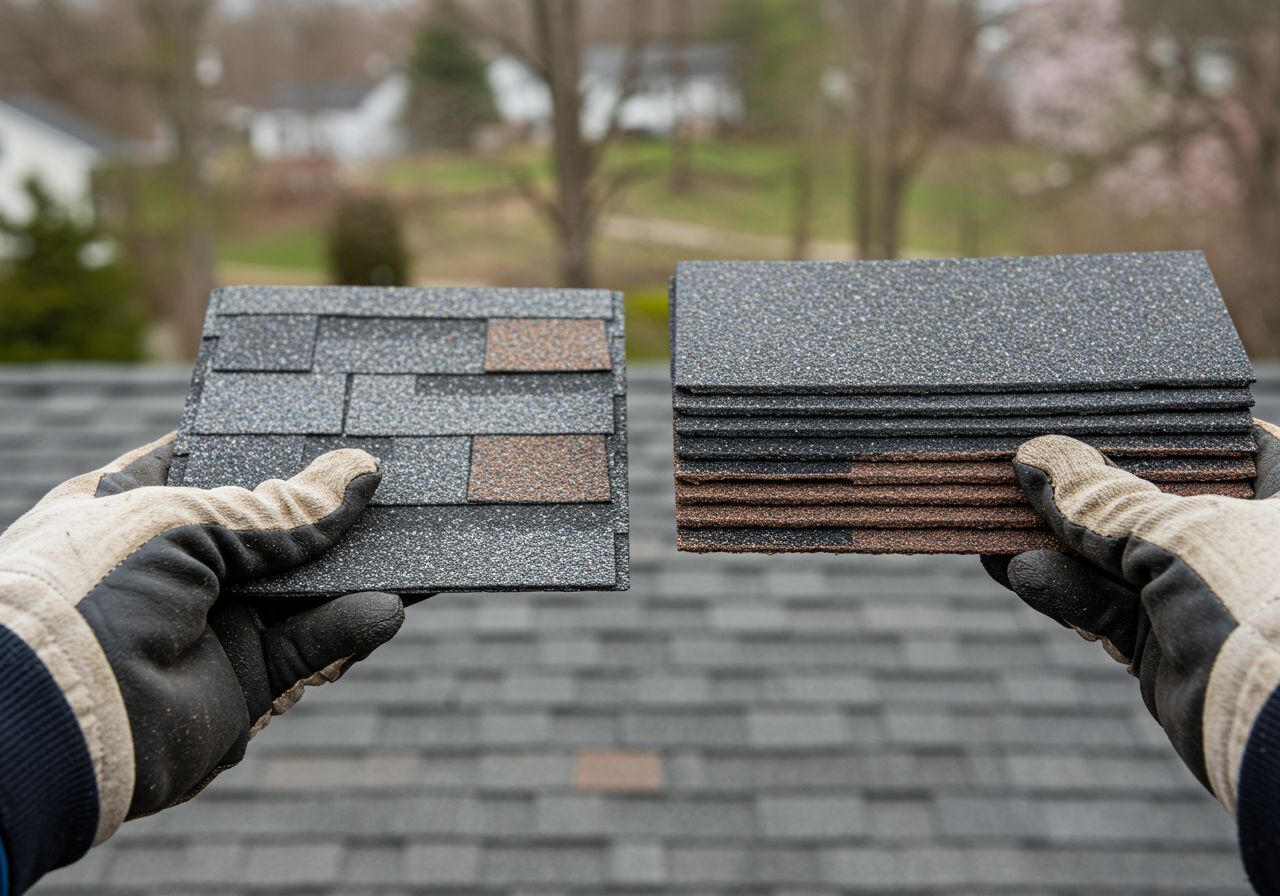
Architectural shingles—often called "dimensional" or "laminated" shingles—aren't just thicker for the sake of aesthetics. They consist of two or more layers of shingles laminated together. This creates a staggered, wood-shake look, but the technical benefit is the weight and wind resistance. A standard square (100 square feet) of 3-tab shingles weighs roughly 195 pounds. An architectural shingle like the GAF Timberline HDZ or CertainTeed Landmark comes in closer to 240 pounds per square.
That extra mass matters when the wind catches the edge of your roof. Because they lack the vertical "slits" or tabs of the traditional style, there is no easy way for wind to get underneath the material and create uplift. According to FEMA's technical guidelines on roof systems, the bond strength and material weight are critical factors in preventing catastrophic failure during high-wind events. When I'm calculating a bid, I'm looking at the fastener pull-through resistance—basically, how hard it is for a nail to rip through the shingle. Dimensional shingles win that fight every single time.
Real-World Lifespan in Connecticut Weather
Hamden's Microclimate: Why Your Neighborhood Matters
If you live up near Mount Carmel, your roof faces different stressors than a house down in Highwood. The elevation changes in Hamden create "wind tunnels" where 3-tab shingles simply can't compete. Furthermore, our high humidity levels in the summer lead to Gloeocapsa magma (that's the black streaking you see on roofs).
Look, most 3-tab shingles are the "budget" line for manufacturers, meaning they skimp on the copper-lined granules that prevent algae growth. Architectural shingles almost always come standard with 10 to 15 years of algae resistance. If you're planning on selling your home in five years, those black streaks on a 3-tab roof will cost you thousands in "perceived" damage during a home inspection. I've seen buyers walk away from perfectly dry houses just because the roof looked "old" due to algae. Beyond aesthetics, keeping your roof clean and reflective is part of a whole-home approach to efficiency, much like the Department of Energy's recommendations for attic insulation. A cooler roof means a cooler attic, which means your AC isn't screaming all July.
Expert Tip
The Math of the "Cheap" Roof: A 12-Year Retrospective
Let's talk numbers, because that's where most Hamden comparisons fail. Let's say a full architectural roof for a standard Hamden colonial costs $14,800. A 3-tab version might cost $12,900. You're "saving" $1,900 today.
But if the 3-tab roof lasts 15 years (if you're lucky) and the architectural lasts 30, your "cost per year" for the 3-tab is $860. The cost per year for the architectural is $493. You are essentially paying a 74% premium for the "cheaper" roof over the long term. I've kept field notes on replacements since 2011, and the homes that went with 3-tabs are already back on the market for their second roof, while the architectural jobs I did back then still look like they were installed yesterday.
3-Tab vs. Architectural Comparison
Pros
- Lower upfront material cost
- Lightweight for older structures
- Easier for DIY small repairs
Cons
- Poor wind resistance (60mph)
- Shorter warranty periods
- Lower impact on home resale value
- Dated aesthetic
Installation Nuances: The "Six-Nail" Rule and Warranty Gaps
The material is only half the battle. Architectural shingles have a wider "nailing zone"—the area where the installer can safely drive a fastener through both layers of the shingle. This makes it much harder for a tired roofer on a Friday afternoon to "high-nail" the shingle.
High-nailing is the silent killer of Connecticut roofs. When a nail is placed too high, it doesn't catch the shingle underneath. With 3-tabs, the nailing zone is barely an inch wide. With architectural shingles, manufacturers like Owens Corning have developed reinforced nailing strips (like the SureNail series) that act like a target. If you want a roof that survives the next nor'easter, finding a contractor who actually uses the six-nail method is more important than the brand on the package. You also need to consider how certain materials contribute to urban heat; research from the EPA on cool roofing suggests that material choice and color can significantly impact the surrounding temperature of your property.
Making the Call: When 3-Tab Actually Makes Sense (Rarely)
I'm not a total snob; there are times I'll tell a Hamden homeowner to go with 3-tabs. If you're roofing a detached garden shed or a small "fix-and-flip" property where the budget is paper-thin and the structure won't be in your hands for more than 24 months, sure—save the cash.
But for your "forever" home in Mount Carmel or a rental property you plan to hold in New Haven County, the 3-tab shingle is a liability. You're essentially buying a temporary umbrella instead of a permanent shield. If you want to see the actual price difference for your specific roofline without the high-pressure sales pitch, you should get an instant roof estimate. It'll show you the delta between these materials so you can see that the "upgrade" is usually the smartest financial move you'll make this year.
Get Your Free Roof Quote
Enter your zip code to get started
In conclusion, don't let a $2,000 difference today blind you to a $15,000 expense twelve years from now. Hamden's weather is only getting more unpredictable, and your roof is the only thing standing between your living room and a very expensive indoor swimming pool. Stick with the dimensional shingles—your future self (and your bank account) will thank you.