
Key Takeaways
- Standard asphalt shingles almost never qualify for federal tax credits in 2026 unless they meet specific solar-reflective indexes (SRI).
- The Section 25C credit for cool roofs shares a strict $3,200 annual aggregate cap with other upgrades-many Stamford homeowners burn through it in one project season.
- Always demand the Manufacturer's Certification Statement before the first nail is driven, not after the job is done.
- Tax credits reduce tax liability-they aren't a rebate check from the IRS, so verify with a CPA that you can actually use the credit.
I was looking at a "finalized" contract for a homeowner in North Stamford last week-let's call him Gary-and I felt that familiar tightness in my chest. Gary was about to sign off on a $28,400 roof replacement for his colonial near High Ridge Road. The salesman had promised him a "guaranteed 30% federal tax credit" that would "basically pay for the gutters and then some."
Here's the problem: the shingles they were installing didn't actually qualify for the Section 25C credit under the 2026 standards. Gary was looking at a $0 return from the IRS, not the $8,500 windfall he'd been promised.
It's a story I'm seeing more often across Fairfield County. Contractors use the idea of energy efficiency as a closing tool, but they rarely stay up to date on the shifting line items of federal tax law. If you're living on the Gold Coast, you're already paying a premium for labor and materials. The last thing you need is a surprise bill from the IRS because your "energy-efficient" roof was just a standard architectural shingle with a fancy marketing name.
The "Energy Efficient" Label Trap
When you're walking through the Chelsea Piers area or driving past the revitalized Harbor Point, you'll see plenty of new roofs. Many of them are "cool roofs," designed to reflect sunlight. But there is a massive gulf between a roof that saves you $40 a month on your Eversource bill and a roof that the federal government considers a "qualified energy property."
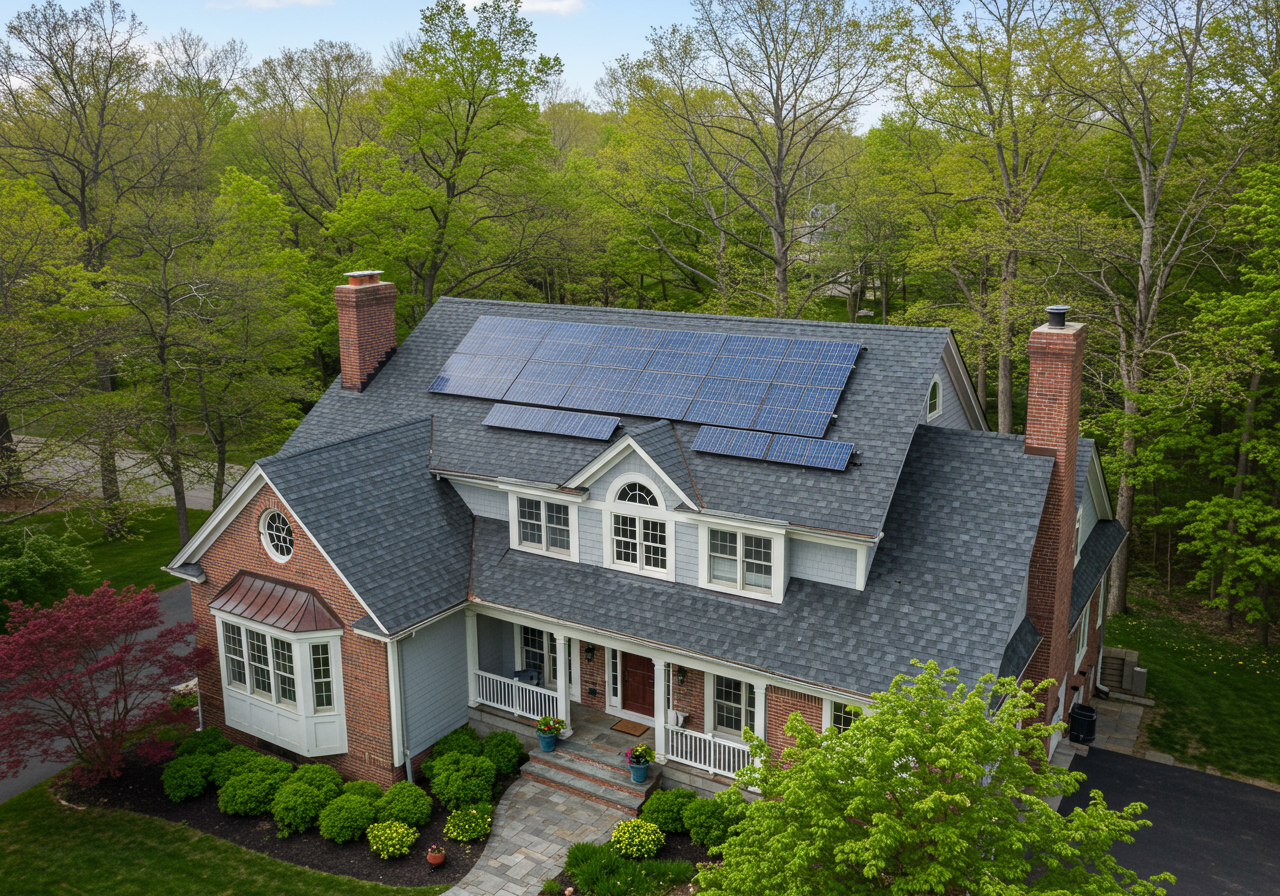
Stamford roofs: curb appeal versus IRS compliance
Cool marketing is not the same as a Manufacturer's Certification Statement that holds up on Form 5695.
Not All Shingles Are Created Equal
In 2026, the bar for what constitutes an energy-efficient roof in Connecticut has been raised. Gone are the days when any Energy Star-rated shingle would get you a pass. Now, the IRS focuses heavily on the Solar Reflective Index (SRI). If you're looking at a standard asphalt shingle, it needs to be specifically engineered with cooling granules.
I've seen Stamford residents get sold on "Slate Gray" shingles under the guise of them being "cool." Dark colors, even with modern granules, rarely hit the SRI threshold required for the 30% credit. If the contractor can't produce a spec sheet showing an SRI of at least 35 for a steep-slope roof, you're looking at a standard home improvement, not a tax-incentivized upgrade.
The Reflective Roof Standard for 2026
It isn't just about the material; it's about the system. For a project in a high-cost area like Stamford to succeed, the ventilation must be handled as a line-item. I always tell people to verify their contractor's license and track record and ask specifically about their experience with "Total Envelope" efficiency. A reflective shingle on a poorly ventilated attic is like wearing a fur coat with a t-shirt-it's a waste of money.
According to the USA.gov guide to home repair and improvement, federal assistance and credits are increasingly tied to holistic standards. If your contractor is just "ripping and gripping" (slapping on new shingles without checking your soffit vents), they aren't just doing a bad job; they're potentially disqualifying you from federal incentives.
The $3,200 Annual Limit vs. The 30% Dream
Let's talk math, because that's where the "success" part of this article lives or dies. Most homeowners hear "30% tax credit" and stop listening. They think if they spend $30,000, they get $9,000 back.
But for most roofing components under the Energy Efficient Home Improvement Credit (Section 25C), there is an aggregate annual limit of $3,200. And that $3,200 is often split between different types of upgrades-heat pumps, windows, and doors.
Understanding the 25C vs. 25D Divide
If you want the "unlimited" 30% credit, you have to move into the territory of Section 25D-the Residential Clean Energy Credit. This applies to solar roofing. In Stamford, where the average roof replacement can easily hit $22,000 to $35,000, the difference between the $1,200 cap for building envelope components and the 30% credit for solar shingles is life-changing.
But-and this is a big "but"-you can't just claim the whole roof. If you install GAF Energy Timberline Solar shingles, only the solar-generating portion and the related electrical components qualify for that 30%. The "non-solar" shingles used to fill in the gaps? Those fall back into the 25C bucket or don't qualify at all.
Why the Math Often Doesn't Add Up for Stamford Estates
I recently reviewed a bid for a home in Glenbrook. The contractor quoted $42,000 for a high-end metal roof. He told the owner she'd get $12,600 back.
The reality:
- The metal was reflective, yes.
- But metal roofing falls under the $1,200 annual cap for building envelope components.
- She was actually eligible for $1,200, not $12,600.
That's an $11,400 "misunderstanding." When I pointed this out, the contractor said, "Well, most people don't get audited anyway." That is not a financial strategy; that's a gamble with the IRS. You need to read real stories from CT homeowners who insisted on clear, line-item breakdowns before signing.
2026 potential federal savings by material (illustrative)
Contractor Lies and the "Instant Discount" Scam
"Sign today, and we'll bake the tax credit into the price as an instant discount."
If you hear those words from a Fairfield County roofer, walk away. Or better yet, run toward the Merritt Parkway and don't look back. A contractor cannot "give" you a federal tax credit. Only the IRS can do that after you file your taxes the following year.
The Negotiation Script You Need
When a contractor starts talking about tax credits, hit them with this: "I plan to file Form 5695. Please provide the Manufacturer's Certification Statement for these specific shingles and a line-item breakdown of labor versus materials for the energy-efficient components."
If they stammer or say "it's all included," they are hiding something. Professional crews know that the IRS requires you to separate the cost of the "energy property" from the general labor of the roof.
Vetting the Fairfield County "Specialist"
A real pro will also be obsessed with safety and standards, not just tax loopholes. I've noticed that the guys who lie about tax credits are often the same ones who "forget" to use proper harnesses on a steep Shippan Point Victorian. According to the OSHA residential fall protection guidance, you can tell a professional crew by their equipment. If they're cutting corners on safety, they're definitely cutting corners on your tax documentation.
Tax credit strategy: 25C (cool roof) vs. 25D (solar)
Pros
- 25C is easier to install with standard crews
- 25D offers much higher dollar-for-dollar savings when the system qualifies
- Both can support resale value in the Stamford market when documented honestly
Cons
- 25C has a very low $1,200 annual cap for building envelope components
- 25D requires specialized electrical subcontractors and utility coordination
- Miscalculating what qualifies under 25D can trigger IRS scrutiny
A Successful Case Study in Glenbrook
Let's look at how this should work. I worked with a couple in Glenbrook who wanted to do it right. They didn't want the cheapest roof; they wanted the best ROI.
They opted for a high-SRI standing seam metal roof. The total cost was $31,500. Instead of pretending the whole thing was a credit, we broke it down.
The Documentation That Actually Passes an Audit
The contractor provided a split invoice:
- Non-qualifying costs: Tear-off, disposal, plywood replacement, and standard underlayment ($14,000).
- Qualifying material cost: The actual metal panels and specialized reflective insulation ($17,500).
Because they were using Section 25C, they knew their credit was capped at $1,200. But they also timed their project. They did the roof in 2026 and waited until 2027 to do their windows. Why? Because the $3,200 cap is annual. If they had done both in May 2026, they would have "wasted" the credit potential of the windows.
The Solar Shingle Strategy
For those who want to go bigger, solar shingles are the only way to see a five-figure tax credit. In Stamford, where the sun exposure is surprisingly good for many north-south facing lots, a 6kW solar shingle system might cost $45,000. But with the 30% 25D credit, that's a $13,500 direct reduction in taxes.
And here's the kicker: browse our roofing and energy guides for a full breakdown on how these systems handle the heavy snow we get in Fairfield County. (Spoiler: they often handle it better than traditional panels because there's no gap for ice dams to form underneath).
Verify SRI on the certification
Confirm the Solar Reflective Index on the Manufacturer's Certification Statement matches the exact product bundle going on your roof.
Line-item your quote
Get material, labor, disposal, and permit costs separated so energy property is identifiable.
Stress-test liability with your CPA
Confirm you have enough federal tax liability to absorb non-refundable 25C benefits.
File Form 5695 correctly
Attach supporting docs when you file your annual return-don't rely on verbal promises.
Archive everything digitally
Store receipts and certification statements in a permanent folder you can reproduce in an audit.
Don't let a slick salesperson in a branded SUV tell you that the government is going to buy you a new roof. They aren't. They are offering an incentive for specific, high-performance choices.
If you want to find out what a real, qualified roof costs in Stamford without the "tax credit" fluff, you need to look at data from people who have actually done the work. Before you sign a contract that sounds too good to be true, take a look at the math and make sure it holds up under the 2026 rules.
See Stamford-area pricing without the tax-credit fairy tales
Get matched with pros who quote line items, not hype.
No credit card required • Free to use
Get Your Free Roof Quote
Enter your zip code to get started
The Fairfield County market is unique. We have high labor costs, strict building codes, and a weather pattern that oscillates between humid summers and ice-heavy winters. According to the NWS Storm Events Database, Stamford has seen a 15% increase in "severe wind events" over the last decade. Your roof needs to be tough first and energy-efficient second.
At the end of the day, the only person looking out for your wallet is you. Put the numbers on paper before you sign anything. Ask them to show the math line by line. If they can't, they don't deserve the job.