
Key Takeaways
- A tax credit reduces federal tax you owe—it is not a rebate check, so retirees and heavy deduction households may see little or no usable benefit.
- Cool-roof shingles that qualify for credits do not always suit Connecticut's humid summers and snowy winters; chasing credits can raise heating costs.
- Documentation matters: without a Manufacturer's Certification Statement and correct Form 5695 filing, a new roof is just a home repair in the IRS's eyes.
- Treat any contractor who leads with tax savings as a red flag—negotiate on line-item pricing first, then treat credits as a possible bonus.
Last spring, I sat down with a couple over near the Deep River Landing who were absolutely fuming. They'd just finished a $24,850 roof replacement on their colonial, fully expecting a massive check from the IRS to offset the cost. Their contractor—a guy who probably spent more time on his truck wrap than studying tax law—told them the whole project was "tax-deductible."
The "Refund" Myth That Costs Deep River Families Thousands
But here's the reality: when tax season rolled around, they realized they didn't actually owe enough in federal taxes to even use the full credit. A tax credit isn't a check mailed to your house; it's a reduction of what you owe. If you're retired or have a lot of deductions already, that "savings" might be worth exactly zero dollars.
And don't get me started on the difference between a deduction and a credit. In Deep River, where property taxes already bite, you can't afford to miscalculate your federal return. I always tell people: don't sign a contract based on a tax promise. Get the real cash price in writing before you match with contractors before you even think about incentives.
Why "Cool Roofs" Don't Always Make Sense on the Shoreline
In Middlesex County, we deal with a specific brand of weather. We have humid, sticky Mays followed by winters that can dump two feet of snow on a Tuesday. The "cool roof" technology that qualifies for many tax credits is designed to reflect sunlight. That's great for a ranch in Arizona, but in Connecticut, reflecting heat in the winter means your attic stays colder, potentially increasing your heating bill.
The IRS is very specific about what qualifies. According to the Energy Star cool roofs product guidance, only certain pigmented shingles or cooling granules meet the criteria. If you install a dark charcoal architectural shingle because it looks better with your siding, you likely won't see a dime of that credit, even if the roofer claims it's "energy efficient."
I've seen homeowners spend an extra $2,100 on premium "cool" shingles just to chase a $1,200 credit. Do the math. You're spending a dollar to save fifty cents. It doesn't make sense unless the material actually improves the longevity of your home against our shoreline winds.
Energy-efficient shingle trade-offs
Pros
- Reduced cooling loads in summer
- Potential extension of shingle life
- Federal tax liability reduction when you qualify and owe enough tax
Cons
- Higher upfront material cost
- Increased heating demand in CT winters
- Strict IRS documentation requirements
The Contractor "Markup" Trap
Here is a script I want you to use. When a contractor starts talking about tax credits, ask them: "Can you show me the line-item cost difference between the standard shingle and the Energy Star-rated version?"
Usually, they'll stutter.
Some less-than-honest folks in the industry see those tax credits as an opportunity to pad their margins. They know you think you're getting $1,200 back, so they conveniently raise their labor or "specialty material" fees by $1,000. It's a shell game. You need to see the math. I've looked at enough quotes in the Deep River area to know that a fair price for labor shouldn't magically jump just because the shingles are white instead of grey.
If you're seeing quotes that feel inflated, it might be time to get a baseline estimate from verified pros who don't play games with "incentive pricing." You want the price of the roof, period. Any tax benefit should be a "cherry on top," not the foundation of the deal.
"If a contractor uses a tax credit as their primary closing tool, they aren't selling you a roof; they're selling you a financial fantasy. Check the SRI ratings yourself."
Documentation Disasters and Form 5695
I once helped a homeowner in the Middlesex area who tried to claim the credit using nothing but a handwritten receipt that said "Energy Roof." The IRS laughed at him (metaphorically, though they aren't known for their humor).
To actually claim these credits, you need the Manufacturer's Certification Statement. This is a specific document that proves the materials meet the standards set by the IRS instructions for Form 5695. Without it, you're just a person with a new roof and an audit risk.
But what happens if your roof fails before tax season even arrives? If you're dealing with a leaking roof or storm damage that cannot wait in the middle of a May downpour, you aren't thinking about tax forms—you're thinking about your ceilings. Make sure your emergency repairs are documented just as strictly as a planned replacement if you're hoping for any energy-related offsets.
Confirm the shingle's SRI rating with the manufacturer
Match the exact product bundle on your contract to published specs—marketing names are not proof for the IRS.
Verify your federal tax liability with a CPA
Non-refundable credits only help if you owe enough tax; model your return before you bank on savings.
Secure the Manufacturer's Certification Statement
Request this from your installer before final payment, not months later when folders go missing.
File IRS Form 5695 with your annual return
Follow the worksheet in the instructions and keep digital copies of invoices and certifications.
The Real Impact of Connecticut's Climate on Efficiency
Deep River isn't just "anywhere." We are right on the water, and our humidity levels in May can make a roof work twice as hard. Reflective roofing is only one part of the energy equation. If your attic isn't vented properly, all those fancy "energy-efficient" shingles won't do a thing to lower your AC bill.
I've seen people chase the $1,200 credit while ignoring $4,000 worth of heat loss through a poorly insulated attic. It's like putting a high-tech lid on a pot with no sides. According to FEMA's fact sheet on sloped roof systems, the structural integrity of your roof—how it's attached to the rafters—is far more important for shoreline homes than the color of the granules. If the wind rips the "efficient" shingles off, the tax credit won't help you dry out your living room.
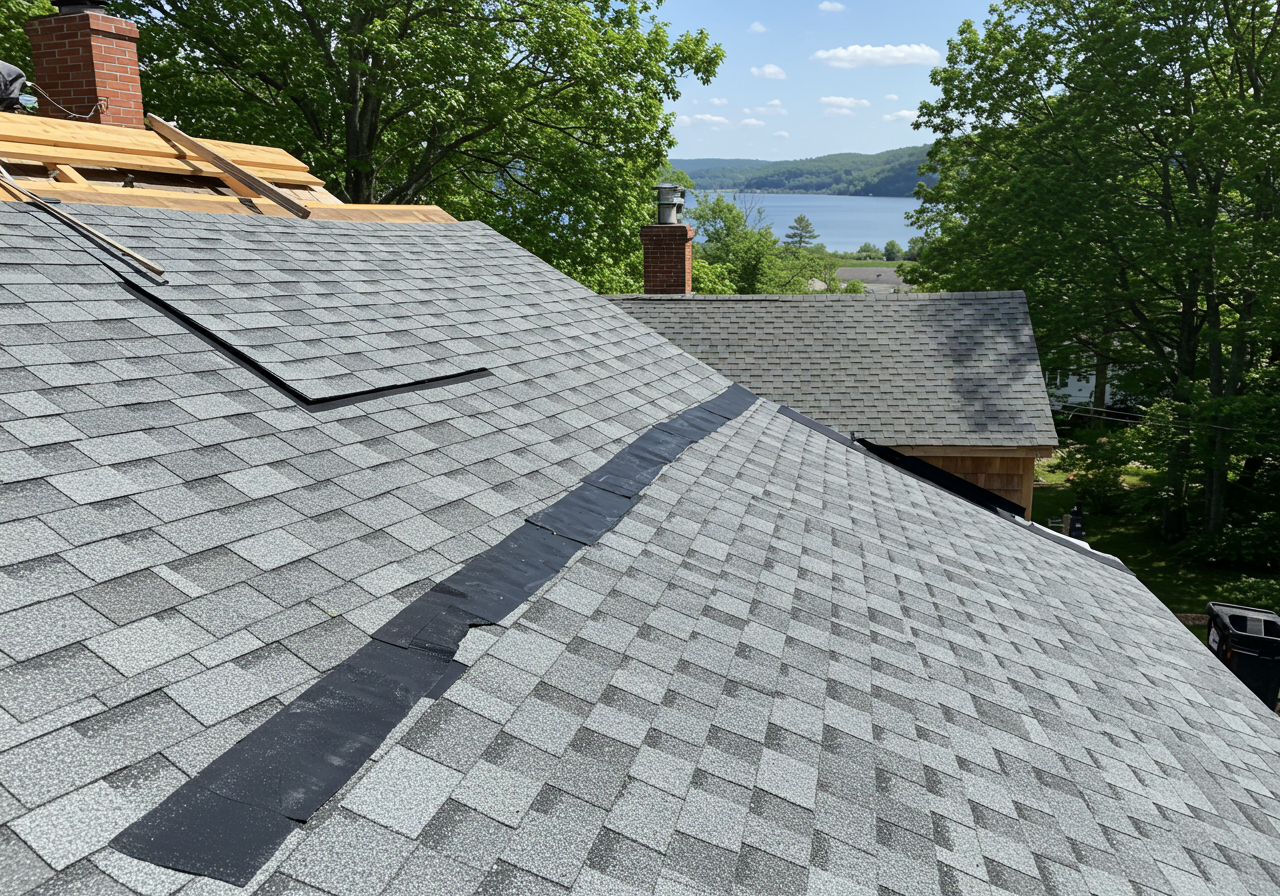
Deep River shoreline: structure before shiny tax labels
Humidity, wind, and attic performance often matter more than reflective granules alone.
Negotiation: How to Use Efficiency as Leverage
If you actually want to save money, use the energy-efficient angle as a negotiation tool, not just a tax hope. Tell the contractor: "I know these shingles qualify for a credit, but I also know they cost you more at the supply house. I'm willing to pay the material difference, but I'm not paying extra for 'specialty' labor."
Most roofing labor is the same whether the shingle is "cool" or not. Don't let them tell you it requires a "certified efficiency technician." That's a made-up title designed to separate you from your savings.
And remember, the credit is often capped per year. If you're doing windows and a roof, you might hit the ceiling before you even finish the project. This is why line-item math is your best friend. Demand to see the price of the shingles, the price of the nails, and the price of the labor. If they won't show you, they're hiding something.
Pro tip
The Bottom Line for Deep River Homeowners
Energy tax credits are a decent bonus, but they are a terrible reason to buy a roof. In Deep River, your priority should be a system that can withstand the Middlesex County wind and humidity first, with energy savings coming in a distant second. Get your documentation in order, talk to your tax professional before you sign, and never let a roofer tell you how much you'll "get back" from the government. They don't know your tax return, and frankly, it's none of their business. Focus on contractor reputation, license verification, and line-item transparent pricing instead.
Compare real roof numbers for Deep River—not tax fairy tales
Line-item quotes from vetted Connecticut pros, no incentive games.
No credit card required • Free to use
Get Your Free Roof Quote
Enter your zip code to get started