
Key Takeaways
- Fairfield County labor rates are 14.2% higher than the national average, driving up Bridgeport roofing costs.
- Hidden structural costs like tear-off and decking replacement can add $1,500-$2,800 to your project.
- Energy-efficient roofing materials can qualify for federal tax credits, reducing your net cost by thousands.
- Vetting contractors thoroughly prevents costly mistakes with unlicensed 'storm chaser' companies.
I remember standing on a steep-slope Victorian roof near Seaside Park a few years back, looking at a quote the homeowner had received from a "trunk-slammer" contractor. The bid was for $7,200, which, even back then, wouldn't have covered the cost of high-grade materials and a legitimate crew for a house that size. As I walked the ridge, my boot sank nearly three inches into a soft spot near the chimney—a clear sign of structural rot that the previous estimator hadn't even bothered to look for from the ground. That homeowner was about to sign a contract that would have ballooned by $5,000 the moment the first shingle was ripped off. It's those "surprises" that I've spent my career trying to eliminate by forcing transparency into the numbers.
In Bridgeport, the "average" cost is a moving target, especially as we navigate the early months of 2026. If you're looking at your roof this February and noticing granular loss or curling tabs, you aren't just buying shingles; you're buying a localized insurance policy against the Long Island Sound's humidity and the unpredictable freeze-thaw cycles of a Connecticut winter. The data shows that Fairfield County homeowners face a unique set of pricing pressures that our neighbors in Litchfield or Windham simply don't. From higher permit fees to the "Gold Coast" labor premium, getting an honest handle on the numbers requires more than a napkin sketch.
1. The Fairfield County Labor Premium and Material Volatility
Here's the thing about roofing in Bridgeport: you are at the epicenter of one of the most expensive labor markets in the country. When I pull data for my project reports, I consistently see labor rates in the 06604 and 06606 zip codes tracking significantly higher than the national median. It isn't just about "wealthy neighborhoods"; it's about the cost of doing business. A contractor in Bridgeport has to carry higher general liability and workers' comp insurance than someone in a less litigious or less densely populated state.
Currently, for a standard architectural shingle installation—using a product like the GAF Timberline HDZ or Owens Corning Duration—you should expect to pay between $4.50 and $6.75 per square foot. (In roofing terms, a "square" is 100 square feet, so that's $450 to $675 per square). If you're being quoted $3.00 per square foot in 2026, I can almost guarantee that the contractor is cutting corners on either underlayment quality or crew insurance. I've seen crews show up with no fall protection and sub-par fasteners just to hit a low-ball price point, and it's the homeowner who pays when the building inspector shuts the job down.
The materials themselves have stabilized slightly compared to the chaos of 2021, but "stable" in 2026 means an annual 3-5% climb. We are seeing asphalt prices fluctuate with oil markets, and because most shingles are petroleum-based, your quote in February might look different by May. This is why I always tell people to get an instant, data-backed estimate rather than relying on a price their cousin paid three years ago. The market moves too fast for old anecdotes to be useful.
2. Hidden Structural Costs: The Tear-Off and Decking Reality
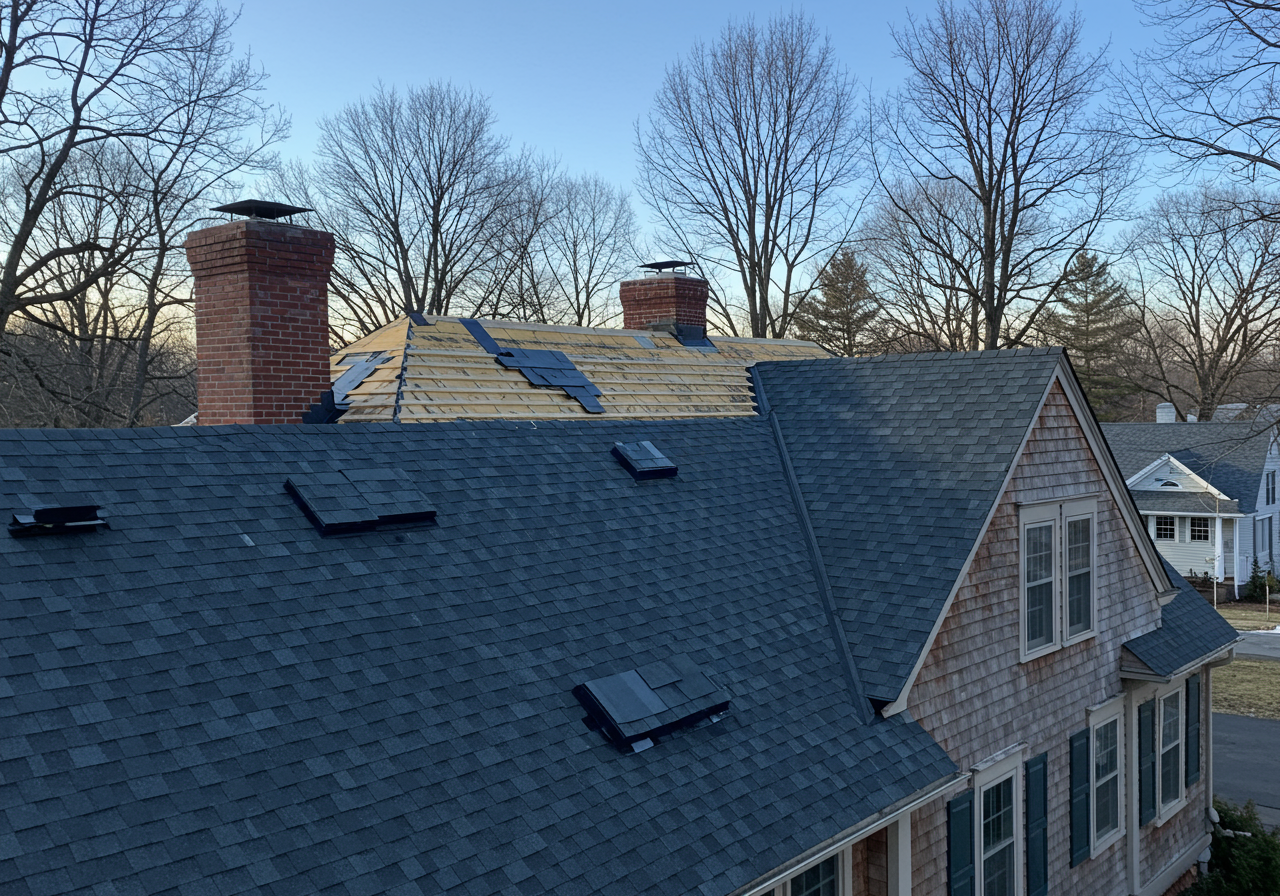
Most Bridgeport homeowners think they're paying for the "skin" of the house—the shingles. In reality, a large portion of your $13,420 average is spent on what's underneath. I've found that roughly 18% of homes in the North End and Black Rock areas still have multiple layers of shingles. Connecticut building code—specifically the International Code Council (ICC) standards we follow here—strictly prohibits more than two layers of roofing. But honestly? If you have two layers, you need a full tear-off anyway.
A full tear-off in Bridgeport typically adds $1,500 to $2,800 to the project, depending on the weight and disposal fees at the local transfer station. Then there is the "decking" or the wood sheathing. If your home was built before 1970, there's a high probability you have 1x6 or 1x8 tongue-and-groove boards rather than modern CDX plywood. As shingles age and leak, these boards rot. If more than 10% of your deck is compromised, a reputable pro will recommend a full re-sheeting.
Bridgeport Roofing Lifespan vs. Initial Investment
In my field notes from last season, I documented a project near the Trumbull line where the homeowner thought they just needed a "quick over-lay." Once we got up there, we realized the original cedar shakes were still buried under two layers of asphalt. We had to strip it to the rafters and install 54 sheets of 5/8" OSB. That turned a $10,000 job into a $16,000 job instantly. But that's the reality of New England construction. You can't nail new shingles into rotted wood and expect them to hold during a Nor'easter. If you're facing a sudden leak after a storm and can't wait for a full replacement, you might need to look into emergency roofing services just to buy yourself time to budget for the full deck replacement.
3. The Components That Actually Protect Your Home
The "average" cost is often driven by things you can't see from the driveway. For instance, the flashing around your chimney and in your valleys is the most common point of failure. In Bridgeport, where we get heavy, wet snow that sits and melts slowly, your flashing needs to be bulletproof. I prefer 16-ounce copper for high-end colonial homes, but at the very least, you should be seeing custom-bent .032 gauge aluminum.
Be wary of any quote that lists 're-using existing flashing.'
Then there's the "Ice and Water Shield." In Connecticut, the code requires this self-adhering membrane to be installed from the eave's edge to a point at least 24 inches inside the interior wall line. This prevents the "ice dam" backups that plague Bridgeport homes every February.
Shingle Types for Fairfield County
Pros
- Architectural shingles handle 130mph winds
- Better curb appeal for resale
- Easier to repair after minor damage
Cons
- Higher initial cost than 3-tab
- Requires professional attic ventilation to maintain warranty
I once inspected a house near Brooklawn where the contractor had only used a single 36-inch course of ice and water shield on a low-slope roof. By February, the ice dams had backed up 4 feet, bypassed the shield, and ruined the homeowner's master bedroom ceiling. Saving $400 on an extra roll of membrane cost them $6,000 in interior drywall and paint. When you start your search for a contractor on our platform, we make sure the pros understand these local code nuances so you don't end up with a "South Carolina roof" in a Connecticut climate.
4. Tax Credits and the 2026 Energy Efficiency Impact
One factor that is bringing the "net cost" of roofing down in 2026 is the expansion of federal tax incentives. Under the updated IRS Form 5695 guidelines, certain roofing materials that meet Energy Star requirements—like "cool roofs" with high solar reflectance—can qualify for significant credits. This isn't just for solar panels; it's for the actual roofing membranes and shingles that reduce your home's cooling load.
In a city like Bridgeport, where summer utility bills can skyrocket, a cool roof can save you approximately 10-15% on annual air conditioning costs. While these shingles might cost 15% more upfront, the combination of the tax credit and the monthly energy savings usually results in a "break-even" point within 6 to 8 years.
Select an Energy Star certified 'Cool Roof' shingle or metal system.
Choose roofing materials that meet Energy Star requirements for high solar reflectance.
Ensure your contractor provides a Manufacturer's Certification Statement.
This document is required to claim the tax credit and proves your materials qualify.
File IRS Form 5695 with your annual tax return.
Include this form when filing your taxes to claim the energy efficiency credit.
Maintain the records of your material costs.
Keep receipts and documentation (labor is often excluded from the credit percentage).
I recently consulted for a family in the Black Rock district who opted for a reflective metal roof. Their initial quote was $21,400—well above the "average." However, between the energy credit and the lower insurance premiums their provider offered for hail-resistant materials, their effective cost dropped closer to $16,000. Plus, their attic temperature stayed nearly 20 degrees cooler during that July heatwave we had last year. It's about looking at the 20-year cost, not just the check you write this week.
Bridgeport Roofing Cost Breakdown
Understanding the components that make up the $13,420 average cost
5. Vetting the Bridgeport Contractor Market
The final variable in the average cost equation is who you hire. In Bridgeport, we see a massive influx of "storm chasers" every time a big wind event hits the coast. These are out-of-state companies that swoop in, underbid the locals, and disappear before the first warranty claim. To avoid this, you have to be rigorous. I always recommend checking the Better Business Bureau's Roofing HQ to verify a company's track record in Connecticut specifically.
"A cheap roof is the most expensive thing you will ever buy. If the price seems too good to be true in Fairfield County, it's because the contractor isn't paying for his permits or his insurance."
A legitimate Bridgeport contractor will handle the building permit process through the City of Bridgeport's Building Department. This fee is usually based on the project value (roughly $15-$20 per $1,000 of the estimate). If a contractor asks *you* to pull the permit as the homeowner, that is a massive red flag—it usually means they aren't licensed or insured to work in the city.
Get Your Free Roof Quote
Enter your zip code to get started
The "real" stories of Bridgeport roofing aren't found in the glossy brochures. They're found in the attic inspections, the chimney flashings, and the permit logs. When I help people navigate these costs, I'm not just looking for the lowest number; I'm looking for the "right" number. The number that ensures your roof survives a 2026 winter and still looks great in 2046.
The bottom line for Bridgeport? Expect to pay for quality. This is a tough environment for a house, and your roof is the only thing standing between your family and the elements. Spend the time to understand the line items, demand the high-grade underlayment, and always, always verify that your contractor is a local pro who will still be here when the next Nor'easter rolls through.