
Key Takeaways
- Climate Sensitivity: Ashford's heavy shade and humidity require specific 'pressure-treated' cedar to prevent premature rot.
- Maintenance Debt: Expect to spend roughly $700–$1,200 every 3–5 years on professional cleaning and preservation treatments.
- Insurance Impact: Some Connecticut insurers require a specific fire-retardant rating (Class A) for wood roofs, which can increase initial material costs.
January in Ashford isn't just about the quiet beauty of snow settling on the Natchaug State Forest; it's a high-stakes stress test for your home's first line of defense. If you're living along Westford Road or tucked away near the Mount Hope River, you know that our corner of Tolland County deals with a specific kind of damp, shaded environment that makes roofing choices complicated. Many of my neighbors are drawn to the rugged, "Old New England" charm of cedar shakes—and why wouldn't they be? It looks spectacular on a Cape Cod or a sprawling colonial. But here's the problem: Ashford's heavy tree canopy and the relentless cycle of freezing and thawing can turn a $22,000 cedar investment into a rotted, mossy nightmare if you don't respect the material's limitations. I've seen homeowners fall in love with the silver-gray patina only to realize four years later that the northern slope of their roof hasn't dried out since October.
The reality is that cedar isn't a "set it and forget it" material. It's a living, breathing organic product that reacts to Ashford's humidity and microclimates. While a standard asphalt shingle might shrug off a damp January, cedar shakes are actively absorbing and releasing moisture. If they can't breathe, they fail. This creates a unique challenge for those of us in the more wooded parts of town where the sun struggles to reach the roofline during the short winter days. Before you commit to this premium material, we need to talk about the actual performance data and the maintenance reality that most contractors won't mention until the check has cleared.
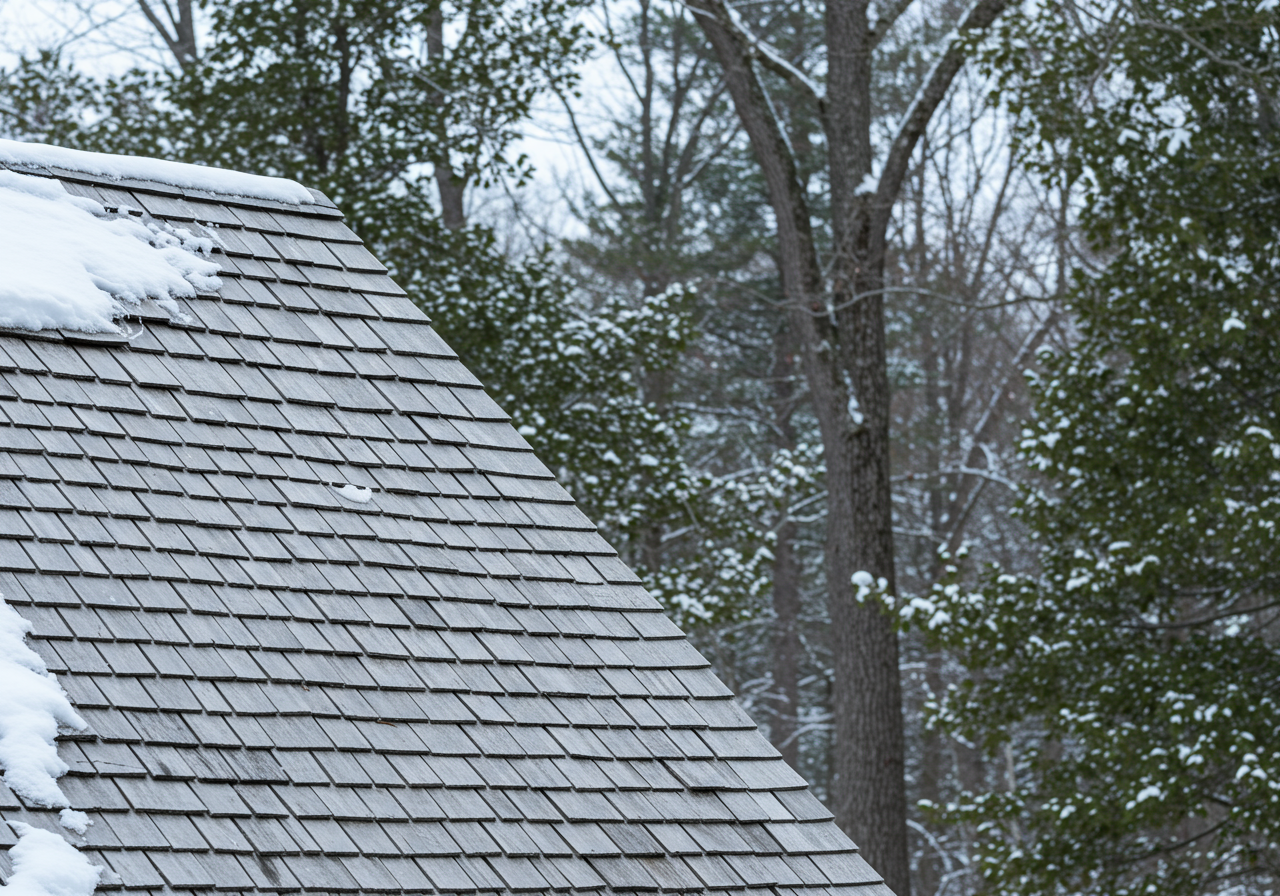
A classic cedar shake roof on a colonial home in Ashford, Connecticut
The natural beauty of cedar shakes, showing the characteristic silver-gray patina that develops over time.
The Ashford Microclimate: Why Your Location Dictates Material Survival
In my years tracking local weather patterns, I've noticed that Ashford behaves differently than, say, Manchester or even Willimantic. We sit in a pocket that tends to hold onto moisture longer. When the dew point hovers just below the air temperature on a foggy January morning, your roof isn't just cold—it's soaked. For a cedar shake roof, this is the danger zone. Cedar relies on "taper-sawn" air gaps to dry out. If your home is surrounded by those beautiful, towering oaks common in Tolland County, you're looking at a roof that stays damp for 18 hours a day.
I remember a project near Iron Mine Lane where the homeowner was adamant about natural white cedar. It looked incredible for exactly three seasons. But because the house sat in a hollow, the lack of airflow led to "cupping"—where the shakes curl upward like a dried leaf. Once that happens, the integrity of the water-shedding surface is compromised. In Ashford, the wind doesn't always whip through the valleys fast enough to dry out the wood after a heavy nor'easter. According to the NWS Historical Storm Events Database, Tolland County has seen a significant increase in "wet" snow events over the last decade, which places a heavier, more sustained moisture load on wooden roofing than the dry, powdery snow of the past.
The "Breathe" Factor in Wood Roofing
Wood needs to move. In the summer, it shrinks; in our damp winters, it expands. If a contractor nails these shakes too tightly, or if they don't use a "cedar breather" (a nylon matrix installed under the shakes), the wood will rot from the underside out. You won't even see the damage until a leak appears in your attic. This is why I always tell people that the installation method in Ashford is actually more important than the wood grade itself.
Did You Know?
Ashford's average humidity in the winter months is often 10% higher than the coastal regions of CT, meaning wood roofs here take significantly longer to dry between storms.
Comparing the Options: White Cedar vs. Red Cedar vs. Synthetics
Not all wood is created equal. Most Ashford homeowners are choosing between Eastern White Cedar and Western Red Cedar. White cedar is a local favorite because it silvers out beautifully and is naturally resistant to decay, but it's thinner and can be more prone to splitting during a deep Ashford freeze. Western Red Cedar is the "gold standard"—it's thicker, contains natural oils (tannins) that repel insects and rot, and holds its shape better. However, it comes with a price tag that can be 30% higher.
Then there's the "new kid on the block": synthetic cedar. These are made from polymers and recycled resins. From the street, you'd be hard-pressed to tell the difference. They don't rot, they don't host moss, and they carry a Class A fire rating. For many people in Tolland County, this is becoming the pragmatic choice. If you're tired of worrying about the weather, how our matching process works can help you find a pro who specializes in both natural and synthetic options so you can see the samples side-by-side.
Cedar Material Comparison for Ashford Homes
| Feature | Eastern White Cedar | Western Red Cedar | Synthetic Composite |
|---|---|---|---|
| Expected Lifespan | 20-25 Years | 30-40 Years | 50+ Years |
| Rot Resistance | Moderate | High | Immune |
| Initial Cost | Medium | High | High |
| Maintenance Needs | High | Moderate | None |
| CT Fire Code Ready | Requires Treatment | Yes (with treatment) | Yes |
The Real Story on Fire Ratings
Here is a bit of "inside baseball" that most people miss: Ashford is a volunteer fire department town. While we have excellent coverage, response times in the rural outskirts can be longer than in a city. Because of this, some insurance carriers in Connecticut are getting nervous about wood roofs. You might find that your premium jumps by $400 or $500 a year just for having a natural wood roof. Western Red Cedar shakes can be pressure-treated with fire retardants to achieve a Class A rating, which is what I strongly recommend if you're going the natural route.
The Maintenance Debt: What January Teaches Us
I have a folder of photos from Ashford inspections where the homeowners thought they were doing a great job, only to find a forest of "Lycogala" (slime mold) growing between their shakes. In our town, maintenance isn't optional. Every 3 to 5 years, you need to have the roof "soft washed"—never power washed, which destroys the wood fibers—to remove the lichen and moss that trap water.
If you let the moss take hold, it acts like a sponge, keeping the wood underneath perpetually wet. In January, that trapped water freezes, expands, and cracks the shake. It's a slow-motion demolition of your investment. I recently spoke with a specialist who noted that "the dew point tells you more than the thermometer" when it comes to wood health. If the air is saturated, that moss is actively drinking, even if it's 35°F outside.
Pros
- Unmatched natural aesthetic that increases curb appeal
- Excellent natural insulation (R-value) compared to asphalt
- Eco-friendly and biodegradable material
- Resistant to high winds during summer thunderstorms
Cons
- Significant maintenance requirements every few years
- Higher risk of moss and algae growth in shaded areas
- Potential for increased homeowner insurance premiums
- Higher initial installation cost ($15k - $30k+)
Finding the Right Hands for the Job
You cannot hire a general asphalt roofer to do a cedar job. The nailing pattern is different, the flashing requirements around Ashford's typical stone chimneys are unique, and the "starter course" needs to be perfect. Before you sign anything, verify that your contractor is actually licensed for this kind of specialty work. You can check their status directly on the CT eLicense portal to ensure they are registered as a Home Improvement Contractor in good standing.
Critical Installation Warning
Cost Breakdown: Investing in an Ashford Landmark
Let's talk numbers. A standard 2,500-square-foot roof in Ashford using high-quality asphalt shingles might run you between $10,500 and $14,000. For natural Western Red Cedar shakes, you are looking at a starting point of $24,800 and easily climbing to $38,000 depending on the "perfection" grade of the wood and the complexity of your roof's peaks and valleys.
Is it worth it? From a pure ROI (Return on Investment) standpoint, cedar is a luxury. You won't get 100% of that money back when you sell your house. However, for a historic home or a custom build near the Ashford Lake area, the aesthetic value is what defines the property. But you have to be honest with yourself: are you the kind of homeowner who will remember to schedule a roof treatment every four years? If the answer is no, you're better off with a high-end asphalt shingle or a synthetic.
"In Ashford, a cedar roof is a marriage, not a transaction. You have to commit to the upkeep, or the New England dampness will file for divorce within a decade."
The Longevity Gap
In a perfect world, a cedar roof lasts 40 years. In Ashford? If you don't clear the leaves off the valleys and don't treat the moss, you'll be lucky to get 18 years. I've seen it happen time and again. The freeze-thaw cycles we experience in Tolland County are particularly brutal on organic materials. When Hartford hits 45°F, adhesives in asphalt might relax, but wood is still busy soaking up the melted snow. If you're ready to see what the actual market rate is for your specific home, you can get an instant roof estimate to start comparing those numbers against your budget.
Noah's Seasonal Advice
Frequently Asked Questions
Making the Final Call for Your Ashford Home
Deciding on a cedar roof is a balance between your heart and your ledger. Yes, it is the most beautiful roofing material available in Connecticut, and it fits the Ashford aesthetic perfectly. But it demands respect. If you're willing to invest in the material and the ongoing maintenance, it will reward you with a home that stands out in the neighborhood for decades.
If you're still on the fence, I recommend looking at some of the modern synthetic options. They offer the look without the "January anxiety." Whatever you choose, make sure you're working with a team that understands the specific challenges of our Tolland County climate. Don't let a "fair weather" contractor talk you into a material that isn't suited for your specific lot's shade and moisture levels.
Get Your Free Roof Quote
Enter your zip code to get started