
Key Takeaways
- Document everything before removing the tree—photos of interior cracks, window alignment, and attic damage can turn a $1,200 spot repair into a $9,400 structural claim.
- Tree removal costs are often capped at $500-$1,000, but if the tree is on your structure, extraction costs may be covered under dwelling coverage instead.
- In Connecticut, fallen trees are almost always considered 'Acts of God'—your insurance covers it, not your neighbor's, unless you can prove the tree was dead and you warned them in writing.
- Structural decking damage is often missed—demand a moisture probe or pull test to ensure the plywood underneath isn't compromised.
If you live out near the Salmon River State Forest or in one of those heavily wooded neighborhoods off Route 149, you know that a "thump" in the night during a January windstorm is enough to make your stomach drop. It's a sound every Colchester homeowner fears. But here is the cold truth: the tree hitting your roof is only the first disaster. The second disaster happens three weeks later when your insurance company sends a check that covers the shingles but ignores the structural trauma underneath.
I've seen this play out dozens of times. A homeowner sees a limb through the roof, panics, and calls a tree service to "get it off now." By the time the adjuster shows up, the evidence is in wood chips and the roofer is left trying to explain why the rafters are out of alignment. If you want to avoid eating $4,000 in "hidden" repair costs, you need to treat your roof like a crime scene. Put the phone down, grab your boots, and let's look at the math of a fallen tree.
1. The Immediate "Audit" Before the Chainsaws Arrive
Your insurance company's favorite phrase is "pre-existing condition." If you remove that oak limb before documenting how it punctured your ridge vent, they will try to claim the sag in your roof was already there. You need a folder of evidence before a single leaf is moved. Take photos from the ground, from the attic, and—if it's safe—from a ladder. You aren't just looking for broken shingles; you are looking for "displacement."
When a tree hits a house in New London County, the force is often lateral. It's not just a weight sitting there; it's a hammer blow. Look for cracks in the drywall of the ceiling below the impact. Check the windows in that part of the house—do they still open smoothly? If they stick, the frame has shifted. That is a structural claim, not a simple shingle patch. Documenting these secondary signs of impact is how you move a claim from a $1,200 "spot repair" to a $9,400 structural restoration.
2. Separating Tree Removal from Roof Repair Costs
Here is where the math gets messy. Most homeowners assume "it's all one claim." In reality, your policy likely has a specific sub-limit for "Tree Debris Removal." In Connecticut, I often see this capped at $500 or $1,000 per tree. However, there is a loophole: if the tree is on the structure, the cost to get it off the house is usually part of the dwelling coverage (which has a much higher limit) rather than the debris removal limit.
I once worked with a family near the Bacon Academy area who got hit with a $2,800 bill for a crane to lift a pine off their garage. The insurance company tried to cap the payout at $500. We had to prove the crane was "mitigating further damage" to the roof deck to get the full amount covered. Always ask your tree contractor to split their invoice: one line for "Extraction from Structure" and one line for "Haul Away." This simple clerical move can save you $1,500 out of pocket. To get ahead of these numbers, you should get an instant roof estimate to understand what the actual construction portion will cost before the adjuster dictates the price.
Dana's Documentation Checklist
3. The "Act of God" Myth and Your Deductible
I hear this every season: "My neighbor's tree fell on my house, so his insurance pays for it, right?" Wrong. In 95% of cases in Connecticut, if a healthy tree falls due to wind, it is considered an "Act of God," and your own insurance covers it. You are on the hook for your deductible—usually $1,000 or $2,500. The only way your neighbor pays is if you can prove the tree was dead or rotting and you had previously warned them in writing (certified mail is the gold standard here).
Don't waste time arguing with the guy next door while water is pouring into your attic. File the claim with your carrier and let them "subrogate" (chase the neighbor's insurance) if they think there's a case. While you wait, check your policy for "Law and Ordinance" coverage. If your Colchester home was built before the latest building codes were adopted, this coverage pays for the extra costs to bring your entire roof up to current CT code during the repair. This can be the difference between getting 2026-standard flashing or a 1980s-style patch job.
4. Assessing Structural Decking vs. Surface Damage
Shingles are just the skin. The plywood underneath—the decking—is the muscle. When a limb hits, it can "star fracture" the plywood. You might not see a hole, but the structural integrity is gone. If a roofer just nails new shingles over cracked plywood, those nails will eventually "pop" as the wood expands and contracts. Within two winters, you'll have a leak in the exact same spot.
If your home has any flat or low-slope sections, like a porch or a modern addition, the damage assessment is even more critical. According to FEMA's guide on low-slope roof systems, these areas are highly susceptible to "hidden ponding" after an impact. If the tree creates even a slight depression in a flat roof, water will sit there, eventually rotting the entire section. Demand that your contractor perform a "moisture probe" or a "pull test" on the decking to ensure it's still solid.
Spot Repair vs. Full Section Replacement
| Feature | Spot Repair | Section Replacement |
|---|---|---|
| Waterproof Integrity | ||
| Warranty Coverage | ||
| Insurance Likelihood | ||
| Resale Value |
5. Emergency Tarping and the "Fair Price" Trap
January in Colchester isn't exactly prime roofing weather. You're likely going to need an emergency tarp. Be extremely careful here. I've seen "storm chasers" charge $2,500 for a 10-minute tarp job using a $40 blue tarp from the hardware store. Most insurance companies consider $500 to $900 "reasonable and customary" for an emergency tarp. If a contractor asks for more, make them justify it in writing—was there a steep pitch? Was it 2:00 AM?
And for the love of your bank account, do not sign a "Direction to Pay" or an "Assignment of Benefits" (AOB) form just to get a tarp put on. This gives the contractor the right to collect your entire insurance check directly. You lose all your leverage. Tell them you'll pay for the tarping service in cash or credit and you want a receipt to submit for reimbursement. Keeping the money in your hands ensures the final roof repair is done to your standards, not theirs. You can always connect with verified contractors who understand how to work within insurance "reasonable" limits without holding your check hostage.
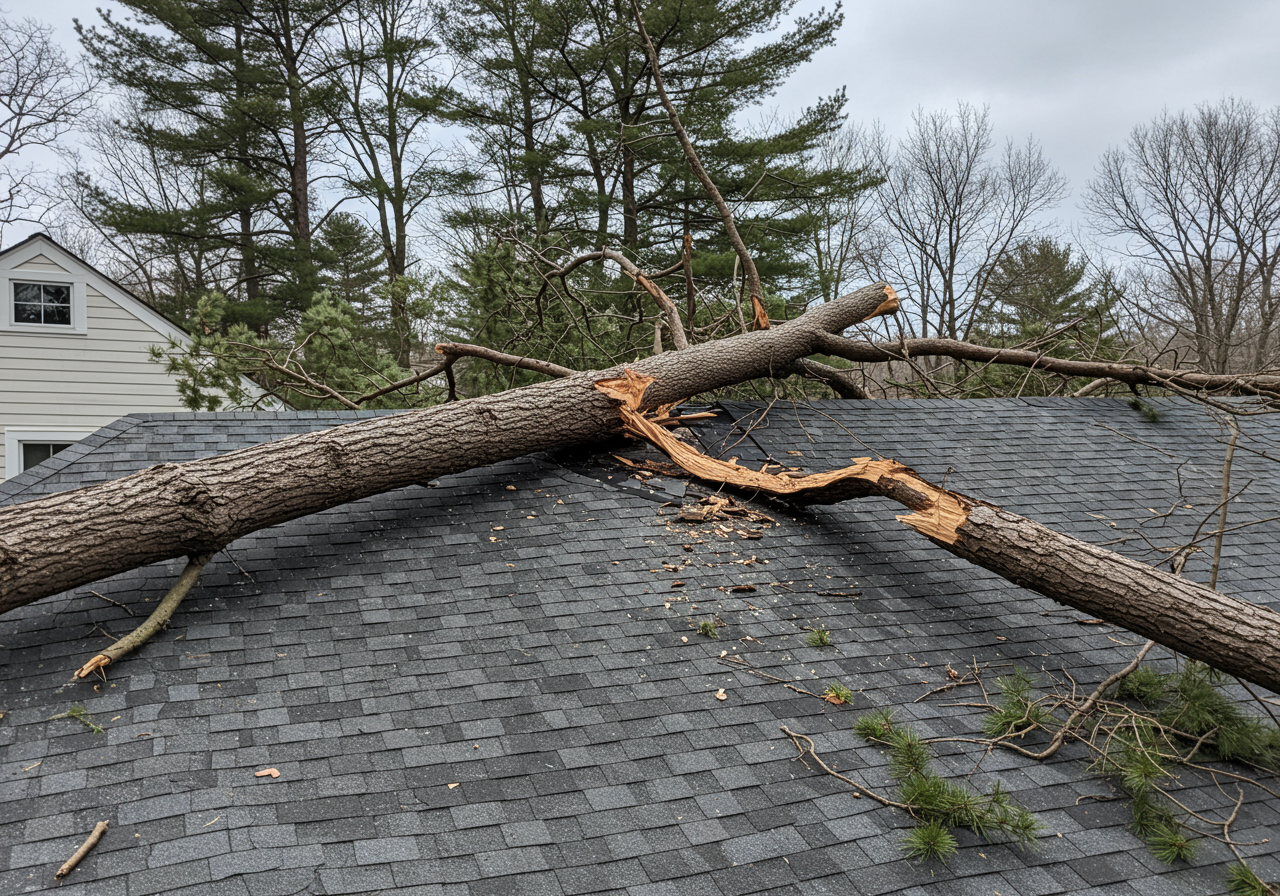
A fallen tree limb on a gray shingle roof in a wooded area
In Colchester, the weight of the tree isn't the only issue; the impact can fracture the underlying roof deck.
6. Negotiation Scripts for Your Insurance Adjuster
When the adjuster shows up, don't just point at the hole. You need to lead the tour. They are often coming from out of state and don't know the specific snow load requirements for New London County. Use these phrases to make sure they know you've done your homework:
- "I've documented the interior drywall cracks which indicate a structural shift. I'd like to see the allowance for a structural engineer's inspection in the estimate."
- "The impact fractured the decking, not just the shingles. A shingle-only repair won't meet CT building code for a continuous load-bearing surface."
- "Since this shingle line is discontinued, a patch will result in a 'non-uniform' appearance. I'm requesting a full slope replacement to maintain the home's pre-loss value."
Remember, if you are upgrading your materials during the repair—say, moving to a more energy-efficient shingle—keep your receipts. As noted in the IRS instructions for Form 5695, you may be eligible for residential energy credits on the material cost of the upgrade, even if insurance is paying for the base repair.
Filing a Claim vs. Paying Out of Pocket
Pros
- Covers expensive structural repairs
- Pays for professional tree removal
- May cover interior water damage
Cons
- Deductible can be $1,000+
- Potential for premium increases
- Lengthy appraisal process
A tree through the roof is a chaotic mess, but don't let the urgency of the moment trick you into a bad financial deal. Colchester has plenty of reputable pros, but they can't help you if you've already signed away your rights to an out-of-town "storm chaser." Take the photos, get the line-item math for the tree removal, and don't accept the first lowball check the insurance company dangles in front of you. You pay your premiums for a reason; make sure you get the full value of that protection when the oaks start falling.
Get Your Free Roof Quote
Enter your zip code to get started
Frequently Asked Questions
Need a Professional Assessment?
Don't guess at the damage. Get an instant, line-item estimate for your roof repair from verified Colchester contractors.
No credit card required • Free to use