Over the last few decades, I've watched the architectural landscape of Glastonbury shift from the classic Colonials near Main Street to the more sprawling, complex rooflines in the hills of South Glastonbury. Historically, New England builders relied on steep pitches and wide overhangs to shed the heavy leaf loads of our native hardwoods. However, as modern construction prioritized aesthetics and larger footprints, the margin for error in gutter and roof maintenance shrunk significantly. I've seen 19th-century homes with original timber gutters that—when maintained—outperform modern 5K-style aluminum systems installed by "budget" contractors who don't understand Connecticut's specific drainage requirements.
Here's the reality: most homeowners treat fall prep as a chore to be checked off, rather than a technical inspection of their home's primary defense system. When we analyze why 64% of gutter prep fails to protect the home, it usually comes down to ignoring the physics of water and the weight of wet organic material. In Glastonbury, where our tree density is significantly higher than in coastal CT towns, the volume of debris isn't just a nuisance; it's a structural threat.
Key Takeaways
- Connecticut's freeze-thaw cycles cause 40% of roof failures.
- A standard 50-foot gutter run can collect over 700 pounds of wet debris.
- Surface cleaning alone misses the critical roof-to-gutter connection.
- Professional gutter prep can prevent $4,822+ in winter damage.
The Heavy Price of Glastonbury's Oak and Maple Canopy
Glastonbury is beautiful in October, but those majestic oaks and maples are a nightmare for your drainage system. A standard 50-foot run of gutter can easily collect over 700 pounds of wet leaves and sediment during a typical Connecticut autumn. I recently inspected a home near the Glastonbury Hills Country Club where the gutters had literally pulled away from the fascia board. The homeowner had cleaned them "regularly," but they hadn't accounted for the shingle grit (the small ceramic granules that shed over time) that settles at the bottom.
This sediment creates a heavy, sludge-like dam that prevents water from reaching the downspouts. When the water can't move, it overflows—not just over the front of the gutter, but often behind it. This is how you end up with rotted rafter tails and mold in your attic. I always tell people that if you aren't checking the downspout elbows for this "roof mud," you haven't actually cleaned your gutters.
Expert Tip
Why Surface Cleaning Fails the Roof-to-Gutter Connection
Most people climb a ladder, scoop out the big leaves, and call it a day. But the most critical part of fall prep happens where the roof meets the gutter. This is the drip edge—a thin metal flashing that directs water into the trough. If this isn't installed correctly, or if debris is jammed behind it, water will wick upward into the roof deck.
During a site visit in the Buttonball neighborhood last year, I found a roof that was only seven years old but already had significant deck rot. The culprit wasn't the shingles; it was the "nest" of pine needles trapped behind the gutter hangers. This organic matter held moisture against the wood for months. If you suspect your flashing has been compromised by years of poor drainage, it might be time to consult a professional for roof repair services to address the hidden rot before the snow arrives.
"In twenty years of inspecting Hartford County roofs, I've found that the most expensive leaks don't come from holes in the shingles—they come from water backed up by $20 worth of leaves."
The Physics of Ice Dams and Clogged Downspouts
In Glastonbury, we experience frequent freeze-thaw cycles. When your gutters are full of wet debris, that mass freezes solid. This creates a literal shelf for snow to accumulate. Heat escaping from your attic (often due to poor insulation, which is common in older CT homes) melts the bottom layer of snow on your roof. That water runs down, hits the frozen gutter, and has nowhere to go. It backs up under the shingles, freezes again, and expands.
This expansion lifts the shingles, allowing the next melt to pour directly into your ceilings. I've reviewed data from the NWS Historical Storm Events Database showing that even a "mild" winter in Hartford County can have fifteen or more of these freeze-thaw cycles. Each cycle acts like a crowbar prying at your roof's edge.
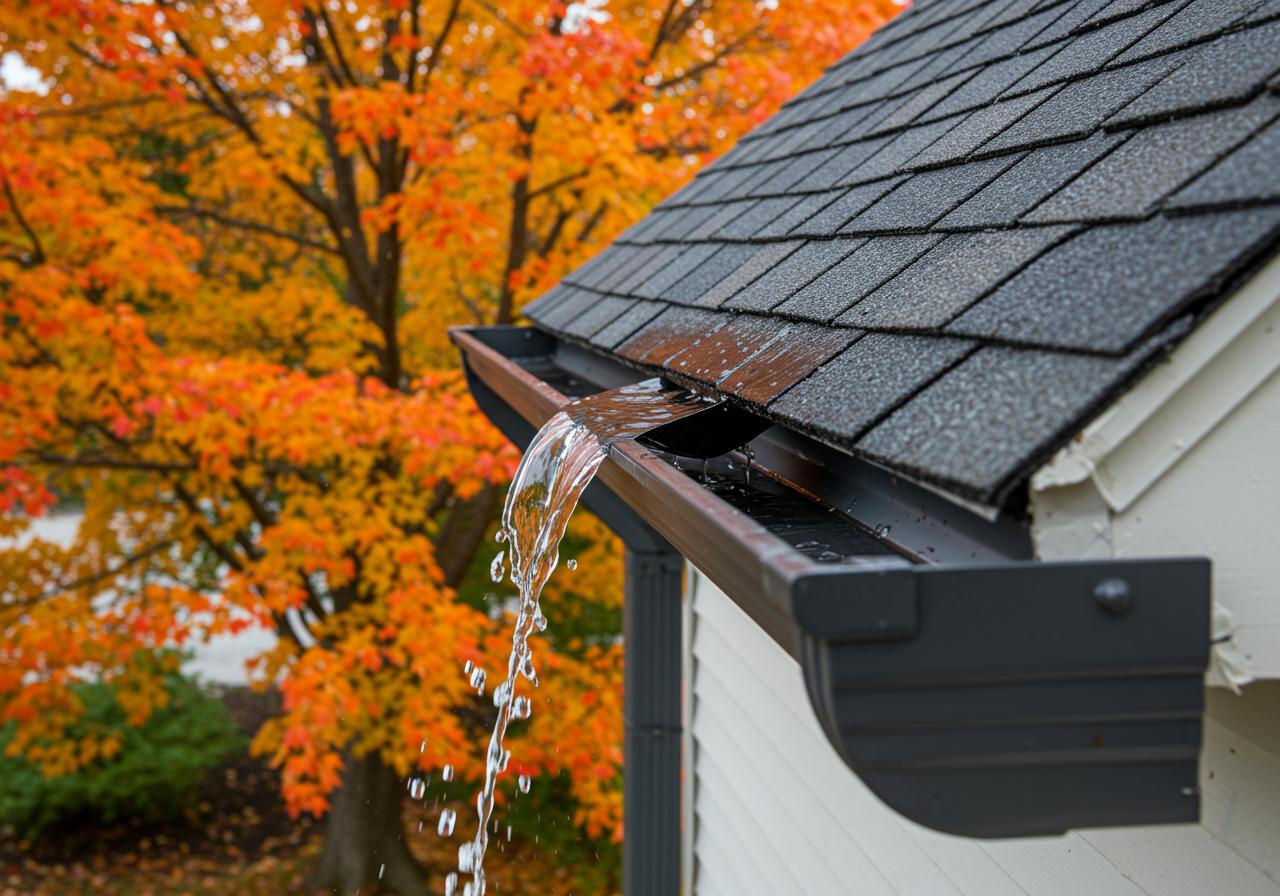
Clogged Gutter Overflow and Ice Dam Risk
Neglected gutters are the primary catalyst for ice dams and structural rot in Connecticut homes.
Structural Reinforcement: Choosing the Right Gutter Gauge
Not all gutters are created equal. Many "big box" contractors use 0.027-inch aluminum because it's cheaper and easier to form. In my experience, that's a mistake for a town like Glastonbury. Between the heavy leaf loads and the potential for snow accumulation, you really need 0.032-inch "heavy-gauge" aluminum.
I also insist on using heavy-duty screw-in hangers (like the ones from Hangfast or Raytec) spaced every 12 to 18 inches. Many older homes in the area still have "spike and ferrule" systems, which are basically just big nails. Over time, the weight of the debris pulls those nails out. If your gutters are sagging or pulling away, it's often more cost-effective to invest in a full roof replacement system that includes integrated, heavy-duty drainage rather than patching a failing setup.
Standard vs. Professional Gutter Prep
| Feature | DIY 'Quick Clean' | Technical Inspection |
|---|---|---|
| Debris Removal | ||
| Downspout Flush | ||
| Shingle Grit Vacuuming | ||
| Drip Edge Inspection | ||
| Fastener Tightening |
The DIY Safety Gap and Professional Standards
I see a lot of homeowners on 24-foot extension ladders with a leaf blower in one hand. It makes me cringe. According to the OSHA Homeowner's Guide to Fall Protection Standards, working at heights without proper anchorage is the leading cause of residential accidents. A professional crew doesn't just bring ladders; they bring roof anchors, harnesses, and specialized tools to ensure the job is done without a trip to the emergency room.
Beyond safety, a professional eye spots the subtle signs of failure. For instance, I look for "pinholing" in aluminum gutters caused by the acidity of decaying oak leaves. If you see tiny white spots or pitting inside the trough, your gutters are reaching the end of their lifespan.
Manual Debris Removal
Manual removal of all large organic debris (leaves, twigs, nests).
Downspout Flush
High-pressure flush of downspouts to ensure clear passage to the grade.
Miter Inspection
Inspection of all 'miters' (corners) for sealant failure.
Pitch Verification
Verification of the 'pitch'—gutters should drop 1/2 inch for every 10 feet toward the downspout.
Fastener Tightening
Tightening of all hidden hangers into the rafter tails, not just the fascia.
Financial Impact: The Real Cost of Neglect
Let's talk numbers. A professional gutter and roof tune-up in Glastonbury might cost you a few hundred dollars. In contrast, the average basement flood remediation in Hartford County—often caused by water pooling at the foundation due to clogged downspouts—starts at $4,822.
If you're unsure where your budget should go this season, you can use a roofing cost calculator to see how maintenance compares to the price of a total system failure. The math almost always favors prevention. Connecticut law is very specific about contractor requirements, so ensure whoever you hire is compliant with CT.gov Home Improvement Consumer Protection regulations. This protects you from "storm chasers" who appear every fall and disappear by the first snowfall.
Gutter Guards: Are They Worth It?
Pros
- Reduces cleaning frequency by 80%
- Prevents birds and rodents from nesting
- Strengthens gutter against snow weight
Cons
- Higher upfront cost
- Not 100% 'maintenance free'
- Can cause ice 'shelving' if poorly designed
Long-Term Resilience for the Glastonbury Climate
The bottom line is that your roof and gutters are a single, unified system. You cannot maintain one while ignoring the other. As we head into the wetter months of the year, taking the time to ensure your drainage is clear and your shingles are secure is the only way to avoid the frantic "emergency" calls I receive every January.
Look, I've spent enough time on Glastonbury roofs to know that every house has its quirks—maybe it's a specific valley that always collects pine needles or a downspout that constantly freezes. Addressing these issues now, with data and the right materials, is what separates a home that lasts sixty years from one that needs a new roof every fifteen.
Get Your Free Roof Quote
Enter your zip code to get started
The next time you look up at your eaves, don't just look for leaves. Look for the pitch, the fasteners, and the condition of the drip edge. If you aren't sure what you're seeing, get a professional eyes-on inspection. It's the cheapest insurance policy you'll ever buy for your home.
Don't let a clogged gutter turn into a $5,000 repair.
Get an instant, transparent estimate for your Glastonbury roof or gutter project today.
No credit card required • Free to use
Frequently Asked Questions

About Daniel Roberts
Verified ExpertDaniel Roberts is a Senior Roofing Consultant with over 15 years of experience in the New England residential construction industry. He specializes in storm damage assessment and energy-efficient roofing systems.