Looking out over the Niantic River Bridge on a gray February morning, it's easy to think about how much the salt air and coastal wind batter our homes here in East Lyme. But what's harder to stomach is the phone call I got last week from a homeowner near Gorton Pond. They had clear wind damage from a January nor'easter, yet their insurance company offered a payout that wouldn't even cover the cost of the dumpster, let alone the shingles.
Here's the reality: insurance companies are in the business of keeping their money, and homeowners are often in the dark about what they're actually entitled to. I've spent over 14 years looking at these "adjuster summaries," and I can tell you that the first offer is rarely the final word. In East Lyme, where our roofs face a unique cocktail of high humidity and sudden winter gusts, a "standard" claim often misses the nuances of local building requirements. If you're staring at a leak in your ceiling and wondering if you should call your agent or a contractor first, you're in the right place. We're going to look at the math, the policy traps, and how to make sure you aren't left holding a $12,450 bill for a "covered" loss.
Key Takeaways
- Insurance companies' first offer is rarely the final word—supplements can increase payouts by thousands.
- RCV policies pay full replacement cost minus deductible; ACV policies pay depreciated value, leaving huge gaps.
- Having a contractor present during adjuster inspection increases claim payouts by an average of 27%.
- Never sign an Assignment of Benefits (AOB) form without legal review—it gives contractors control over your insurance money.
The "Free Roof" Myth and the East Lyme Storm Chaser
Every time a storm rolls through New London County, the "storm chasers" follow. You've seen them—unmarked trucks with out-of-state plates knocking on doors in Flanders or Niantic, promising a "completely free roof" and claiming they can "waive your deductible." Let's be incredibly clear: in the state of Connecticut, it is illegal for a contractor to pay, waive, or "absorb" your insurance deductible. It's considered insurance fraud. If a contractor suggests this, they are likely cutting corners on your materials or labor to make up that $1,000 or $2,500 difference.
I recently helped an East Lyme family who fell for a high-pressure pitch. The contractor promised to handle everything, but when the insurance check arrived for $9,842, the contractor suddenly "discovered" $4,000 in extra repairs that weren't in the original estimate. Because the homeowner hadn't checked the Better Business Bureau's roofing guidelines or vetted the company, they were stuck with a half-finished roof and a legal headache.
Before you even let someone on your ladder, you need to understand that a "free" roof doesn't exist. You are responsible for your deductible—that's your skin in the game. Your goal shouldn't be "free"; it should be "fully restored to code." I always tell people to look for contractors who have a permanent physical address in Connecticut. If they don't have a local reputation to protect, they won't care if your roof leaks again by the time the Fourth of July fireworks go off at McCook Point Park.
Assignment of Benefits Warning
Decoding the Math: RCV vs. ACV Payouts
When you pull your policy out of the junk drawer, look for two acronyms: RCV and ACV. This is where most East Lyme homeowners get a "sticker shock" that ruins their month. Replacement Cost Value (RCV) means the insurance company pays what it actually costs to buy a new roof today, minus your deductible. Actual Cash Value (ACV) means they pay you what your old, beat-up roof was worth *right now* after years of depreciation.
Let's look at a real-world comparison for a typical 2,200-square-foot colonial in the Giants Neck area. If that roof is 15 years old and gets hit by a falling limb, the math changes dramatically based on those three little letters.
RCV vs. ACV Payout Comparison (15-Year-Old Roof)
If you have an ACV policy, you aren't getting a new roof; you're getting a coupon for half a roof. I've seen homeowners try to bridge that $8,620 gap using high-interest credit cards, which is a financial disaster. Instead, you need to know your "cash price" before you even talk to the insurance company. Using a roofing cost calculator can help you set a baseline expectation so you know if the adjuster's numbers are even in the same zip code as reality.
I remember a case in 2024 where the adjuster "forgot" to include the cost of removing the second layer of old shingles. That's a $1,200 line item they just left out. If the homeowner hadn't known the math, they would have been stuck paying that out of their own pocket. Always ask for the "unit price" for things like plywood decking and flashing—don't just accept a lump sum.
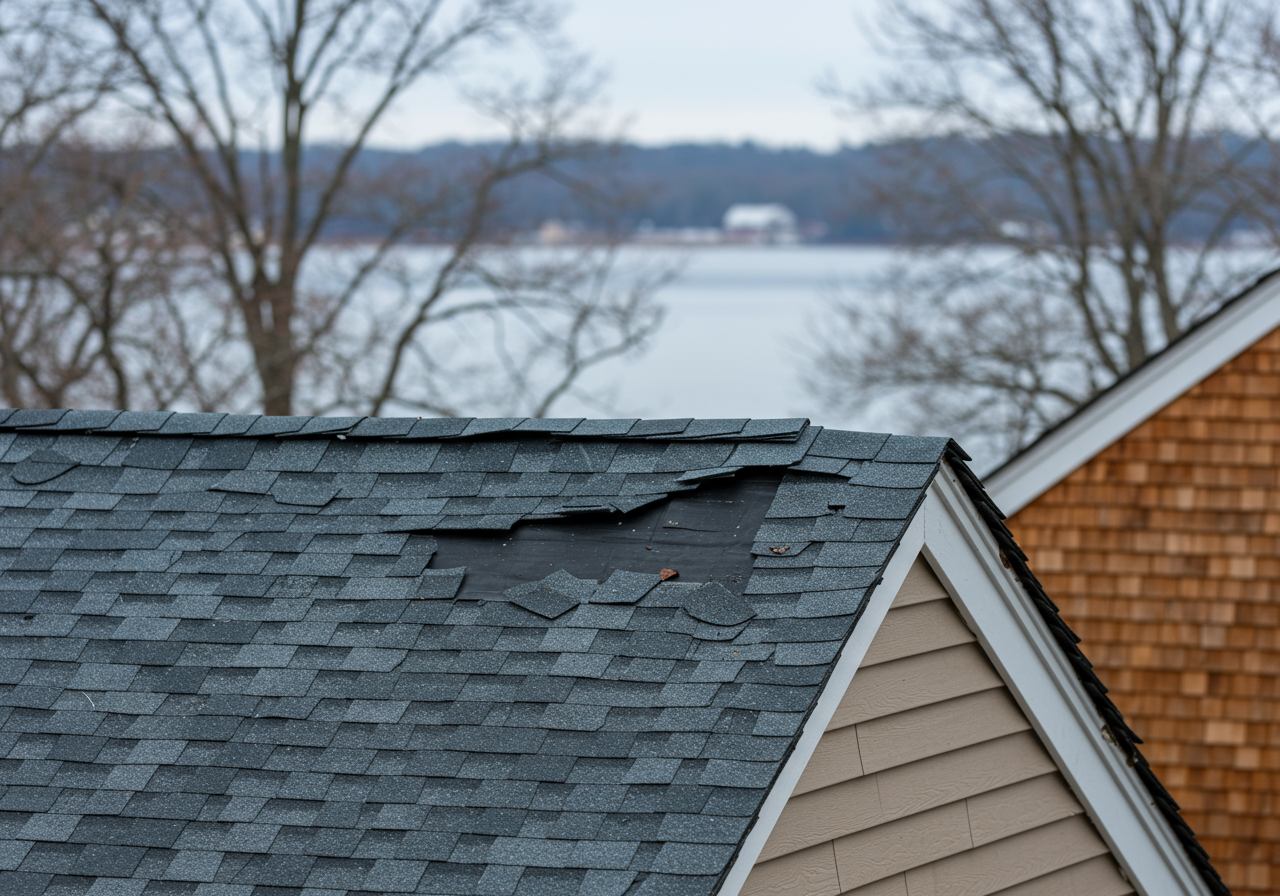
Typical Storm Damage in East Lyme
High winds off the Sound often lift shingles without tearing them off completely—a 'hidden' damage that adjusters frequently miss during quick inspections.
The Secret Language of Adjusters and How to Speak It
Adjusters use software called Xactimate to price out your claim. It's a database that's supposed to reflect local market costs, but in a specialized market like Southeast Connecticut, those numbers are often six months behind. When an adjuster walks your roof, they are looking for "bruises" (hail) or "creases" (wind). If they don't see those specific markers, they'll call it "wear and tear" and deny the claim.
But here's what they don't tell you: they are often on a tight schedule. They might spend 15 minutes on your roof and miss the rusted flashing around your chimney or the delaminating plywood in your valleys. If you have an active leak, you need emergency roofing services to tarp the area immediately. Insurance companies expect you to "mitigate" the damage. If you let a small leak turn into a mold colony in your attic because you were waiting for the adjuster, they can deny the interior damage portion of your claim.
I always suggest having your own contractor present when the adjuster arrives. It's a lot harder for an adjuster to ignore a creased shingle when a professional is standing right there pointing at it with a chalk marker. I've seen "denied" claims turn into "full replacements" just because the contractor pointed out that the shingle was no longer manufactured and couldn't be repaired. In insurance lingo, this is called "un-repairability," and it's a powerful tool in your arsenal.
The Step-by-Step Filing Process Without the Headaches
Filing a claim feels like a part-time job you never applied for. You have to juggle phone calls, emails, and the constant fear that you're saying the wrong thing. One wrong word—like saying your roof has been "leaking for years" instead of "started leaking after the storm"—can result in an immediate denial based on "pre-existing conditions."
Before you pick up the phone, do your homework. You need to know that the person you eventually hire is actually legal. You should verify their license via the CT eLicense portal to ensure they are a registered Home Improvement Contractor (HIC). I've seen East Lyme residents hire "handymen" for insurance jobs, only to find out the insurance company won't pay because the person isn't properly insured or licensed for roofing.
Document everything
Take photos of the damage, the interior leaks, and any debris on the ground.
Call a local pro
Get an independent inspection to confirm the damage is storm-related, not just old age.
File the claim
Contact your agent with the specific date of the weather event (e.g., the February 2nd windstorm).
The Adjuster Meeting
Ensure your chosen contractor is there to walk the roof with the insurance representative.
Review the Summary
Check every line item. Did they include the ridge vents? The drip edge? The permit fees?
Supplementing
If the cost to build is higher than the payout, have your contractor submit a 'supplement' for the difference.
I once worked with a homeowner near the high school who was told their permit fees weren't covered. We pulled the policy language, showed them the "Ordinance and Law" coverage, and forced the insurance company to cough up the extra $350 for the town permits and the $1,200 for the required code upgrades. It pays to be "annoyingly" thorough.
Handling the "Matching Shingle" and Code Upgrade Trap
This is the biggest hurdle for East Lyme homes built in the 90s or early 2000s. Let's say a tree limb falls and destroys 15% of your roof. The insurance company wants to pay for just those 15%. But guess what? That specific shade of "Weathered Wood" or "Slate" from 2004 isn't made anymore. Or, the remaining shingles are so brittle that if a roofer tries to patch them, they'll break the surrounding ones.
In Connecticut, we have strict adherence to the International Code Council (ICC) building codes, which govern how a roof must be constructed. If a repair cannot be made to code, or if the result is a "mismatched" eyesore that devalues your property, you may be entitled to a full replacement. Some policies have "matching endorsements," but even without them, we often argue that a partial repair is not a "functional restoration."
The Code Upgrade Reality
I had a client in the Brightwater neighborhood whose adjuster insisted on a patch. We sent a sample of the shingle to an independent lab (it costs about $100), and the lab confirmed the shingle was no longer in production. Armed with that report and the local building code requirements, the "partial repair" turned into a $16,400 full replacement within 48 hours. Don't let them tell you a "close match" is good enough for your biggest investment.
Why Professional Matching Changes the Insurance Game
The paperwork involved in a claim is designed to be exhausting. You get an "Initial Payment" (the ACV), and then you have to "Recover the Depreciation" (get the rest of the money) once the job is finished. Many homeowners forget that second check or don't know how to file the "Certificate of Completion" to get it.
This is why I'm such a proponent of the ZikQuote model. Instead of you hunting for a contractor who *might* understand insurance, the system matches you with verified local roofing professionals who handle this paperwork every single day. They know how to write "supplements" for things like steep-slope charges or double-layer tear-offs that the insurance company "forgot" to include.
I've seen East Lyme residents save thousands simply because their contractor knew how to document "hidden" damage under the shingles. When you have a professional who speaks the language of adjusters, you stop being a "claim number" and start being a homeowner who is getting their house put back together correctly.
"The insurance adjuster works for the insurance company. You need someone on your side who knows the difference between a 'cheap fix' and a 'code-compliant restoration.' Don't leave your roof's integrity to a software algorithm."
If you're sitting there looking at a water stain on your ceiling or a pile of shingles in your yard after the last windstorm, don't panic. But don't wait, either. The longer you wait, the easier it is for the carrier to claim the damage was caused by "neglect" rather than a sudden event. Get your numbers, get your photos, and get a professional in your corner.
Get Your Free Roof Quote
Enter your zip code to get started
The Bottom Line: Insurance claims in East Lyme don't have to be a battle, but you do have to be prepared for one. Make sure you check your policy for RCV coverage, never accept the first lowball offer, and always—always—insist on a contractor who knows the local CT building codes inside and out. Your home is your sanctuary; make sure the insurance company treats it that way.
FAQ

About Dana Jackson
Verified ExpertDana Jackson is a Homeowner Advocate & Cost Analyst who helps Connecticut families navigate the financial aspects of roofing projects. She specializes in finding the best value and avoiding common pricing pitfalls.