Key Takeaways
- Act within the first 12 hours: document damage for insurance and to limit secondary water damage.
- Safety first: never climb a wet or wind-damaged roof; professional tarping is the safe temporary fix.
- Verify before you hire: use the CT eLicense portal to confirm your emergency contractor is registered in Connecticut.
- Think beyond the patch: use the moment to judge whether your roof still protects your home’s value.
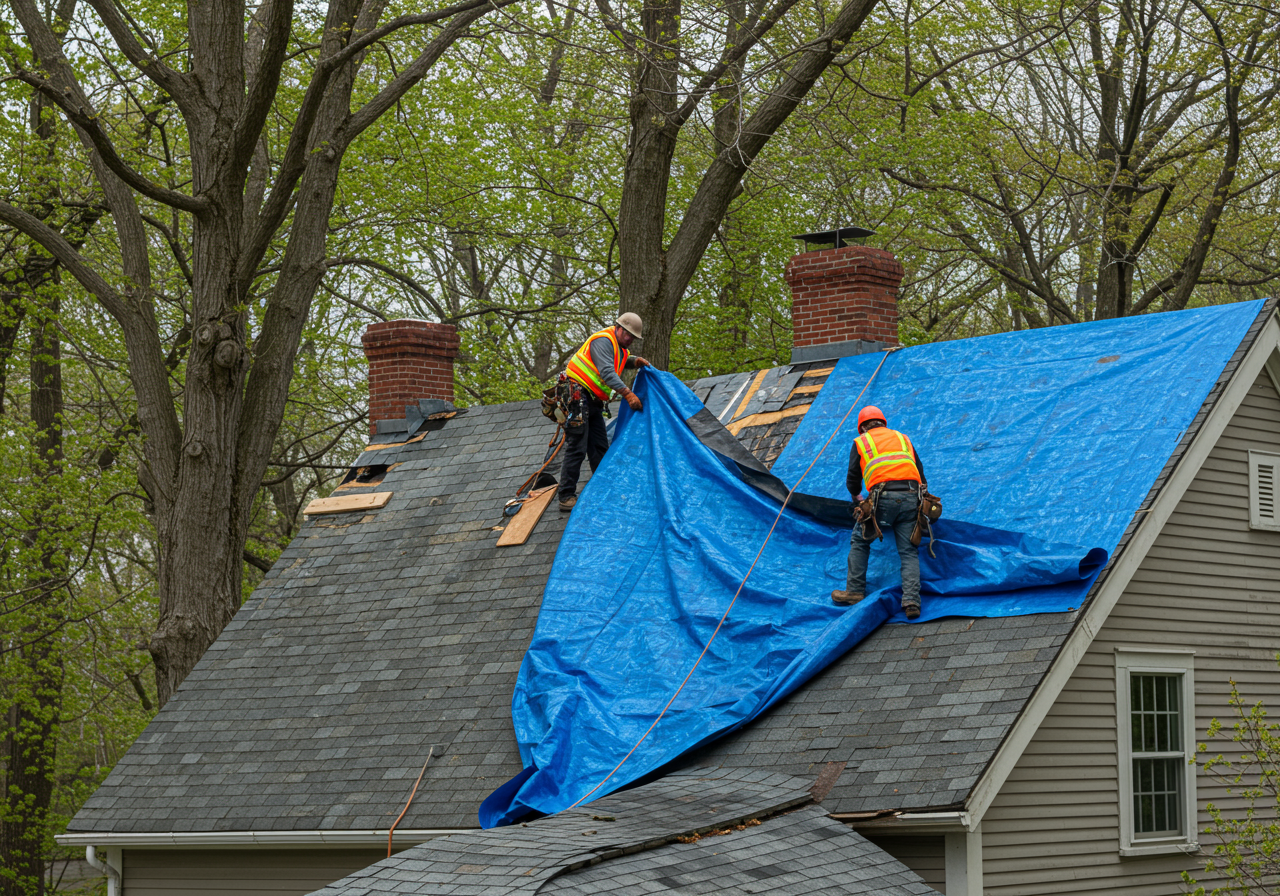
Emergency Storm Repairs in Windham County
Tarping, documentation, and vetting pros after wind and hail keep Brooklyn homes dry and claims on track.
It happens in a heartbeat. You're sitting in your living room in Brooklyn—maybe catching up on a book while the rain drums against the glass—and then you hear it. Not the rhythmic thrum of a spring shower, but a rhythmic plink, plink, plink inside the house. That sound is enough to make any homeowner's heart skip a beat. In the "Quiet Corner" of Connecticut, we're used to our fair share of unpredictable weather, but nothing quite prepares you for the moment your roof decides it's had enough of the elements.
Brooklyn homeowners face a specific kind of pressure when a storm rolls through Windham County. Because we're tucked away in a more rural, scenic part of the state, getting a qualified contractor to show up on short notice can feel like winning the lottery. You aren't just dealing with a few missing shingles; you're racing against the clock to prevent water from ruining your insulation, your drywall, and those hardwood floors you worked so hard to refinish. The reality is that an emergency repair isn't just about a hammer and nails—it's about managing a minor crisis before it becomes a five-figure disaster.
The Midnight Panic: Immediate Steps When a Leak Starts
I remember a call I got from a friend over near the Brooklyn Fairgrounds a few years back. A massive limb had come down during an April gale, and she was frantic. Her first instinct was to grab a ladder and a blue tarp she had in the garage. I told her exactly what I'll tell you: stay off the ladder. A storm-damaged roof is structurally unpredictable, and a wet roof is a skating rink. Your priority isn't fixing the hole at 11:00 PM; it's containing the mess inside.
The first thing we always suggest is the "bucket and pin" method. If you see a bulge in your ceiling where water is pooling, don't just let it sit there. Take a small nail or a screwdriver and poke a tiny hole in the center of that bulge. It sounds counterintuitive to make a hole in your ceiling, but it directs the water into a single stream you can catch in a bucket. This prevents the water from spreading horizontally across your ceiling joists and causing a massive collapse.
Once the interior is "stable," start your paper trail. Insurance companies are much easier to deal with when you have clear, timestamped evidence. Take photos of the leaking ceiling, the soaked carpets, and—if you can do it safely from the ground—any visible damage to the roofline. I've seen claims get held up for weeks simply because the homeowner waited until things dried out to take pictures.
Storm chasers in Windham County
Evaluating the Exterior: What Did the Storm Actually Do?
After the clouds clear and the sun pops out over Route 6, it's time for a sober look at the exterior. In Brooklyn, our homes range from beautiful 19th-century colonials to modern raised ranches, and each reacts differently to wind and hail. You might see what looks like "granule loss"—those tiny sand-like particles from your shingles filling up your gutters. While it doesn't look like an emergency, it's actually a sign that the protective layer of your shingle has been sandblasted away, leaving the asphalt core vulnerable to UV damage.
Then there's the obvious stuff: lifted shingles, torn flashing around the chimney, or the dreaded "tree-to-roof" contact. I once looked at a house near Quinebaug Lake where the homeowner thought they just had a few loose shingles. When we looked closer, the wind had actually "scalloped" the entire windward side, lifting the tabs just enough to break the sealant strip. They weren't missing, but they were no longer waterproof.
When you're looking at the damage, you have to decide if you're looking at a localized fix or something bigger. If the storm was particularly nasty, you might find yourself bringing in a pro for a tight, code-aware patch rather than trying a DIY fix that might fail during the next afternoon thunderhead. According to the NWS Storm Events Database, Windham County has seen a significant uptick in localized wind microbursts over the last five years, making these "invisible" lift-off issues more common than ever.
The Insurance Dance and Contractor Vetting
This is where things usually get frustrating for Brooklyn residents. You call your insurance, and they tell you to get three quotes. Meanwhile, every roofer in a 30-mile radius is booked solid. This is where being prepared pays off. Before you sign anything—even an "authorization to inspect"—you need to know who you're dealing with.
Connecticut has very specific laws about home improvement. Any contractor doing emergency work on your roof must be registered with the state. You can easily verify a contractor's registration through the official state portal. It takes two minutes and can save you two years of headaches. If they can't provide a HIC (Home Improvement Contractor) number, thank them for their time and keep looking.
I've heard horror stories of people paying cash upfront for "emergency tarps" only to never see the contractor again. In our state, Connecticut's home improvement consumer protections are there to prevent exactly this. A legitimate local pro will usually offer a contract that outlines the scope of work, the materials used, and a clear price.
Emergency repair vs. full replacement (at a glance)
| Feature | Repair | Replace |
|---|---|---|
| Faster to schedule right after a storm | ||
| Lower upfront cash outlay | ||
| Includes long manufacturer material warranty | ||
| Best when decking is soft or damage is widespread |
To Repair or Replace: Making the Design-Savvy Choice
When you're standing in your driveway looking up at a blue tarp, it's hard to think about "curb appeal" or "architectural integrity." But as someone who obsesses over how a roof meets the sky, I think it's the most important time to consider it. If your roof is more than 15 years old and a storm just ripped off 20% of your shingles, you're at a crossroads.
Do you spend $1,200 on a patch that won't quite match the faded color of your existing shingles? Or is it time to consider a full new roof that restores a clean, uniform look? In a historic area like Brooklyn, a patchy roof can actually hurt your home's resale value more than you'd think. I once saw a gorgeous Cape on the way to Pomfret that had three different shades of gray shingles because the owners kept "emergency repairing" it over a decade. It looked like a quilt, and not in a good way.
If the structural decking is still in good shape, a repair is a perfectly fine stop-gap. But if the storm revealed soft spots or widespread moisture, a replacement is often the more fiscally responsible move. You can compare repair vs. replacement numbers with our cost tool to see if the gap between a major repair and a full replacement is smaller than you anticipated. Sometimes, the insurance payout for a large repair can be used as a significant "down payment" on a full system that will last another 30 years.
Typical ballpark costs after storm damage (varies by home)
Finding a Reliable Local Pro in the Quiet Corner
One of the quirks of living in Brooklyn is that we're a bit of a haul for the big companies based in Hartford or New Haven. We rely on local reputation. When I'm looking for a pro for my own projects, I look for someone who understands the specific wind patterns of Windham County. We get those swirling winds that come off the open fields, and a roofer who doesn't use six nails per shingle (instead of the standard four) isn't doing you any favors.
The process of getting an estimate shouldn't be a week-long ordeal. We've all been there: calling five guys, getting two callbacks, and having one actually show up. That's why we focus on matching you with people who are actually ready to work in your specific zip code.
Step 1: Secure the interior
Direct water into buckets and move furniture away from the leak site.
Step 2: External tarping
Hire a professional to install a heavy-duty tarp to stop water at the source.
Step 3: Professional inspection
Have a roofer check for structural damage, wet insulation, and unseen shingle lift.
Step 4: Insurance filing
Submit your photos and the roofer's initial assessment to your insurance adjuster.
Step 5: Final restoration
Decide on the permanent fix—either a color-matched repair or a full replacement.
In the end, your roof is the most important "furniture" you own. It protects everything else. When a storm hits Brooklyn, take a breath, get the buckets out, and then make a plan that doesn't just fix the leak, but protects your home's future. Whether you're over by the Quinebaug River or up near the town center, keeping a dry house is the first step in keeping a happy one.
Get Your Free Roof Quote
Enter your zip code to get started
Moving Forward with Confidence
Dealing with an emergency is never on anyone's "to-do list" for a Tuesday morning. But if you handle it with a clear head and a focus on quality, you can come out the other side with a home that's even stronger than it was before the storm. Don't settle for the first guy with a truck and a ladder; find a partner who understands that a roof is a design choice and a safety shield all rolled into one. If you need a hand figuring out where to start, we're here to help you find that perfect match.
Frequently Asked Questions

About Sheri Wilde
Verified ExpertSheri Wilde is a Home Improvement Editor with a background in interior design and sustainable living. She helps Connecticut homeowners make informed decisions about their biggest investments.