About three years ago, I stood on a driveway on Broad Street in Old Wethersfield, looking up at a 1920s Colonial. The homeowner, a capable guy named Mark, had spent his last three Saturdays attempting to "dry in" his rear dormer. He'd followed a YouTube tutorial to the letter, but as we stood there, a light March drizzle was migrating right under his newly laid starter strip. He'd saved roughly $2,100 in labor at that point, but the structural water damage to his rafters was already racking up a $3,400 repair bill. Mark's story isn't unique; it's the classic "Connecticut DIY Paradox" where the desire to save on Hartford County labor rates runs head-first into the technical reality of our regional weather patterns.
Key Takeaways
- DIY roofing in Wethersfield often costs more long-term due to structural damage and warranty voiding.
- Connecticut's high-wind region requires specific 4-6 nail fastening patterns per shingle that DIYers frequently miss.
- The 'time tax' of DIY work can make professional installation more cost-effective when factoring in opportunity costs.
- Manufacturer warranties are almost always voided by DIY installation, leaving homeowners unprotected.
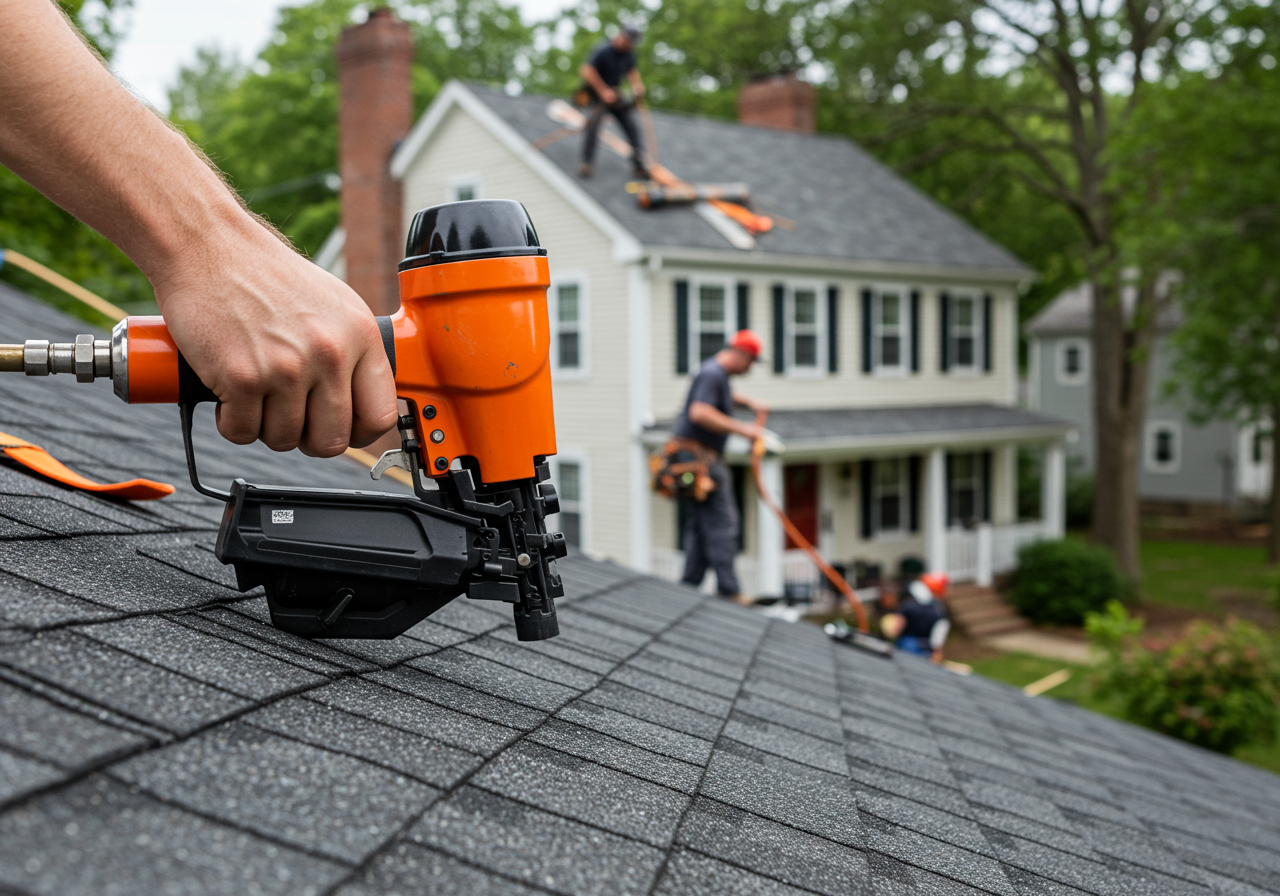
Wethersfield Roofing Complexity
The mix of mid-century ranches and steep-pitched historical homes in Wethersfield creates varying levels of roofing complexity that require professional expertise.
The Hidden Complexity of Wethersfield Roof Lines
Many homeowners assume a roof is just a series of overlapping shingles. The reality is that a high-performing system is an integrated assembly of drip edges, underlayments, and ventilation components. In Wethersfield, where we have a mix of mid-century ranches and steep-pitched historical homes, the complexity varies wildly. I've measured roof pitches in the Griswoldville area that hit a 10/12 slope—that's a rise of 10 inches for every 12 inches of depth. At that angle, you aren't just "walking" on a roof; you're mountain climbing with a 70-pound bundle of shingles on your shoulder.
The technical specs matter more than most realize. For instance, the offset between shingle joints—what we call the "stagger"—must be precisely maintained (usually 5 to 6 inches depending on the brand) to prevent water channels. If you're off by even an inch, a driving rain coming off the Connecticut River will find its way to your plywood. Before you commit to doing this yourself, you should calculate your potential savings to see if the financial margin is wide enough to cover the tools and safety gear you'll need to buy.
Why "Good Enough" Shingle Nailing Fails in Connecticut
Look, I'm a stickler for fasteners. Most DIYers use a standard hammer or a rented framing nailer, but shingles require a specific depth. If a nail is "over-driven" (too deep), it cuts through the shingle mat, and the first 40mph gust will rip that shingle right off the deck. If it's "under-driven" (sitting high), it will eventually wear a hole through the shingle above it.
Did You Know?
Connecticut is part of the "International Building Code" high-wind region. According to the International Code Council standards, shingles in our area must be fastened with a minimum of four to six nails per shingle, depending on the slope, to withstand our coastal-adjacent wind speeds.
In my field notes from a 2024 inspection near the Silas Deane Highway, I found a roof where the DIYer had used 1-inch nails. Our local code generally requires 1.25-inch galvanized nails to ensure enough bite into the 5/8-inch OSB or plywood. That 1/4-inch difference was the only thing standing between that roof and a total failure during a March nor'easter.
The Math Behind the $4,850 DIY Savings Illusion
People often look at a $14,000 roofing quote and see $7,000 in materials and $7,000 in "profit." That's a dangerous oversimplification. When you factor in the cost of a dumpster rental (roughly $550 in Hartford County), the purchase of a fall protection kit ($150–$300), and the premium for high-quality flashing, the "savings" start to evaporate.
DIY Materials & Gear vs Professional Installation
While you might see a theoretical savings of $5,110, you have to account for the "time tax." A professional crew of five can tear off and replace a roof in about 14 hours of active labor. A solo homeowner will likely spend 60 to 80 hours on the same task. If you value your time at even $40 an hour, the DIY route actually becomes more expensive than hiring a pro. If you're dealing with a leak rather than a full replacement, investing in minor shingle fixes through a professional might be the smarter financial move to bridge the gap until a full replacement is feasible.
Safety Standards and Liability in Hartford County
Safety isn't just about not falling; it's about the legal and financial liability of having people on your property. When you hire a contractor, you're paying for their workers' compensation and liability insurance. If you ask a few buddies to help you for a weekend and one of them slips, your standard Wethersfield homeowners' insurance policy might not cover the medical costs of a "voluntary labor" accident.
DIY Roofing Comparison
Pros
- Significant labor cost savings
- Complete control over material choice
- Personal satisfaction of home maintenance
Cons
- No labor warranty if leaks occur
- High physical risk on steep pitches
- Extremely slow completion time
I always tell people to verify a contractor's credentials via the state's eLicense portal before they sign anything. If you do go DIY, you are the general contractor. That means you are responsible for pulling the permits at the Wethersfield Town Hall and scheduling the mid-project inspections. Most homeowners find the bureaucracy of the building department more exhausting than the actual nailing.
Manufacturer Warranties: The Fine Print DIYers Miss
This is the part that manufacturer reps talk about in hushed tones. Brands like GAF or Owens Corning offer incredible 30-year or "lifetime" warranties, but they are almost always contingent on "professional installation according to manufacturer specifications." If you install your own shingles and a ridge vent fails five years later, the manufacturer will likely deny the claim the moment they see the shingles weren't laid with the exact required 5 5/8-inch exposure.
"A warranty is only as good as the person who drove the nails. In twenty years of consulting, I've seen exactly zero DIY warranty claims approved because of minor installation technicalities."
When you invest in a full system replacement through a certified contractor, you often get a secondary "labor warranty" that covers the installation itself. For a DIYer, the warranty ends at the hardware store's exit door. If you make a mistake, you pay for it twice.
Transitioning from Patchwork to Professional Results
If your roof is a simple "up and over" ranch with a 4/12 pitch, you might be a candidate for a DIY repair. But for anything involving valleys, chimneys, or skylights, the risk-to-reward ratio shifts heavily toward the pros. Wethersfield homes are an investment in history; treating them with "YouTube-level" expertise often leads to long-term structural headaches.
Assess your roof's pitch and height
Determine if you need specialized safety harnesses. A 10/12 pitch requires professional-grade fall protection equipment that most homeowners don't own.
Calculate the total square footage
Add 10% for waste and ridge caps. Most DIYers underestimate material needs, leading to multiple trips to the supplier and mismatched batches.
Check Wethersfield local building codes
Verify ice dam protection requirements. Hartford County has specific ice-shield mandates that must extend 24 inches inside the exterior wall line.
Compare the cost of DIY materials
Weigh against a professional estimate to find the true 'time tax.' Factor in your hourly value, potential weather delays, and the cost of mistakes.
The goal isn't just to keep the water out today; it's to ensure your home remains an asset for the next thirty years. Don't let a $5,000 savings today turn into a $15,000 restoration project tomorrow.
Get Your Free Roof Quote
Enter your zip code to get started
FAQ

About Daniel Roberts
Verified ExpertDaniel Roberts is a Senior Roofing Consultant with over 15 years of experience in the New England residential construction industry. He specializes in storm damage assessment and energy-efficient roofing systems.