Have you ever looked up at your ceiling after a heavy March rain and spotted a tea-colored stain near your chimney, even though your shingles look brand new? It's a frustrating riddle many of us in Vernon face. Often, the culprit isn't the shingle itself, but the connective tissue of your roof: the flashing. Whether you're living in a classic colonial near Henry Park or a newer build closer to the Talcottville area, those thin metal strips are the only thing standing between a dry living room and a massive interior restoration bill. I've seen enough mystery leaks in Tolland County to know that flashing is the unsung hero of your home's exterior design—and its primary defense.
Key Takeaways
- Identify early: 85% of roof leaks originate at flashing points, not the shingles themselves.
- Material choice: Copper offers the best longevity for Vernon's fluctuating climate, while galvanized steel is a budget-friendly alternative.
- Code compliance: Proper flashing must follow International Code Council (ICC) standards so your homeowners insurance stays defensible.
- Professional matching: The surest way to get intricate flashing right is to find a contractor who actually shows up and knows local details.
What is Roof Flashing and Why Does It Fail in Vernon?
Think of flashing as the weather-stripping for your roof. It's typically made of galvanized steel, aluminum, or copper, and its job is to redirect water away from places where the roof meets a vertical surface—like a chimney, a dormer, or a skylight.
In our corner of Connecticut, we deal with a lot of thermal expansion. One day it's a crisp 45 degrees, and the next, the sun is beating down on the shingles. This constant breathing of your home puts immense stress on the sealant and nails holding your flashing in place. I remember helping a neighbor near Valley Falls who couldn't figure out why their attic was damp; it turned out the sealant on their chimney flashing had simply dried out and cracked after ten years of Tolland County seasons.
When work is permitted or inspected, details usually track the I-Codes published through the International Code Council—not because flashing is exciting, but because sloppy transitions are exactly how small leaks become whole-wall damage.
The Role of Metal in a Shingle World
Shingles are great for shedding water on a flat plane, but they are terrible at turning corners. That's where the metal comes in. It creates a waterproof bridge. When that bridge fails, water doesn't just drip; it funnels directly into your wall cavities.
Common Culprits: Rust and Wind
While modern materials are rust-resistant, older Vernon homes often have original steel flashing that eventually loses its protective coating. Additionally, the wind gusts we get coming off the hills can catch a loose piece of step flashing (the individual metal bits along a wall) and peel it back like a sardine can.
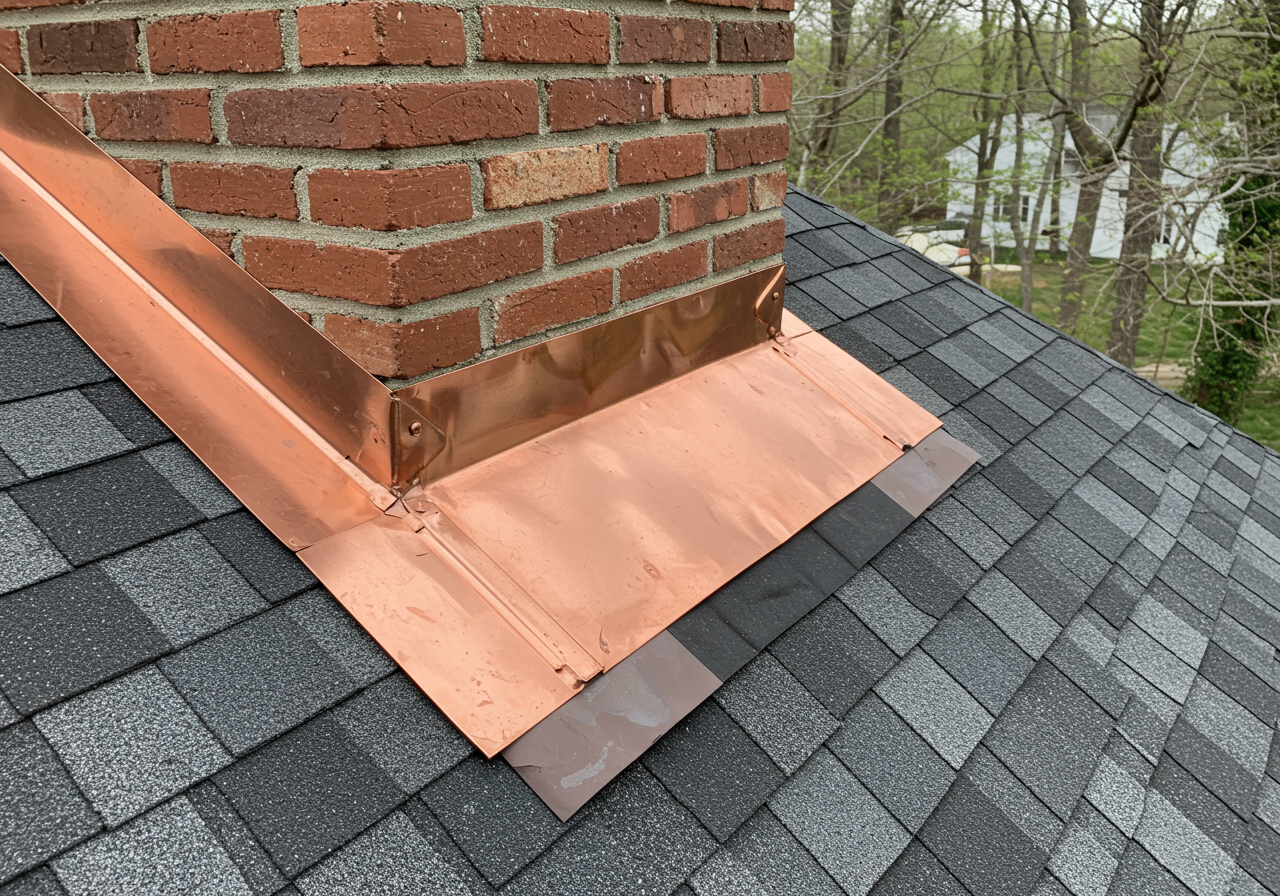
Copper step flashing done right
Properly installed step flashing is the most critical defense against interior water damage on chimneys and walls.
Spotting the Signs: Is Your Flashing Failing?
You don't always need a ladder to tell if something is wrong. I often tell my friends to grab a pair of binoculars and do a curb-side audit of their roof line. It's a great way to maintain that curb appeal we all work so hard on while catching problems early.
The Visual Walk-Around
Look for lifting. If you see a piece of metal pulling away from the chimney or a dormer, that's an open invitation for rain. Also, keep an eye out for caulk-heavy repairs. If a previous owner just slapped a mountain of silver goop over a corner, it's likely a temporary fix that has reached its expiration date.
Interior Warning Signs
If you see bubbling paint on a wall that shares a side with a dormer, or moisture in the attic rafters near the valleys (where two roof sections meet), your flashing has likely been breached. In my experience, waiting even one season can turn an $865 flashing repair into a $4,200 mold remediation project.
Repair vs. Replacement: Making the Call
One question I get constantly is: "Sheri, can I just patch it?" The answer depends on the why. If a single piece of step flashing was nicked by a branch, a localized repair is fine. But if your flashing is rusting or the shingles around it are curling, a full replacement is the only way to sleep soundly during a nor'easter.
Flashing Material Comparison
| Feature | Galvanized steel | Copper |
|---|---|---|
| Expected lifespan | ||
| Rust resistance | ||
| Curb appeal | ||
| Vernon weather rating |
See what a pro would quote for your flashing
Match with roofers who understand Tolland County transitions—not just shingle counts.
No credit card required • Free to use
The Step-by-Step Guide to Flashing Repair
If you're dealing with a minor leak, the process is surgical. It's not about how much roofing cement you can use; it's about how you layer the materials. This is one area where DIY often leads to SOS.
- Clear the area: Remove the shingles surrounding the damaged metal carefully.
- Remove old flashing: Pry up the old, rusted, or bent metal without damaging the underlayment.
- Inspect the decking: Check for rot. If the wood is soft, it must be replaced before the new metal goes down.
- Install new metal: Slide the new flashing into place. For walls, use step flashing where each piece overlaps the one below it.
- Seal and reshingle: Apply a high-grade polyurethane sealant and tuck new shingles over the metal flange.
Assess from two vantage points
Assess the damage from the ground and attic to pinpoint the entry point.
Lift shingles carefully
Carefully lift the shingles around the transition area (chimney, valley, or wall).
Swap corroded metal
Replace old, corroded metal with 26-gauge galvanized steel or copper.
Add peel-and-stick protection
Apply ice and water shield underlayment for an extra layer of protection.
Fasten and seal
Secure with roofing nails and seal edges with high-performance solar-grade sealant.
Choosing the Right Material for Tolland County Weather
In Vernon, we aren't just fighting rain; we're fighting ice dams. When snow melts and refreezes, it pushes water up under your shingles. Your flashing needs to be robust enough to handle that back-pressure.
While aluminum is common because it's easy to bend, I prefer 26-gauge galvanized steel for most Vernon homes. It's rigid and holds its shape against the wind. However, if you have a historic home or want that green patina over time, copper is the gold standard. It's also worth asking your accountant whether any energy-efficient roof improvements tied to a full system qualify under the IRS Form 5695 residential energy credit rules—flashing alone rarely drives the credit, but whole-roof upgrades sometimes do.
For a plain-English overview of how ice dams form and why airflow and insulation matter as much as metal, the U.S. Department of Energy insulation and air-sealing guidance is a useful cross-check when you're planning repairs.
Why Precision Matters Around Chimneys and Dormers
Chimneys are the most common failure point I see. They require two types of flashing: the base and the counter. The counter-flashing is tucked into the mortar joints of the brick. If a contractor just nails a flat piece of metal to the outside of the brick and caulk the top, it will leak within three years.
I always tell people: look at the corners. If the metal looks like an origami masterpiece, you've got a pro. If it looks like a crumpled soda can, you've got a problem. When water is already moving through the assembly, emergency roofing help can stop the bleed while you line up proper counter-flashing and masonry coordination.
Finding a Vernon Specialist for the Job
Flashing is meticulous work. It's the trim carpentry of the roofing world. You don't want the cheapest bid; you want the roofer who understands how water moves. The least stressful route is often a matching service—it removes guesswork and gets you talking to crews who know Tolland County building expectations. Finding a contractor who actually shows up saves more money than chasing the lowest postcard coupon.
If you're ready to see what a professional repair would look like for your specific roofline, you can get an instant roof estimate through ZikQuote's automated system. It's a lot faster than waiting three days for a callback from someone who might not even show up.
Get Your Free Roof Quote
Enter your zip code to get started
Conclusion
Taking care of your flashing isn't just about stopping a leak; it's about protecting the investment you've made in your home. A weekend spent addressing a lifting piece of metal can save you thousands in structural repairs down the road. Remember to check your valleys and chimney every spring, choose high-quality materials like galvanized steel or copper, and never settle for a caulk-only fix. Your roof is a system, and the flashing is the glue that keeps it all together. Stay dry, Vernon!
FAQ

About Sheri Wilde
Verified ExpertSheri Wilde is a Home Improvement Editor with a background in interior design and sustainable living. She helps Connecticut homeowners make informed decisions about their biggest investments.