
Key Takeaways
- Ice dams are caused by uneven roof temperatures, not just heavy snowfall.
- Trumbull's classic colonial architecture often hides insulation gaps that fuel ice buildup.
- Proper prevention combines attic ventilation, R-60 insulation, and high-quality underlayment.
- Immediate fixes like roof raking are temporary; permanent solutions require addressing heat loss.
Critical Safety Warning
You're finally settled in for the night, maybe catching a game or just enjoying the quiet of a Trumbull evening, when you hear it. Drip. Drip. Not from a faucet, but from somewhere inside the wall of your living room near the fireplace. It's that sinking feeling every Fairfield County homeowner dreads in January. You look outside, and those picturesque icicles hanging off your gutters suddenly look less like a postcard and more like a $5,800 repair bill waiting to happen. In our neck of the woods, where we take pride in our well-manicured Gold Coast estates and historic colonials, an ice dam isn't just a maintenance hiccup—it's a direct assault on our home's integrity. I've seen beautiful crown molding in Tashua homes ruined in a single weekend because a small heat leak in the attic turned a six-inch snowfall into a frozen reservoir on the eaves.
The Science Behind the Ridge Line Freeze
Here is the reality: ice dams aren't actually a "roof" problem in the way we usually think about them. They are a temperature problem. When your attic is too warm—usually because of air leaks or thin insulation—the underside of your roof deck heats up. This melts the bottom layer of snow sitting on your shingles. That water then runs down the slope until it hits the "cold" part of the roof: the eaves that overhang your house. Since those eaves aren't sitting over a heated room, they stay at freezing temperatures. The water refreezes there, building a literal dam of ice.
I remember helping a neighbor near the Nichols Fire District who couldn't understand why her brand-new roof was leaking. The shingles were perfect, but her attic was pushing 75 degrees because of unsealed recessed lights. That water has nowhere to go but backward, under your shingles and into your soffits. According to the International Code Council (ICC), modern building standards require specific underlayment to combat this, but older Trumbull homes often lack that critical "Ice and Water" shield that acts as a waterproof membrane.
Why Trumbull's Classic Architecture is at Risk
We love our dormers, gables, and complex rooflines in Trumbull. They give our neighborhoods character, but every valley and intersection on your roof is a potential collection point for snow and a trap for ice. If you live in one of the 1960s-era split-levels or a sprawling colonial near Daniels Farm, you likely have "hot spots" where different roof planes meet. These areas often have restricted airflow, making it nearly impossible for the roof to maintain a uniform, cold temperature.
I've looked at dozens of "problem" roofs in the area, and the culprit is almost always a lack of consistency. One section of the roof stays frozen while another melts, creating a jagged, ugly mess that pulls at your gutters. It's a design challenge as much as a structural one. I always tell people that your roof line is a design choice, but it's also a weather-management system. If your home has low-slope sections or flat-roof additions (common in some of our more modern Fairfield County builds), FEMA's guide on low-slope protection highlights how water ponding behind ice can be even more destructive on those surfaces.
Did You Know?
Did you know that just two inches of snow on your roof can act as an insulator, trapping heat inside your attic and accelerating the melting process that leads to ice dams? It's the 'igloo effect' happening right above your head.
The Attic Insulation and Ventilation Connection
If you want to stop the cycle, you have to look under the hood—or in this case, under the rafters. The Department of Energy (DOE) suggests that most homes in our climate zone need R-49 to R-60 insulation in the attic. Many older homes in Trumbull are sitting on R-19 or R-30, which is like wearing a light windbreaker in the middle of a nor'easter. When I renovated my last place, I realized that doubling the blown-in cellulose didn't just save me 18% on my heating bill; it completely eliminated the icicles that used to haunt my front porch.
But insulation is only half the battle. You need air to move. Baffles should be installed at your soffit vents to ensure that the cold air can travel from the eaves up to the ridge vent without being blocked by insulation. Think of it as a cold-air "curtain" that keeps your roof deck at the same temperature as the outdoor air. Before you commit to a major project, our blog library has some great deep dives on how ventilation systems work together to keep your home breathing.
Estimated Cost: Repair vs. Prevention
Immediate Triage When the Ice Moves In
So, what if you're reading this while the ice is already three inches thick? You can't exactly blow in insulation while it's snowing. Your first line of defense is a roof rake. I keep one in my garage and use it after every snowfall of more than four inches. By clearing the bottom three to four feet of the roof, you prevent the dam from ever forming. It's a bit of a workout, but it's cheaper than a contractor's emergency call.
Another "emergency" fix involves calcium chloride socks. You fill a nylon stocking with calcium chloride (not rock salt!) and lay it vertically across the dam so it melts a channel for the trapped water to escape. It's not pretty—it looks like your roof is wearing gym socks—but it works. Just be careful, as the runoff can be tough on your landscaping. If you're feeling overwhelmed, don't just hire the first guy with a truck and a shovel. I always tell homeowners to verify their contractor's license and insurance before they let anyone onto a snow-covered roof.
"In Trumbull, we see the most damage on homes where the owner ignored the 'warning icicles.' By the time the water is inside your walls, the ice dam has likely been there for two weeks."
Long-Term Solutions for a Dry 2026 and Beyond
Once the spring thaw hits, that's your window to make permanent changes. Beyond insulation, consider "Ice and Water" shield membranes. When we re-roofed a colonial near the Westfield Mall last year, we ran that membrane six feet up from the eaves instead of the standard three feet. It's a small cost increase (usually around $450-$700 for the average home) that provides massive peace of mind.
Another option is heat cables. While some people find the "zigzag" look a bit distracting from the curb, modern low-profile systems are much more discreet. They don't stop the ice from forming, but they ensure that water always has a heated path to the ground. If you're worried about how these upgrades might look or perform, see what other CT homeowners experienced when they tackled their own winter weatherproofing projects.
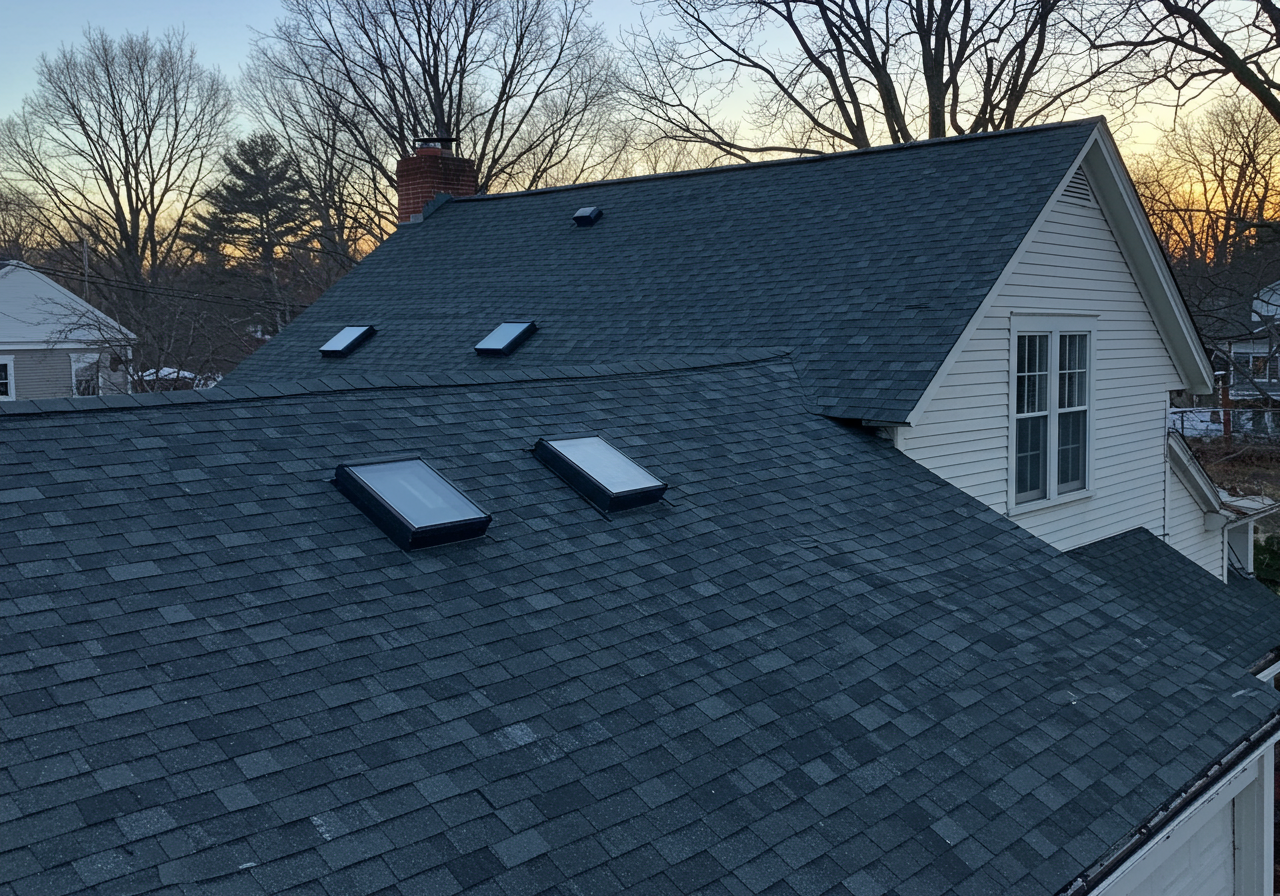
Ice Dam Prevention on a Connecticut Home
A cold roof deck is the ultimate secret to preventing ice dams in our Fairfield County climate.
Final Steps Toward Winter Peace of Mind
The goal isn't just to have a roof that doesn't leak; it's to have a home that handles the Connecticut winter gracefully. Start by hopping into your attic with a flashlight on a cold day. If you feel a breeze or see light where you shouldn't—or worse, if it feels like a sauna up there—you've found your problem. Address the air leaks around your chimney and plumbing stacks first. Then, look at your ventilation.
Get Your Free Roof Quote
Enter your zip code to get started
Taking these steps now means that next January, when the snow starts piling up on the Merritt Parkway, you can stay inside with your hot chocolate and enjoy the view, rather than watching the ceiling for drips. It's about protecting your biggest investment and making sure your home remains the sanctuary it's supposed to be.