
Key Takeaways
- S-1 grade slate is often a century-scale investment—not a 20-year roof cycle.
- Natural slate’s low porosity helps it shrug off salt air, freeze-thaw, and coastal moisture in New London County.
- Lifetime math can favor slate when you compare multiple asphalt replacements over 50 years.
- Weight and structure matter: confirm load capacity before you fall in love with real stone.
A few springs ago, I was walking through the Stonington Borough, just taking in the way the light hits those classic sea-captain homes. I stopped in front of a stunning Federal-style house that looked like it hadn't aged a day since the 19th century. The owner was out tidying the garden, and we got to talking about her roof. She told me the slate up there was original—installed shortly after the 1938 Great New England Hurricane. While every other house on the block had been through three or four asphalt roof replacements, her stone tiles were still shedding rain and resisting the salt air perfectly. It was a vivid reminder that when we talk about "home improvement," sometimes the oldest materials are still the most futuristic.
Choosing a roof in a coastal spot like Stonington isn't just about picking a color that doesn't clash with the neighbors. It's about surviving the damp, salty breeze off the Sound and the occasional late-winter Nor'easter. Slate isn't just a luxury choice; it's a structural one. If you're weighing the high entry price against the promise of never hiring a roofer again, here is what you need to know about the slate reality in New London County.
1. The Century-Long Lifespan Advantage
When we discuss roofing materials, we usually talk in decades. Asphalt might give you 20 years; high-end metal might give you 50. But slate? Slate plays by different rules. A high-quality S-1 grade slate roof is frequently a 100-year investment. In a town like Stonington, where many of us live in homes that have already seen several generations, a material that matches the longevity of the foundation just makes sense.
I often tell friends that a slate roof is essentially a "legacy" choice. You aren't just buying a roof for yourself; you're buying it for the next three owners of the house. Because slate is a natural stone, it doesn't "fail" in the way synthetic materials do. It doesn't evaporate, it doesn't curl, and it doesn't lose its granules in a heavy rain. We see roofs across Connecticut that were installed during the Taft administration that still look and perform beautifully.
2. Resilience Against Stonington's Coastal Climate
Living near the water is a dream, but it's hard on building materials. Salt air is corrosive. It eats away at metal flashings and can cause organic growth to flourish on porous shingles. Slate, however, is virtually non-porous. It has a water absorption rate of less than 0.03%, meaning it doesn't soak up the misty morning air or the heavy spring rains we see in March.
This low absorption rate is also why slate handles our freeze-thaw cycles so well. When water gets into a material and freezes, it expands and causes cracks. Since slate doesn't let the water in to begin with, it doesn't suffer from the "spalling" or "shaling" that ruins lesser stones. I've noticed that homes right on the water in Stonington often struggle with moss and algae, but a properly pitched slate roof stays remarkably clean because there's no "grip" for the greenery to take hold.
Did You Know?
Slate is one of the only roofing materials that is naturally fireproof, providing a massive safety edge in densely packed historic neighborhoods.
3. The Real Cost Breakdown: Upfront vs. Lifetime
Let's be honest: the sticker shock is real. A slate roof in New London County can cost anywhere from $30,400 to over $65,000 depending on the square footage and the complexity of the roofline. I've seen homeowners' eyes go wide when they see that initial quote. But if you look at the math over a 50-year period, the numbers actually flip in slate's favor.
If you install an asphalt roof for $14,600 today, you will likely replace it twice more in the next 50 years. Factoring in labor inflation and material costs, you could easily spend $60,000 on three "cheap" roofs over half a century. Meanwhile, that one-time slate investment is still sitting there, likely needing nothing more than a few minor flashing checks. If you want to see how these numbers look for your specific square footage, you can get a no-pressure look at current installation prices to compare options side-by-side.
Investment Over 50 Years: Slate vs. Architectural Asphalt
| Feature | Natural Slate | Architectural Asphalt |
|---|---|---|
| 100+ year lifespan potential (with quality install) | ||
| Very low ongoing maintenance | ||
| Naturally recyclable stone material | ||
| Lowest upfront install cost |
Ready to see the real numbers for a slate upgrade?
Get an instant, local estimate today from verified Connecticut pros.
No credit card required • Free to use
4. Aesthetic "Wins" for Your Neighborhood Curb Appeal
There is a specific visual weight to slate that you just can't fake. Whether it's the deep charcoals of Pennsylvania black slate or the mottled greens and purples from Vermont, the texture is unmistakable. In Stonington, where curb appeal is practically a local pastime, a slate roof is a major design statement. It says the home is substantial and cared for.
I love how slate interacts with the sky. On a misty March morning, it takes on a soft, matte gray. When the sun breaks through, the mica in the stone can catch the light and give the whole house a subtle shimmer. We often talk about "color palettes" for homes, but slate offers a "texture palette" that adds depth to colonial and Victorian architecture. It turns the roof from a utility into a crown.
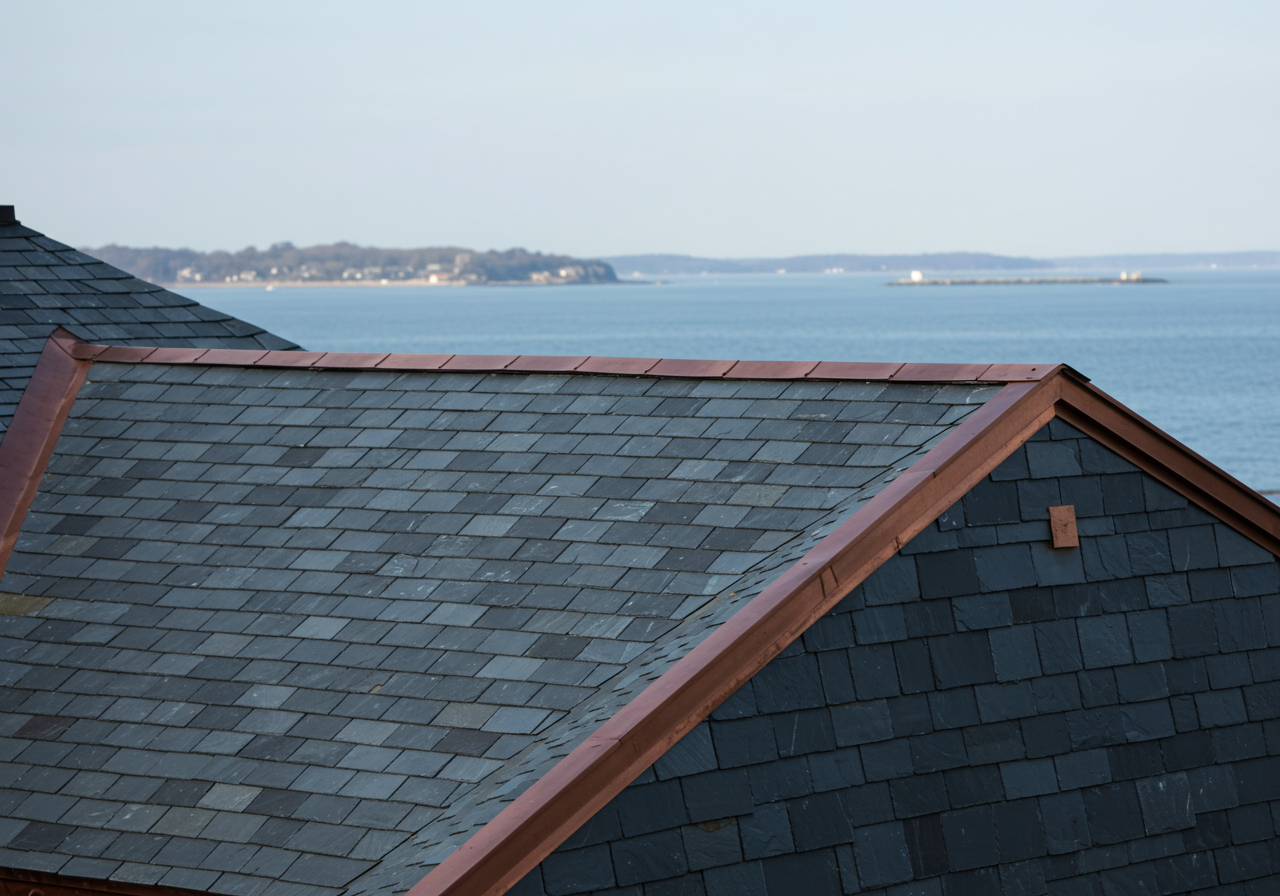
Traditional Stonington Slate Installation
A charcoal slate roof adds timeless elegance and significant resale value to New London County homes.
5. Storm Readiness and High-Wind Resistance
We all remember the gales that can whip through the New London area. When those winds come off the water, lightweight shingles can start to lift and peel. Slate is heavy—it stays where you put it. Most slate tiles are rated to withstand winds well over 100 mph, which is a huge comfort when a storm is rattling the windows.
According to FEMA's hurricane mitigation guidelines for sloped roof systems, the way a roof is attached and the weight of the material play massive roles in storm survival. Because each slate tile is individually nailed to the roof deck (ideally with copper nails), a single damaged tile doesn't mean the whole system is compromised. If a branch comes down in a late-season gale, having someone available for urgent roof repairs is a must, but with slate, you're usually looking at replacing two or three tiles rather than a whole section of shingles.
6. Energy Efficiency and Tax Incentives
Many people assume a "rock" roof would be a heat trap, but the opposite is true. Because of its thermal mass, slate acts as an insulator. It's slow to heat up in the summer and slow to lose heat in the winter. This natural regulation can actually lower your cooling bills during those humid Connecticut Augusts.
Beyond the monthly savings, there are financial incentives to consider. Research from the Energy Star cool roofs program shows that reflective or high-mass roofing can significantly reduce a home's carbon footprint. Furthermore, if you are integrating certain energy-efficient upgrades, you might be eligible for federal credits. You can check the IRS instructions for Form 5695 to see if your specific installation qualifies for residential energy credits.
"Slate isn't just a roof; it's a geological insurance policy for your most valuable asset."
7. Structural Requirements: Can Your Home Carry the Weight?
Here is the one "catch" I always warn people about: weight. A square (100 square feet) of asphalt shingles weighs about 230 pounds. A square of slate can weigh between 800 and 1,500 pounds. That is a massive difference. Before you commit to the beauty of stone, you have to ensure your home's bones can handle the load.
Most older homes in Stonington were built with beefy rafters that can actually support slate, but it's non-negotiable to have a structural engineer or a highly experienced contractor take a look first. The trick is finding a contractor who actually understands the load-bearing math and doesn't just try to sell you the most expensive material. Sometimes, a simple rafter reinforcement is all it takes to make your slate dreams a reality.
The 'Weight' Check
8. Sustainability and Resale Impact
In 2026, we are all thinking more about our environmental footprint. Asphalt shingles are a petroleum-based product that ends up in Connecticut landfills by the ton every year. Slate is literally just stone. When it eventually comes off a roof (a century from now), it can be crushed into gravel or reused. It is the ultimate "green" roofing material.
From a resale perspective slate is a "gold star" on a listing. In the Stonington real estate market, savvy buyers know that a slate roof means they won't have to worry about one of the most expensive home maintenance tasks for the rest of their lives. It adds prestige and permanence that helps a home stand out in a competitive New London County market. When you are ready to pressure-test the budget against real bids, the lead form below is the fastest way to see who actually installs S-1 slate in New London County.
Get Your Free Roof Quote
Enter your zip code to get started
Conclusion
Investing in a slate roof is a decision to stop "renting" your protection and start owning it. For Stonington homeowners, it's a way to honor the historic character of our town while building a fortress against the coastal elements. Yes, the initial check is a big one, but the peace of mind that comes with a 100-year roof is priceless. You won't be checking the attic for leaks every time a March storm rolls in, and you certainly won't be calling a roofer again in 15 years. It's a design choice, a financial choice, and a legacy choice all rolled into one beautiful, stony package.