
While most homeowners in Belle Haven or Riverside are quick to call a landscaper after a spring storm to clear downed branches, they often give their roof a cursory glance and assume everything is fine if the shingles are still attached. But there is a massive difference between a roof that is "leaking" and a roof that is "compromised"—and in the high-stakes real estate market of Greenwich, that distinction can cost you upwards of $14,250 in unrecoverable equity. Hail doesn't always leave a hole; more often, it leaves a bruise that takes eighteen months to turn into a disaster.
Key Takeaways
- Hail damage is frequently invisible from the ground, requiring a 10x magnification chalk test to identify granule loss.
- Most Fairfield County insurance policies have a 12-to-24-month filing window from the date of the verified storm event.
- Impact-resistant shingles (Class 4) can reduce annual premiums in Connecticut by 10% to 15%.
- Professional inspectors should use software to cross-reference your address with historical storm data.
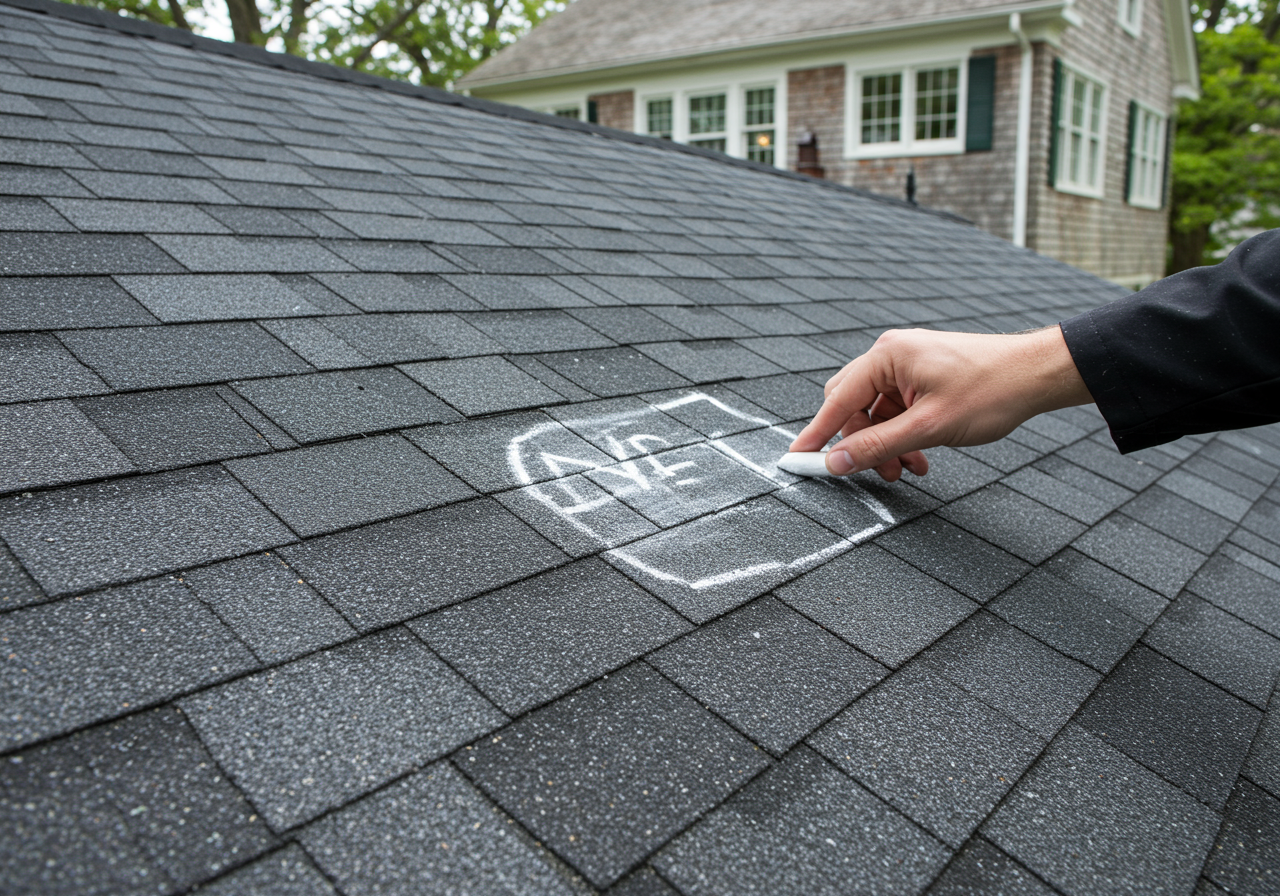
Hail Bruising on a Greenwich Architectural Shingle Roof
Granule displacement and mat compression often hide in plain sight until UV and humidity finish the job.
The Micro-Fracture Reality: Why Greenwich Roofs Fail Months Later
The physics of a hail strike on a Greenwich roof—often featuring heavy architectural shingles or high-end slate—is about kinetic energy transfer. When a 1.25-inch hailstone hits a shingle at terminal velocity, it doesn't always crack the surface. Instead, it compresses the asphalt mat against the wooden deck.
The "Bruising" Effect
Think of it like an apple. You drop it, it looks fine, but two days later, a soft brown spot appears. On a roof, this compression displaces the protective granules. Once those granules are gone, the underlying bitumen is exposed to UV radiation. In the humid Connecticut summers, that bitumen dries out and cracks within 12 to 18 months. I've seen $800,000 homes in Mid-Country Greenwich need full replacements just two years after a "minor" storm because the owner didn't realize their roof's lifespan had been cut by 70%.
Why Visual Inspections Fail
Look, a "binocular inspection" from the driveway is practically useless for hail. To truly see the damage, a consultant needs to be on a pitch-adjusted ladder with a 10x jeweler's loupe. We look for "hits"—circular patterns where the granules have been driven into the mat. If I find more than eight hits in a 10x10 "square" area, the roof is technically totaled by industry standards.
The $14,250 "Hidden Bruise" (Technical Inspection Steps)
The real surprise for Greenwich homeowners isn't the storm itself; it's the realization that they missed their insurance window. If you wait until the roof actually leaks, you've likely passed the "date of loss" deadline set by your carrier.
Step-by-Step Forensic Analysis
I've developed a specific protocol for our Fairfield County inspections that goes beyond just looking for dents. We focus on the peripheral metal first—the soft stuff tells the story that shingles try to hide.
Inspect soft metals
Check lead pipe boots, aluminum flashing, and copper gutters for indentations—they dent before shingles show obvious failure.
Perform a chalk test
Highlight subtle depressions in the asphalt mat so marginal hail strikes read clearly under magnification.
Document gutter granules
Photograph excessive granule accumulation in gutter troughs; heavy shedding after a storm often tracks with impact trauma.
Pin the verified storm date
Align field findings with official storm records so your carrier accepts the date of loss without a timing dispute.
Cross-reference damage with the National Weather Service Storm Events Database to pinpoint the exact date of loss adjusters will use in their own research.
The Role of Soft Metals
Aluminum downspouts and copper chimney flashings are "tattletales." Shingles are resilient, but metal doesn't bounce back. If I see a 1-inch dent in a copper valley flashing on a Round Hill Road estate, I know for a fact the shingles took a beating.
Insurance Timelines in Fairfield County: The 12-Month Clock
One thing I've noticed in my field notes from the last decade of CT storms is the strictness of modern insurance adjusters. They aren't just looking for damage; they are looking for reasons to deny the claim based on "delayed maintenance."
The "Date of Loss" Deadline
Most policies in Connecticut require you to report damage within one year of the event. If a hailstorm hits Greenwich in April 2026, and you don't notice the leak until November 2027, you are likely footing the entire $22,400 bill yourself. The adjuster will pull the same weather data I do, see the storm happened 19 months ago, and deny the claim as "untimely."
Navigating the Adjuster Meeting
When the insurance adjuster arrives, you need more than just a "guy with a ladder." You need a consultant who speaks their language—someone who understands "thermal expansion" and "delamination." I always recommend that homeowners verify a contractor's license and vetting process before allowing anyone to represent them during an adjustment.
Pro Tip
Material Science: How CertainTeed vs. GAF Handle Impact
Not all shingles are created equal when it comes to ice balls falling from the sky. In Greenwich, where we see a mix of coastal winds and inland hail, the material choice determines whether you're doing this again in five years.
SBS Modified Bitumen vs. Standard Asphalt
Standard shingles are rigid. SBS-modified shingles (often called "rubberized" asphalt) are flexible. When hail hits a CertainTeed NorthGate or a GAF ArmorShield, the shingle acts like a shock absorber. It deforms and then bounces back.
Impact-Resistant Shingles (Class 4) vs. Standard Architectural
Pros
- Can lower insurance premiums by up to 15%
- Prevents granule loss during 2-inch hail strikes
- Higher resale value in Greenwich markets
Cons
- Initial material cost is 10-20% higher
- Slightly heavier, requiring structural check
But—and this is a big "but"—even the best materials fail if the installation is sloppy. I've seen Class 4 shingles fail because the installer used a pneumatic nailer at the wrong PSI, over-driving the nails and fracturing the mat before the hail even hit. This is why finding a crew that actually shows up with calibrated tools—not just a sales rep with a drone—is non-negotiable.
The "Storm Chaser" Red Flag: Contractor Vetting
After a storm, Greenwich gets flooded with out-of-state trucks. These "storm chasers" use high-pressure tactics and "free roof" promises. The reality is that if they aren't local, they won't be here when that "repaired" roof starts leaking during a January thaw.
What to Look For
A professional crew should look like a professional crew. They should be following OSHA fall protection standards for residential work and using specific fasteners, not just whatever is on sale at the big-box store.
And don't fall for the "we'll cover your deductible" scam. In Connecticut, that is insurance fraud. A reputable company will provide a detailed line-item estimate that you can take to the bank. If you're dealing with a sudden leak after a storm, your first priority should be 24/7 emergency roofing help to stabilize the structure, not signing a 10-page replacement contract in the driveway.
Did You Know?
In Connecticut, roofing contractors must be registered with the Department of Consumer Protection. Always check their HIC (Home Improvement Contractor) number before signing.
Long-Term ROI: Impact-Resistant Upgrades for Gold Coast Estates
Investing in a hail-resistant roof isn't just about protection; it's about protecting your largest asset's "envelope." In the Greenwich market, a roof with a transferable 50-year warranty is a massive selling point.
The Math of Resilience
Let's look at the numbers. A standard roof might cost $18,000 and last 20 years. An impact-resistant system might cost $21,500 but last 40 years and save you $300 a year on insurance. Over 20 years, the "expensive" roof actually saves you $9,500 in premiums and replacement costs.
If you are struggling with the upfront costs of a high-quality replacement after a storm, there are options for government home repair assistance programs or specialized financing that can bridge the gap.
The reality is that your roof is a system, not just a layer of shingles. From the ice and water shield at the eaves to the ridge vent at the peak, every component needs to be rated for the conditions we see in Fairfield County. If you're ready to stop guessing and get real data on your home's condition, you can get an instant roof estimate from verified local pros today and see where your property stands.
See what hail may have already cost you
Match with vetted Fairfield County roofers and compare real numbers in minutes.
No credit card required • Free to use
Get Your Free Roof Quote
Enter your zip code to get started
Don't let the "Greenwich Surprise" catch you off guard. Hail damage is a slow-motion disaster that rewards early detection and punishes procrastination. By the time you see a brown stain on your ceiling, the chance to have your insurance carrier cover the $14,000+ replacement cost has likely evaporated. Document the damage, vet your contractors, and invest in materials that can withstand the next April storm. Your roof is the only thing between your family and the Connecticut elements—make sure it's up to the task.