
Key Takeaways
- Natural slate can last 100+ years, but requires structural reinforcement in most Coventry homes.
- The 93% humidity in Tolland County creates a high risk for moss and lichen on north-facing slate slopes.
- Synthetic slate offers a 50-year lifespan at roughly 60% of the cost of natural stone.
- Most local 'slate' failures are actually failures of the copper flashing, not the stone itself.
I'm looking out toward Wangumbaug Lake today and the sky is that heavy, slate-gray color that matches the very roofs I want to talk about. It's 33°F right now, and with the humidity sitting at a thick 93%, the air feels like a damp blanket. In Coventry, this kind of winter dampness isn't just uncomfortable; it's a direct assault on your roof's integrity.
Whenever I drive past the older Colonials near the town green, I see slate roofs that have likely been there since the Taft administration. They look magnificent. But when a homeowner asks me if they should drop $27,450 or more on a new natural slate installation, my answer isn't a simple "yes." It's a "let's look at your rafters first."
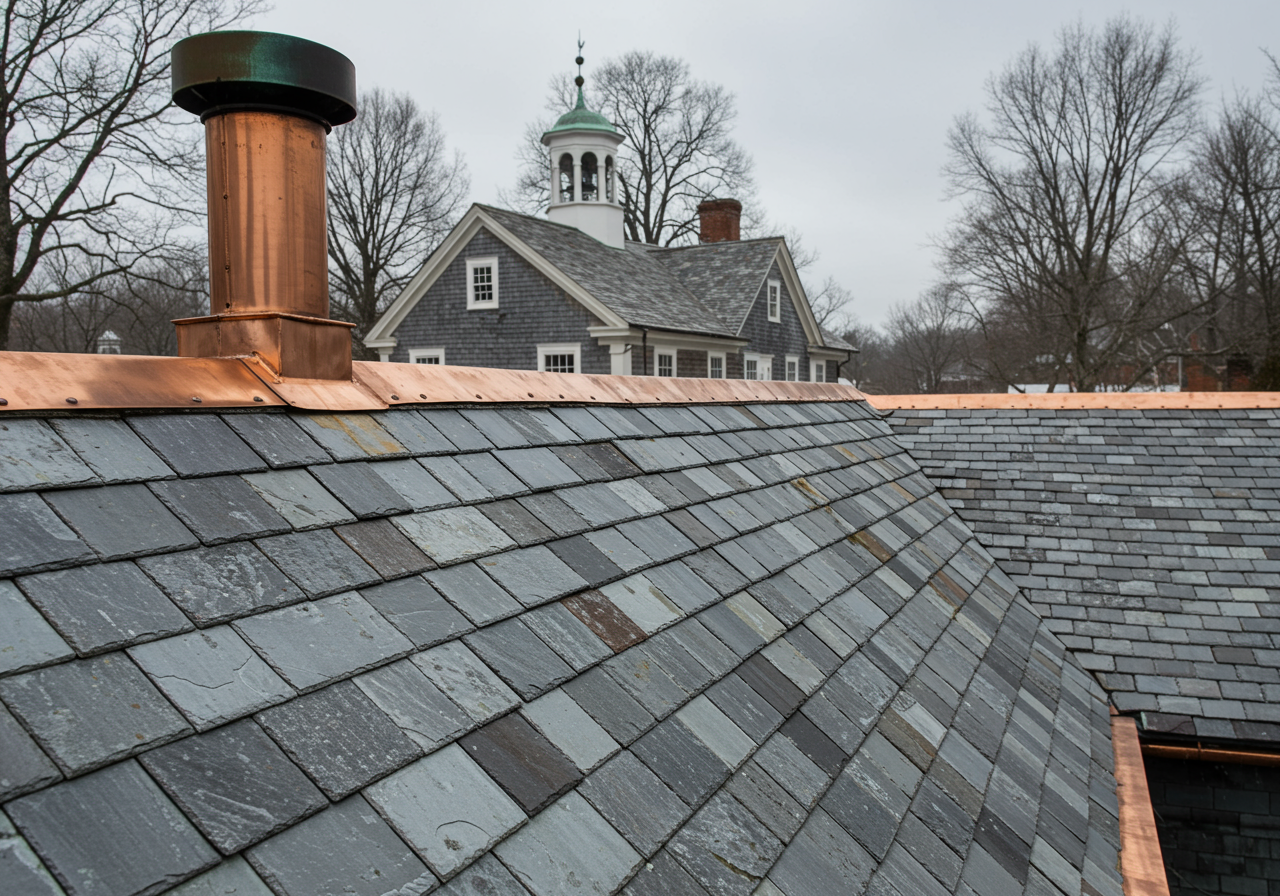
Historic slate roofing on a colonial home in Coventry, CT
Natural slate roofs can last over 100 years, but require proper structural support and maintenance in Connecticut's climate.
The Weight of Tradition: Natural Slate in Tolland County
There is no material on earth that beats natural slate for longevity. I've seen 17-year-old asphalt shingles look like they've been through a blender, while 100-year-old slate just looks "seasoned." But stone is heavy. We aren't talking about a few extra pounds; we are talking about 800 to 1,500 pounds per "square" (a 10x10 area).
Structural Reality Checks
Before you even look at a stone sample, you need a structural engineer. Most homes in Coventry built after 1950 were framed for asphalt. If you try to slap natural slate on a roof designed for shingles, your rafters will eventually resemble a swayback horse. I've seen one homeowner near the South Coventry historic district spend an extra $8,600 just on sistering rafters to handle the load.
The Freeze-Thaw Battle
Today's 33°F temperature is the danger zone. When moisture gets into the microscopic layers of a low-quality slate and then freezes, it acts like a wedge. Over decades, this causes "delamination." High-quality S1-rated slate handles this fine, but cheap imports will flake apart before your mortgage is paid off.
Breaking Down the $27,450 Investment
Let's talk turkey. A real natural slate roof in Connecticut isn't just a roofing project; it's a masonry project on an incline. For a standard 2,000-square-foot home in Coventry, you are looking at a starting point around $27,450, and that's being conservative. I've seen quotes hit $48,000 for complex Victorian-style turrets.
Material Grades
Not all stone is equal. Vermont slate is the gold standard for us here in New England. It's dense, holds its color (unless you buy the "fading" variety on purpose), and survives our ice storms.
Labor Specialization
You cannot hire a "shingle guy" to do slate. You need a slater. This is a dying breed in Tolland County. You're paying for someone who knows how to use a slate hammer and a ripper, not a nail gun. If you see a contractor bring a nail gun to a slate job, tell them to leave before they crack $5,000 worth of stone. To ensure you find the right specialist, you can connect with verified contractors who actually understand historical materials.
Expected Roof Lifespan (Years)
Synthetic Slate: The 50-Year Compromise?
If the $27k price tag makes your stomach churn, synthetic slate is the middle ground. Most of these are made from recycled rubber and plastics (polymers). From the street, 95% of people can't tell the difference.
The Humidity Factor
With Coventry's current 93% humidity, moss is a genuine concern. Natural slate is somewhat resistant, but the rough edges can trap spores. High-end synthetics often include UV inhibitors and algaecides that keep the roof looking cleaner for longer. According to the Energy Star Cool Roofs guide, some synthetic options also offer better thermal reflection than dark natural stone, which can help those July AC bills.
Impact Resistance
I remember the hailstorm we had a few years back—marbles hitting the windows for ten minutes straight. Natural slate can actually crack under large hail. Synthetic slate, being essentially high-grade rubber, usually just bounces the hail off like a trampoline. It's one of the few times "fake" is actually tougher than "real."
Natural vs. Synthetic Slate
Natural Stone
- Lifespan of 100+ years
- Highest resale value
- Eco-friendly natural material
Synthetic Polymer
- 60% less weight
- Class 4 impact resistance
- Significant cost savings
Maintenance: The "Soft" Costs of Stone
You don't just "set and forget" a slate roof. I recommend a "walk-around" inspection every spring after the snow melts. In a town like Coventry, where we get heavy ice damming, the flashing is your weak point.
The Copper Connection
Most people think their slate roof is leaking because a stone broke. Usually, it's because the original builder used galvanized steel flashing that rusted out after 30 years. If you're spending the money on slate, you must use copper flashing. It's the only metal that can keep up with the stone's lifespan.
Dealing with Moss
When the humidity stays at 93%, like it is right now, shaded parts of your roof stay wet for days. This leads to moss. For slate, I suggest a zinc or copper strip installed at the ridge. When it rains, the metallic ions wash down the roof and kill the moss spores naturally. It's a $200 trick that saves $2,000 in cleaning.
Noah's Pro Tip
Is It Worth It for Your Coventry Home?
Deciding on slate comes down to your "forever" timeline. If you plan on handing this house down to your grandkids, slate is actually the cheapest roof you can buy on a per-year basis. If you're moving in five years? You'll never recoup that $27,450.
For most people in our neck of the woods, synthetic slate provides that historical aesthetic without the need for a structural overhaul. It's also worth checking the IRS Instructions for Form 5695 to see if any high-efficiency underlayments or synthetic materials qualify for residential energy credits, though slate itself is usually a hard sell for "efficiency."
Before you commit to a pile of rocks or a load of polymers, learn how our matching process works to ensure you're talking to a contractor who actually knows the difference between S1 and S3 slate.
Get Your Free Roof Quote
Enter your zip code to get started
The bottom line? Coventry weather is hard on houses. Whether it's today's 33°F dampness or a 95°F July afternoon, your roof is the only thing standing between you and the elements. Stone is a hell of a shield—just make sure your house is strong enough to carry it.