"The biggest shift I've seen in Hartford County over the last 14 years isn't just how we install roofs, but what we're actually putting on them," says Marcus Thorne, a veteran materials specialist I spoke with recently. "Synthetic polymers have moved from 'experimental' to the gold standard for homeowners who want the look of the Historic District without the crumbling slate or rotting cedar headaches." It's a sentiment I'm hearing more often around Wethersfield lately. As we shake off the final dust of winter and look toward spring renovations, the conversation in my inbox has shifted from "Can I afford slate?" to "Does synthetic actually look real from the sidewalk?"
Key Takeaways
- Synthetic materials like polymer slate and composite shake offer a 50-year lifespan, nearly doubling the durability of standard asphalt.
- Homeowners in Wethersfield can save roughly $14,000 to $22,000 by choosing synthetic over genuine quarried slate.
- Local building codes and historic aesthetics are easily met with modern Class A fire-rated synthetic options.
- Weight is a major factor; synthetics don't require the expensive structural reinforcement that real slate demands.
The Aesthetic Mimicry: Slate and Cedar Reimagined
When you drive through Old Wethersfield, the architectural DNA is unmistakable. We have these stunning Colonials and Victorians that look like they were plucked right out of a history book. For years, if you wanted to maintain that dignity, you were stuck with heavy, brittle slate or cedar shakes that turned into a mossy mess within a decade.
But things have changed. Modern composites are molded from actual pieces of slate and hand-split cedar. I stood on a driveway on Broad Street last month and honestly couldn't tell the difference from 20 feet away. The way the light hits the "chiseled" edges of a polymer slate tile is remarkably convincing. We aren't just talking about plastic shingles here; we're talking about engineered materials infused with UV inhibitors that prevent that "shiny toy" look that plagued early versions of these products.
Texture and Color Depth
In the past, synthetic meant "flat." Today, the color palettes are variegated. You'll see subtle grays, purples, and greens mixed into a single roofline to mimic the natural geological variations of Vermont slate. I always tell my neighbors: if you're going synthetic, don't pick a uniform color. Nature isn't uniform, and your roof shouldn't be either if you want that high-end curb appeal.
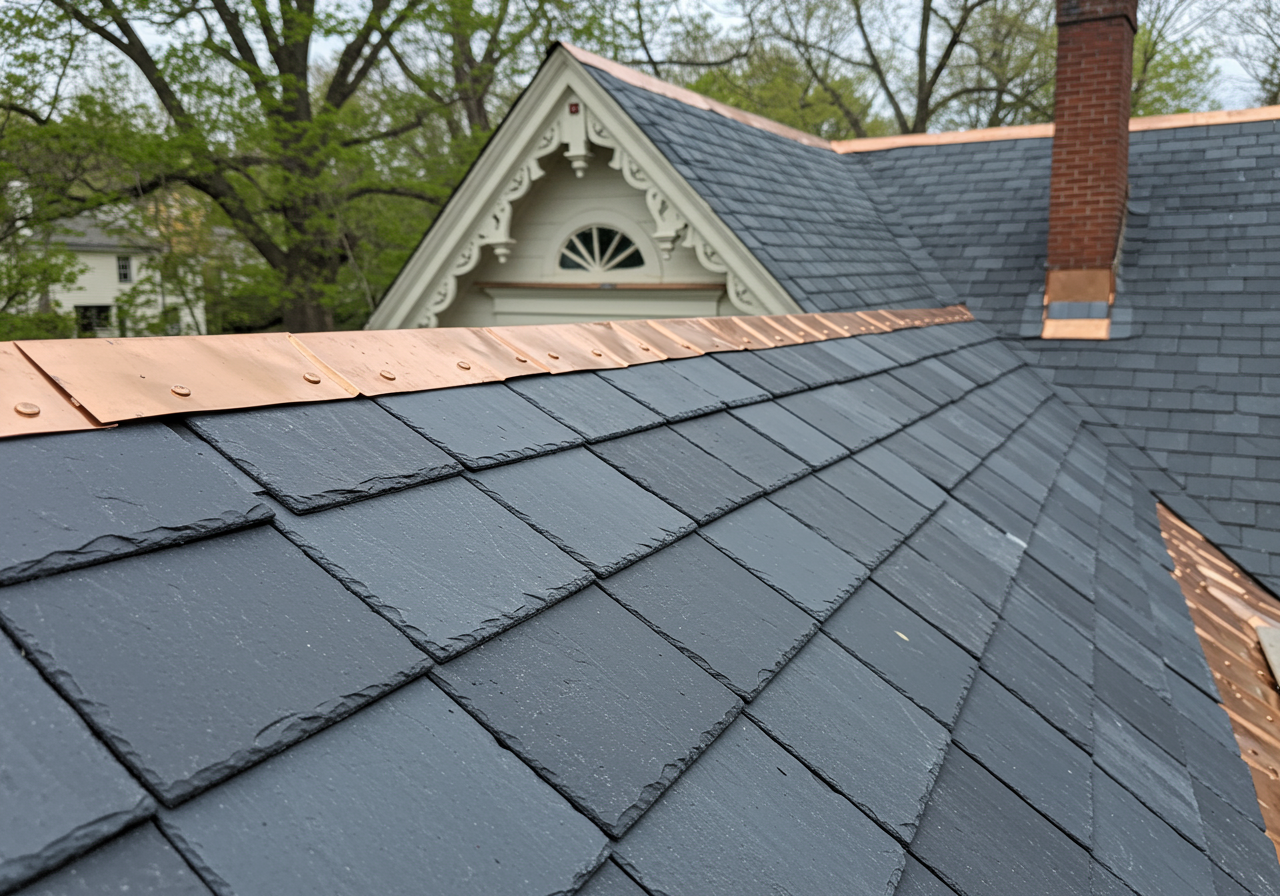
Synthetic Roofing in Wethersfield
Modern synthetic materials blend seamlessly with historic Wethersfield architecture while offering superior durability and performance.
Performance Metrics in the Connecticut Climate
Let's talk about our local weather for a second. We get the full spectrum—icy slush in January and humid, baking heat in July. Natural cedar tends to warp and crack under that stress. Synthetic materials, however, are dimensionally stable. They don't expand and contract at the same rate as organic materials, which means your fasteners stay put and your leak risk drops significantly.
Impact Resistance and Insurance
Most high-end synthetics carry a Class 4 impact rating. This is a fancy way of saying they can take a beating from falling branches or the occasional hail storm without cracking. I've seen some homeowners in the Hartford area actually snag a discount on their premiums after switching. It's always worth verifying your potential savings before you commit to a specific material, as the ROI often extends beyond just the home value.
Projected Lifespan by Material (Years)
The Financial Reality: Upfront Cost vs. Long-term Value
I won't sugarcoat it—synthetic roofing isn't "cheap." It's an investment. If a standard asphalt shingle job in Wethersfield costs you $13,450, a synthetic slate roof might run you $28,900. But when you compare that to the $55,000+ you'd spend on real quarried slate (plus the structural reinforcement needed for all that weight), the "middle ground" of synthetic starts to look like a bargain.
Structural Savings
This is the part many people forget. Real slate weighs a ton—literally. Most Wethersfield homes built after 1950 weren't designed to hold that much weight. If you go with the real deal, you're often paying a carpenter thousands to beef up your rafters. Synthetics weigh about the same as heavy-duty asphalt, meaning you can upgrade to a new roof system without rebuilding your entire attic structure.
Synthetic vs. Traditional Slate
Pros
- One-quarter the weight of natural stone
- Nearly zero maintenance required
- Consistent color and sizing for faster install
- Sustainable (often made from recycled materials)
Cons
- Higher initial cost than asphalt
- Requires specialized installation knowledge
- Can't 'patina' exactly like natural wood
Installation Nuances and Local Codes
You can't just hire a "tailgate contractor" for synthetic slate. The flashing details and the way the valleys are cut require a bit of artistry. According to the International Code Council (ICC) digital building codes, the underlayment requirements for these materials are often stricter than for standard shingles. You want a crew that treats the project like a puzzle, not a race.
FAQ
The Fastener Factor
In Wethersfield, we have to worry about wind uplift. I've seen synthetic tiles installed with stainless steel or copper nails because the tiles themselves are going to last 50 years—you don't want the nails rusting out in 15. It's these little details that separate a "good" job from a "lifetime" job. I always suggest that homeowners check their contractor's history with the BBB to ensure they have experience with these premium systems.
Why Neighborhood Context Matters
One thing I always remind my readers is that your roof isn't just yours—it's part of the streetscape. A bright, neon-blue roof would look ridiculous near the Wethersfield Cove. But a charcoal synthetic slate or a weathered-wood composite shake? That looks like it belongs.
I've lived through enough "budget" repairs to know that the cheapest option usually ends up being the most expensive over time. If you're seeing leaks or missing tabs, sometimes a reliable roof repair can buy you another season of planning, but if the decking is soft, it's time to think about the long game. Choosing a material that honors the character of Wethersfield while standing up to its weather is, in my opinion, the smartest way to protect your biggest asset.
Did You Know?
A standard square (100 sq. ft.) of natural slate weighs between 800 and 1,500 lbs. The same area of synthetic slate weighs only 260 to 340 lbs, roughly the same as a person!
Get Your Free Roof Quote
Enter your zip code to get started
I truly believe that for the average Wethersfield homeowner, synthetic roofing is the ultimate "set it and forget it" solution. You get the architectural prestige without the brittle fragility of stone or the high-maintenance demands of wood. It's a way to look backward at our town's history while using the best technology 2026 has to offer. Take the time to look at samples in different lights—morning sun versus a cloudy afternoon—and you'll see why the journey to synthetic is one more and more of your neighbors are taking.

About Sheri Wilde
Verified ExpertSheri Wilde is a Home Improvement Editor with a background in interior design and sustainable living. She helps Connecticut homeowners make informed decisions about their biggest investments.