Key Takeaways
- Deductibles in Hartford County often hit $2,500+, making small claims financially risky.
- Filing a claim for minor wear can trigger premium hikes of 15% to 22% over three years.
- Farmington's historic district requirements can lead to 'matching' disputes with adjusters.
- Cash-pay 'alternatives' allow for faster scheduling and more room to negotiate labor rates.
If you've spent any time stuck in the afternoon bottleneck where Route 4 meets Route 10 in Unionville, you know that some shortcuts actually end up taking longer. Insurance claims are the "rush hour traffic" of the roofing world. Every February, I see Farmington homeowners rush to file a claim after a heavy wet snow or a gusty Nor'easter, thinking they're getting a "free" roof. But after auditing hundreds of Hartford County insurance settlements, I can tell you the math rarely favors the impulsive. Between climbing deductibles and the looming threat of a non-renewal notice, the "alternative"—paying out of pocket—is looking more like the express lane for savvy homeowners who value their long-term equity.
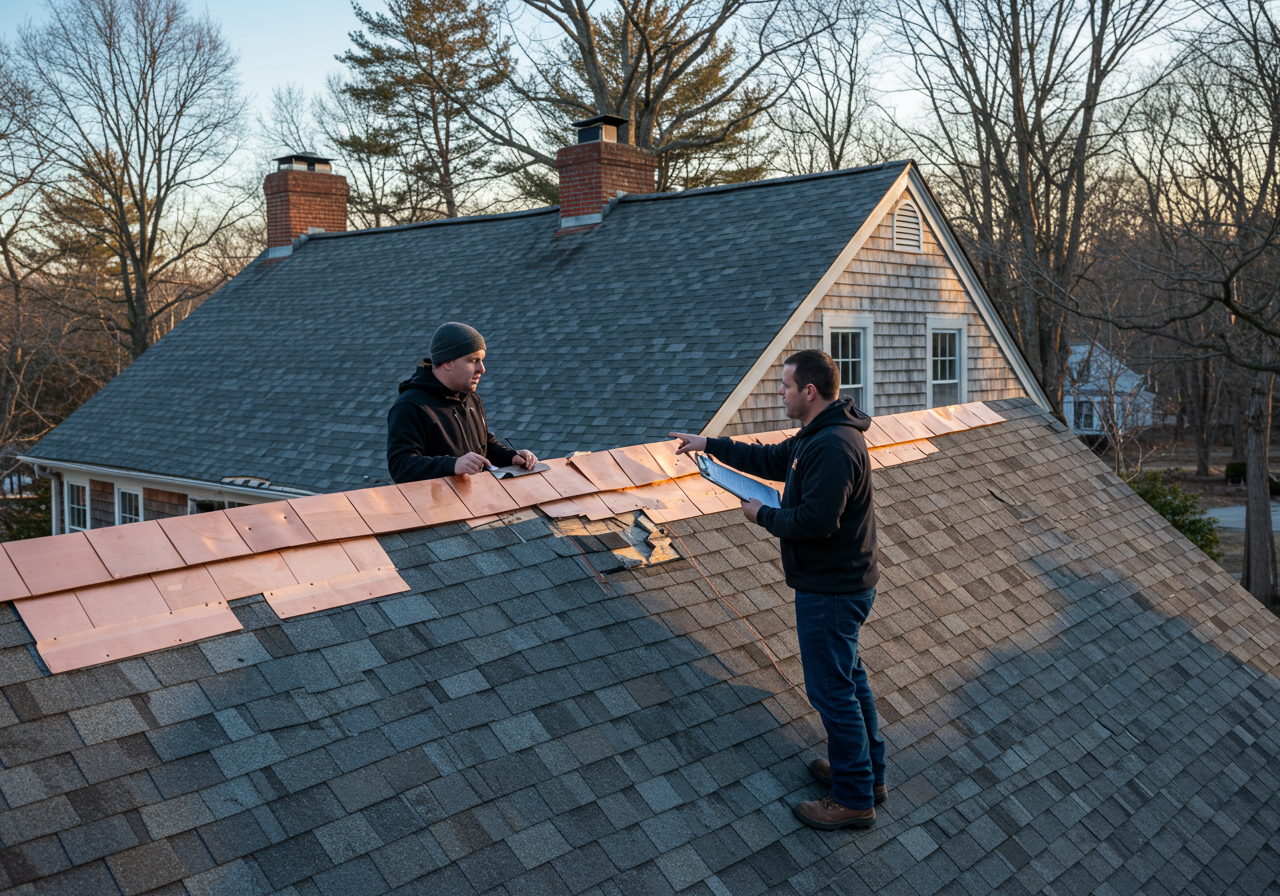
Understanding Roof Insurance Claims vs. Out-of-Pocket Costs
Farmington homeowners face critical decisions when choosing between insurance claims and cash payments for roof repairs.
The Deductible Math That Most Adjusters Skip
Here is a reality check I had to give a homeowner over near the Hill-Stead Museum last month. They had about $3,100 in wind damage to a rear slope. Their policy had a 1% hurricane/wind deductible. On a $650,000 Farmington home, that's a $6,500 out-of-pocket cost before the insurance company cuts a single dime.
In that scenario, filing a claim is essentially volunteering to pay for the repair yourself, while also giving your carrier a reason to hike your rates. Most people think a deductible is a flat $500 or $1,000, but "percentage-based" deductibles are becoming the standard in Connecticut. Before you even call your agent, check your specific repair needs against your policy's declarations page. If the estimate is within $1,500 of your deductible, you're usually better off keeping the insurance company out of it.
The Out-of-Pocket Alternative: Why Cash Still Wins
When you bypass the insurance machine, you gain a level of leverage that a "claim specialist" will never tell you about. When a contractor knows they are working for you and not an insurance software like Xactimate, the pricing structure changes. Insurance pricing is often "fluffed" to account for the months of administrative back-and-forth the roofer has to endure with the adjuster.
By opting for the out-of-pocket route, you can often negotiate a "cash price" that sits 10% to 15% lower than an insurance estimate. Why? Because the contractor gets paid the day the job is done, not three months later when the mortgage company finally endorses the check. If you're worried about the upfront hit, using a cost estimator tool can help you see if a cash-pay project fits your 2026 budget without the insurance headache.
Avg. 25-Square Roof Replacement: Farmington, CT
Farmington Zoning and the "Matching" Shingle Nightmare
Farmington isn't like every other town in the Valley. If you live in one of our historic districts or a neighborhood with strict HOA bylaws, you can't just slap any architectural shingle on your rafters. I've seen adjusters try to pay for a "spot repair" using a standard 3-tab shingle that doesn't match the weathered cedar-shake look of the rest of the house.
In Connecticut, we have "matching laws," but insurance companies fight them tooth and nail. They'll argue that a "close enough" match is sufficient. If you pay out of pocket, you have total control over the aesthetic. You aren't arguing with a guy in a suit in an office in New Jersey about whether your Unionville colonial needs a specific slate-grey finish to meet local standards. You just buy what the house requires.
Never sign a 'Direction to Pay' form before your contractor explains exactly how they handle Farmington's specific permit fees.
The Step-by-Step Reality of Filing a Farmington Claim
If the damage is catastrophic—say, a massive oak tree took a nap on your ridge vent during a winter gale—you're going to have to file. But don't do it blindly. I always tell people to verify the storm date first. You can use the NWS Historical Storm Events Database to pinpoint the exact wind or hail event that caused the issue. This prevents the insurance company from claiming the damage is "gradual wear and tear," which is the #1 reason for denials in Hartford County.
Verify the storm date
Use NOAA or local weather logs to document the exact date of the wind or hail event that caused your damage.
Get a private inspection
Have a licensed contractor inspect your roof before calling your insurance agent to document the full scope of damage.
Compare repair estimate to deductible
Calculate whether the net payout (claim amount minus deductible) exceeds $3,000 before filing.
File the claim only if net payout exceeds $3,000
If the math doesn't work out, consider paying out of pocket to avoid premium increases.
Ensure contractor follows OSHA standards
Make sure whoever is on your roof follows OSHA fall protection standards to avoid liability issues.
Speaking of inspections, make sure whoever is on your roof is following OSHA safety standards. I've seen Farmington claims get bogged down in liability nightmares because a "storm chaser" crew didn't use proper harnesses and an injury occurred on the property.
Spotting the "Free Roof" Scams in Farmington
February is prime time for door-knockers. They'll tell you they "just did a neighbor's roof" and noticed hail damage from the street. Here is my rule: if they lead with "we'll cover your deductible," walk away. In many states, including Connecticut, it is technically insurance fraud for a contractor to "waive" or "rebate" your deductible.
A legitimate contractor doesn't need to play games with your deductible to win the job. They win it by providing a transparent line-item bid. If you're ready for a full roof replacement, you want a partner who respects the law and your wallet. I've reviewed enough "free roof" contracts to know they usually result in the cheapest materials and a crew that disappears the moment the first leak appears in April.
The 'ACV' Trap
Final Math: Is the Claim Worth the Paperwork?
Let's look at the "hidden" cost of a claim. In Farmington, if your annual premium is $2,200, a single claim can bump that to $2,700 for the next three to five years. That's an extra $1,500 to $2,500 in "ghost costs" that most homeowners forget to add to their deductible.
Before you commit to the insurance route, ask for the cash price. Often, the difference between your deductible plus the premium hike and the total cash price is surprisingly small. And if you're looking for federal help instead of insurance, USA.gov offers resources for home repair assistance that might provide a better path than a high-interest claim.
Did You Know?
Connecticut is a 'matching state,' meaning if an insurance company can't find a perfect match for your damaged shingles, they may be legally required to replace the entire roof slope.
Get Your Free Roof Quote
Enter your zip code to get started
In my experience, the smartest Farmington homeowners treat insurance like a catastrophic safety net, not a maintenance fund. If you can fix it for $1,200 out of pocket, do it. Save that "claim card" for the day a Nor'easter decides to rearrange your entire attic.
Get Your Free Roof Quote Today
Connect with verified CT pros in minutes.
No credit card required • Free to use
FAQ

About Dana Jackson
Verified ExpertDana Jackson is a Homeowner Advocate & Cost Analyst who helps Connecticut families navigate the financial aspects of roofing projects. She specializes in finding the best value and avoiding common pricing pitfalls.