
Key Takeaways
- Many Pomfret HOA roofing guidelines were written by developers, not climate specialists, creating policy gaps that can cost homeowners thousands.
- Dark roof colors mandated by HOAs can reach 150°F+ during CT heat waves, causing thermal shock that shortens shingle life and hikes cooling costs.
- March approval delays can turn small roof problems into structural disasters—document emergency damage to bypass monthly board meetings.
- Synthetic roofing materials offer 50-year warranties and Class A fire ratings but are often banned by boards stuck on outdated 'natural materials only' rules.
While some Pomfret neighbors are enjoying the sprawling freedom of ten-acre wooded lots near the Airline Trail, those living in our managed associations are often staring down a forty-page rulebook just to swap out a few wind-damaged shingles. It is a classic Connecticut contrast: the rugged, "Quiet Corner" desire for independence clashing with the rigid "architectural harmony" of a homeowners association. I have seen it play out a dozen times in Windham County—a homeowner wants a high-performance roof that can handle a March ice storm, but the board is stuck on a specific shade of "Weathered Wood" that hasn't been updated since the Clinton administration.
The reality is that many of these HOA guidelines were written by developers, not climate specialists. They care about the curb appeal for the next unit sale, not necessarily the moisture-wicking capabilities of your underlayment during a messy Connecticut spring thaw. In Pomfret, where the elevation can catch wind gusts that lower-lying towns like Danielson miss, these policy gaps can cost you thousands. If your board's approved list doesn't match the reality of our local weather patterns, you are essentially paying for a roof that is designed to fail.
We are entering that strange March "mud season" where the ground is a sponge and the sky can't decide between sleet and sunshine. This is exactly when the friction between HOA bureaucracy and roofing reality becomes a crisis. If you are starting to see granules in your gutters, you don't just need a contractor; you need a strategy to navigate the board before the April showers turn a small problem into a structural disaster.
1. The Uniformity Trap: Why "Standard" Shingles Fail in the Quiet Corner
Most Pomfret HOAs have a "uniformity clause" designed to keep the neighborhood looking cohesive. While that is great for property values, it often creates a technical ceiling on quality. I've reviewed bylaws in several Windham County developments where the "approved materials" list specifically names 3-tab shingles or low-weight architectural shingles that simply aren't beefy enough for our local wind loads.
The problem is that our building codes have evolved while many HOA handbooks have stayed stagnant. According to the International Code Council (ICC) standards, the requirements for roof deck preparation and fastener patterns are much more stringent today than they were even ten years ago. If your HOA insists on a specific shingle that doesn't meet modern Class 4 impact resistance or high-wind fastener specs, they are technically asking you to install an inferior product.
I remember a case near the Pomfret School where a homeowner was denied a move to a heavier-duty synthetic slate because the board felt it "stood out" too much. But here is the catch: the original shingles were failing every three years because of the specific wind tunnel effect created by the local ridge line. When you are estimating the financial hit of a project like this, you have to factor in the "ignorance tax" of a board that doesn't understand wind-uplift. You aren't just buying shingles; you are buying a shield. If that shield isn't rated for Pomfret's specific microclimate, it's just expensive wallpaper.
2. Thermal Blindness: The Hidden Cost of Mandatory Color Palettes
Have you ever noticed how many HOAs in Connecticut demand dark charcoal or deep brown roofs? They look "stately" against the March snow, sure, but they are thermal sponges. In a town like Pomfret, where we can see a 40-degree temperature swing in a single day during the spring, a dark roof can reach 150°F while the air is still crisp. This causes massive expansion and contraction in the roof deck, a process we call "thermal shock."
When the board forces you into a dark color palette, they are inadvertently shortening the life of your shingles and hiking your cooling costs for the upcoming summer. I've looked at NOAA data for Windham County that shows our summer "heat islands" are becoming more intense, even in rural areas. A roof that can't breathe because of its color and poor ventilation—often also restricted by HOA rules on "visible vents"—will bake the adhesives until they become brittle.
If your board is giving you pushback on a lighter, more reflective shingle, show them the data. Better yet, show them how a "cool roof" color that still fits the "earth tone" requirement can save the entire association money on long-term maintenance. I once helped a client in a nearby cluster-housing development prove that their "mandated" dark brown roof was actually causing their attic plywood to delaminate. Once the board saw the photos of the "cooked" wood, they suddenly became much more flexible about the approved color list.
3. The Approval Bottleneck: Why March Delays Lead to April Leaks
March is the most dangerous month for Pomfret roofs. We get that heavy, wet "heart attack" snow that sits on the roof, followed by a quick thaw and then a flash freeze. If your roof is compromised, this cycle will find the weakness. But if you have to wait three weeks for a board meeting to get your shingle choice approved, you are playing a dangerous game of "beat the leak."
I've seen homeowners try to do the right thing by patching up a leak while waiting for the board, only to get a "cease and desist" letter because the repair shingle didn't perfectly match the weathered 20-year-old original. It's frustrating. It's the kind of red tape that makes you want to sell the house and move to a tent in the Natchaug Forest.
"In twenty years of tracking Connecticut weather impacts, I've never seen a storm wait for an HOA board's monthly quorum. If your roof is failing in March, the board's schedule shouldn't be your 'deadline'—the next Nor'easter is."
The fix here is "conditional emergency authorization." Most bylaws have a provision for emergency repairs that bypass the architectural committee. The trick is documenting the damage immediately. If you can show that waiting until the April board meeting will result in internal structural damage, you have a much stronger legal leg to stand on. Don't just ask for permission; provide a professional damage assessment that highlights the risk of inaction.
4. Material Restrictions vs. Environmental Reality: The Synthetic Debate
In the Quiet Corner, we love the look of natural cedar shakes and slate. They fit the historical vibe of Pomfret perfectly. Consequently, many high-end HOAs in the area actually *require* natural materials. But let's be honest: maintaining a cedar roof in the humid, shaded woods of Windham County is a full-time job. Between the moss, the lichen, and the woodpeckers, those "luxury" materials often look like a science experiment after seven years.
There are incredible synthetic options now—polymer slates and composite shakes—that look identical from the street but carry a 50-year warranty and a Class A fire rating. Yet, many HOA boards ban them because "synthetic" sounds cheap to someone who hasn't looked at a roofing catalog since 1995.
Natural vs. Synthetic Performance in CT
| Feature | Natural Cedar | Composite/Synthetic |
|---|---|---|
| Lifespan | ||
| Fire Rating | ||
| Moss/Algae Resistance | ||
| HOA Acceptance | ||
| March Freeze/Thaw Durability |
If you are pushing for a full-scale roof overhaul, bring a sample of the synthetic material to the meeting. Let them touch it. Often, the board's "no" is based on an old mental image of shiny plastic shingles. When they see a modern composite that captures the texture of hand-split cedar but won't rot when the Pomfret fog rolls in, their tune usually changes.
5. Contractor Compliance: Navigating the "Approved List"
Some HOAs maintain a "preferred contractor" list. While this is intended to ensure quality, it can sometimes be a "good ol' boy" network that keeps prices artificially high or excludes the most innovative installers. You are not legally bound to use their list in most cases, provided your chosen contractor meets the state's licensing and insurance requirements.
Before you sign anything, you must verify the contractor's license through the state portal. This is non-negotiable. I don't care if the board president's brother-in-law has been doing roofs since the 70s—if his insurance has lapsed or his registration isn't current with the CT Department of Consumer Protection, he isn't touching your house.
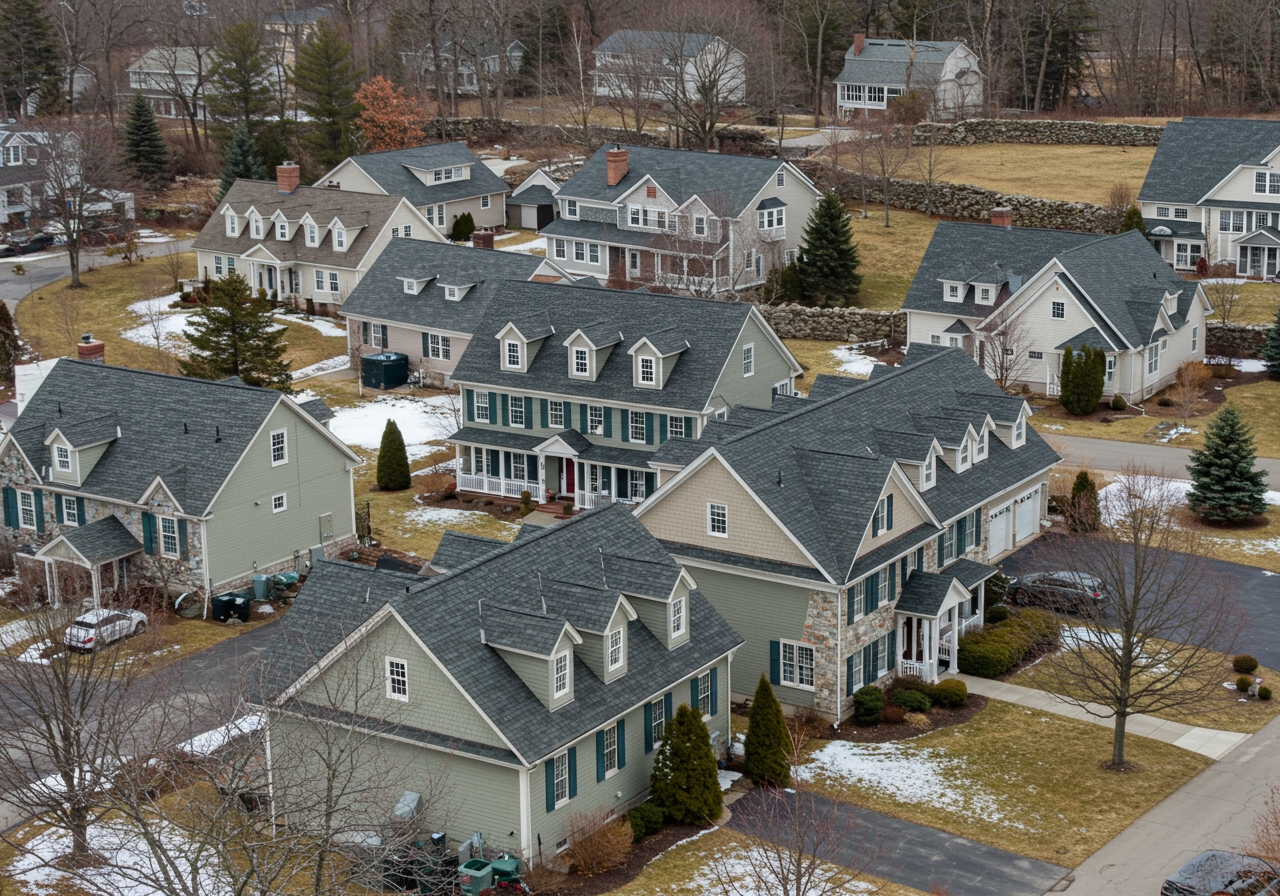
A well-executed HOA roof replacement in Pomfret
A well-executed HOA roof replacement in Pomfret should balance neighborhood aesthetics with high-performance wind protection.
Also, check the Better Business Bureau guidelines for roofing contracts. A good contractor who knows how to work with HOAs will provide a "Board Package"—a pre-made folder with their license, insurance, shingle samples, and a project timeline that you can hand directly to the architectural committee. If a contractor rolls their eyes when you mention the HOA, they are probably going to be a nightmare to work with when the board starts asking for "site cleanup" or "noise ordinance" compliance.
6. Winning the Appeal: How to Pivot When the Board Says No
If your request for a specific, weather-resilient material is denied, don't just grumble at the Vanilla Bean Café and give up. Most HOA decisions can be appealed if you can prove the decision was "arbitrary or capricious." In roofing terms, this means showing that the board is forcing you to use a product that is demonstrably worse for your home's safety or value.
I've found that the "Professional Opinion" route is the most effective. Get a written statement from a roofing specialist (or a weather guy like me) explaining why the "approved" shingle is a poor fit for your specific lot. Maybe your house sits on a hill that catches the brunt of Northwesterly winds. Maybe you have significant overhanging oak trees that make moss-resistant shingles a necessity, not a luxury.
Estimated Lifespan of HOA-Mandated Shingles vs. Performance Upgrades
When you frame the argument as "long-term asset protection" rather than "I just like this color better," boards tend to listen. They have a fiduciary duty to maintain property values. If you can prove that a better roof prevents future insurance claims for the whole association (by preventing common-wall leaks or ice dam damage), you've moved from being a "difficult homeowner" to being a "visionary neighbor."
March in Pomfret is a time of transition. The sap is running in the maples, the peepers are starting to wake up in the wetlands, and your roof is finally shedding its winter coat of ice. Don't let a stale set of bylaws prevent you from giving your home the protection it deserves. Take the time to understand the "why" behind your HOA's rules, and then use the "how" of Connecticut weather reality to get the roof you actually need.
Struggling with HOA requirements?
Get a detailed, board-ready roof estimate that matches your community's rules and Pomfret's weather.
No credit card required • Free to use
Get Your Free Roof Quote
Enter your zip code to get started