Key Takeaways
- Expect base prices for a standard 2,200 sq. ft. New Milford home to land between $14,640 and $22,300 in 2026.
- The "0% Financing" trap often hides a 12% to 15% project markup—always ask for the "cash price" first.
- Decking replacement (plywood) is the #1 "hidden" cost that blows New Milford budgets by $2,400 or more.
- Verify local registrations through the state portal to avoid out-of-state "storm chaser" scams.
Looking back at the Litchfield County building permit archives from 2008, it's wild to see how much the New Milford "roofing reality" has shifted. Back then, a couple of grand and a handshake at the local diner could get your 3-tab shingles swapped out. Fast forward to March 2026, and the math has become significantly more complex. We aren't just paying for shingles anymore; we're paying for specialized petroleum-based logistics, heightened Connecticut insurance premiums, and a labor market that is tighter than a drum. I've reviewed dozens of local estimates recently, and the price spread across Aspetuck Hill and down through Lanesville is wider than I've ever seen.
1. The "Square" Math: What New Milford Contractors Actually Charge
When a contractor walks your property near the Village Green, they aren't thinking in "square feet." They think in "squares" (a 10×10 area). In New Milford, I'm seeing 2026 labor and material bundles hitting $580 to $820 per square for architectural shingles. If you have a steep-pitch Victorian or a sprawling ranch over by Candlewood Lake, that number climbs fast.
I recently helped a homeowner off Poplar Street who received three quotes: $13,500, $19,200, and $27,000. The $13,500 guy? He "forgot" to include the removal of the second layer of old shingles. That's a $2,800 mistake that would have been "discovered" the moment the crew stepped on the roof. This is why I tell people to see what other Connecticut homeowners experienced with their crews before they pick the lowest number on the page.
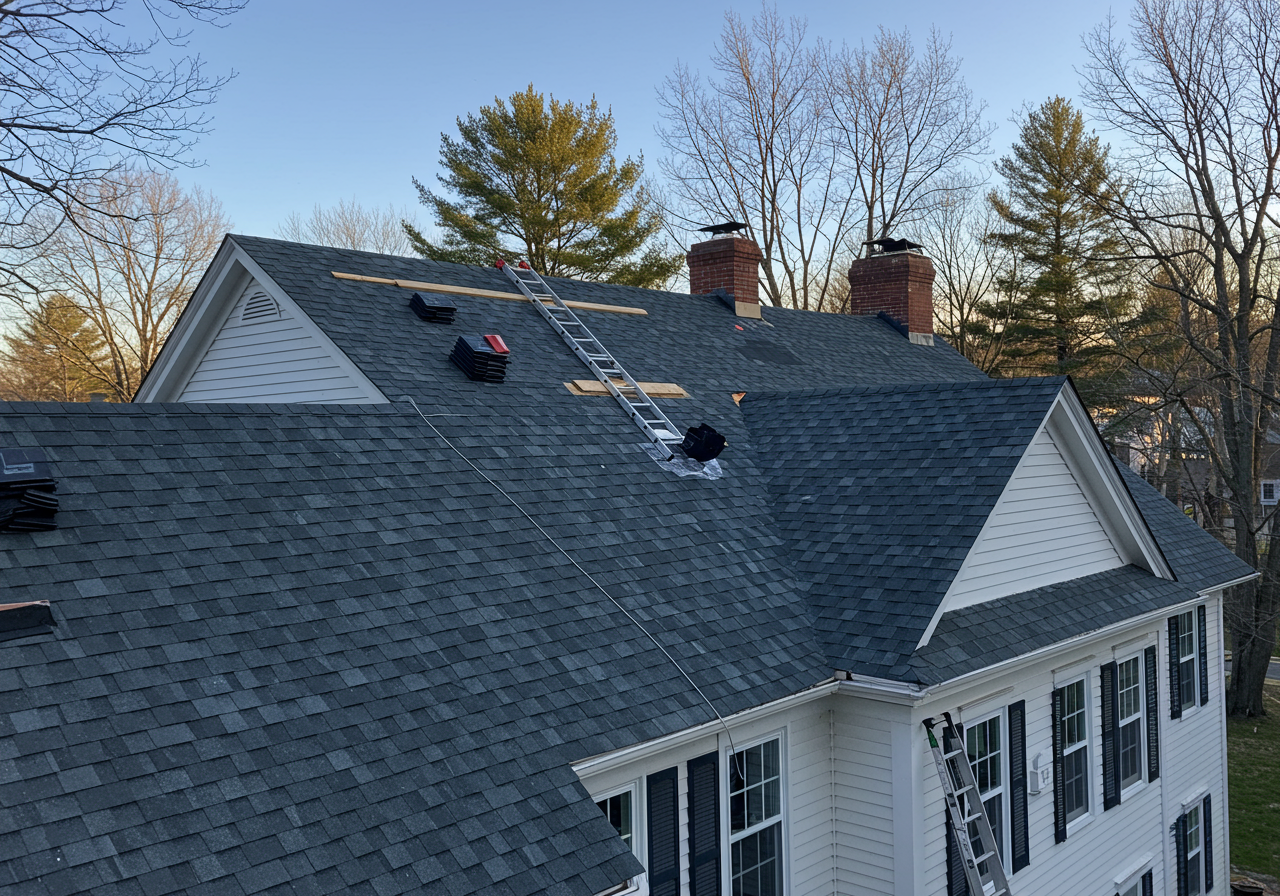
New Milford roofing estimates vary block by block
Litchfield County architecture—from lakefront ranches to steep Victorians—changes labor, safety gear, and waste math on every job.
Understanding the steep-pitch penalty
New Milford has a lot of beautiful, older homes with high-pitched roofs. If your roof is too steep to walk on without ropes, expect a 15% "steep charge." It's not a cash grab; it's the cost of keeping the crew from sliding into your flower beds.
2. Material Realities: Shingles vs. Metal in 2026
We've seen a massive push toward metal roofing in Litchfield County lately, mostly because people are tired of the March wind gusts ripping tabs off older roofs. But the price jump is no joke. While architectural shingles might cost you $18,400 for a standard job, a standing-seam metal roof will easily clear $42,000.
Roofing lifespan in Connecticut weather
I usually suggest that if you plan on living in your home for less than 12 years, the metal upgrade rarely "pays for itself" in resale value. However, if this is your "forever home" near the Housatonic, that 50-year lifespan starts to look like a genius move.
The impact of petroleum costs
Remember that shingles are basically rocks stuck to oil. When oil prices fluctuate, shingle prices move in lockstep. I've seen quotes change by $1,200 in a single week because a supplier's surcharge kicked in.
3. The Hidden Cost of "Rotten" Surprises
The biggest budget-killer in New Milford isn't the shingles—it is what's underneath them. If your roof has been leaking slowly (and most have), the plywood decking is likely soft. In 2026, a sheet of CDX plywood installed can run you $95 to $115.
"The worst thing a homeowner can do is insist on shingling over bad wood. It's like putting a tuxedo on a man who hasn't showered in a month. The foundation is what matters."
If your contractor doesn't give you a per-sheet price for plywood replacement in the initial contract, you're leaving yourself open to a massive "change order" mid-project. I always tell my clients to verify a crew's license and registration before you sign and then demand a line-item price for decking.
Chimney flashing and lead work
Many homes in our area have massive stone chimneys. Re-flashing these isn't a "standard" task. If your quote just says "flashing included," they might just be gooping on some roof cement. Real lead-flashing work for a New Milford chimney can add $850 to $1,400 to the bill.
4. Financing Fails: The "0% Interest" Myth
"No payments for 12 months!" sounds great when you're staring at a $21,000 bill. But here is the Dana Jackson reality check: the contractor is paying a "dealer fee" to that bank (usually 8% to 14% of the project total) to offer you that deal. And guess what? They've baked that fee right into your quote.
Roof financing vs. cash payment
Pros
- Preserves your cash on hand
- Low monthly payments
- Can afford higher-quality materials
Cons
- Project cost is often 10%+ higher
- Harder to negotiate the base price
- Hidden 'dealer fees' in the fine print
If you want the best deal, ask for the "Cash/Check Price" first. Then ask for the financing price. If the jump is more than $2,000, you're better off looking at a Home Equity Line of Credit (HELOC) from a local bank in town. Our roofing cost and contractor guides in the blog library have more on how to navigate these financial traps.
5. The "Dana Jackson Audit": How to Negotiate Your Quote
Don't just look at the bottom number. You need to look at the "waste factor." Standard roofs have about 10–12% waste. I've seen shady contractors bump that to 20% to pad the bill. Ask them, "What is the specific waste percentage you calculated for my gables?" If they can't answer, they're guessing (and you're paying).
The three-quote rule
Get one high-end specialist, one mid-range local, and one value-focused builder.
The eLicense check
Run their name through the CT eLicense portal before they step on your grass.
The 'rotten wood' buffer
Set aside $1,500 in a separate 'oh no' fund specifically for decking.
The magnet sweep demand
Ensure the contract requires a rolling magnet sweep for nails in your driveway.
Also, check for the permit fee. Some contractors try to charge $500 for a permit that costs the town significantly less. According to Connecticut's home improvement consumer protections, all contracts over $200 must be in writing and include a notice of your right to cancel within three days. Use that time to breathe and look at the math one last time.
For active registrants, cross-check names at Connecticut's eLicense lookup so you know who is actually cleared to work as a home improvement contractor in the state.
Final thoughts for New Milford homeowners
Don't let the pressure of a "March Special" force you into a bad financial spot. A roof is a 25-year investment. If a deal feels too good to be true, it's probably because they're cutting corners on the underlayment or the ice and water shield (which is mandatory in CT).
If you're tired of the sales pitches and just want a straight answer, we can help. ZikQuote connects you with vetted crews who actually know how to work with New Milford's specific architecture and climate.
Get Your Free Roof Quote
Enter your zip code to get started
FAQ: New Milford roofing costs

About Dana Jackson
Verified ExpertDana Jackson is a Homeowner Advocate & Cost Analyst who helps Connecticut families navigate the financial aspects of roofing projects. She specializes in finding the best value and avoiding common pricing pitfalls.