Key Takeaways
- Historic New Haven roofs require specialized expertise—standard contractors often miss critical structural issues.
- 62% of historic roofs need partial or total re-decking due to hidden wood rot discovered after tear-off.
- Historic District Commission approval can take 4-8 weeks and requires specific materials—plan ahead.
- Long-term value: Synthetic slate at $31,000 can save $8,000 over 40 years compared to two asphalt replacements.
While a homeowner in a 1990s cul-de-sac in Cheshire might worry about shingle color, a New Haven resident in a 1910 Queen Anne in Westville is playing an entirely different game. Most roofing articles treat every house like a cardboard box with a lid, but if you live near the Yale Bowl or tucked into the streets of Wooster Square, your roof is a complex piece of engineering that has likely been modified half a dozen times since the Great Depression. The difference between a "standard" roof replacement and a historic restoration in New Haven County isn't just the price tag—it's the level of liability you're taking on. If you hire a crew that treats your 120-year-old slate like a weekend ranch-style job, you aren't just losing money; you're potentially compromising the skeleton of your home.
The "Old Home" Penalty: Why Your First Quote Is Probably Wrong
I've looked at thousands of estimates, and the most common mistake I see with historic New Haven properties is the "over-simplified bid." A contractor pulls up, looks at the roof from the curb, and gives you a price based on the square footage. But on an older home, the square footage is the least of your concerns. You have multiple layers of old wood shakes hiding under three layers of asphalt. You have decorative cornices that require custom copper work. And you likely have a deck that hasn't seen the light of day since 1945.
Last year, I helped a couple near Edgerton Park who received a $14,800 quote for a "simple" tear-off. Once the shingles came up, they found 1x12 planking that was so rotted it looked like Swiss cheese. The change order for new decking alone added $6,400 to the bill. If your contractor isn't talking about "re-decking" or "structural load" in their first walkthrough, they aren't being honest about the reality of a century-old roof. I always tell people to verify their contractor's license and ask specifically about their experience with plank-style decking before the first dumpster arrives on the lawn.
Structural Integrity: The Weighty Issue of Modern Materials
Here is a piece of math that most roofers ignore: weight. Your home was built when materials were sourced locally and rafters were sized for specific loads. A modern "designer" asphalt shingle can weigh up to 450 pounds per square (a 10x10 foot area). If you are putting that over old cedar shakes or multiple layers of existing material, you are putting thousands of pounds of extra pressure on a frame that has been settling for a hundred years.
I once walked through an attic in the East Rock neighborhood where the rafters were literally bowing because a previous owner had layered architectural shingles over old slate. It's a recipe for a structural collapse during a heavy February snow. You need to know exactly what is going on top of your house. If you're considering a move from traditional to modern materials, check our blog library for detailed guides that break down the technical specs of different weights and their impact on older framing.
Never allow a contractor to 'nail over' existing shingles on a historic home.
The Regulatory Maze: New Haven's Historic District Commission
If you live in a designated historic district, your roof isn't just yours; it's a matter of public record. New Haven takes its preservation seriously. Whether you're on the Green or in the Quinnipiac River Historic District, you cannot just slap on a charcoal gray shingle because it was on sale at the big-box store. You need a Certificate of Appropriateness.
I've seen homeowners get fined $250 a day because they started a project without HDC approval. It's not just about color—it's about profile and material. If your house originally had slate, they might require a synthetic that mimics the thickness and texture. This process can take 4 to 8 weeks before a single nail is driven. Make sure you check Connecticut's Home Improvement Consumer Protection laws to ensure your contract includes a clause about municipal approvals.
Determine if your property is within a New Haven Historic District.
Check the city's historic district map or contact the Historic District Commission office directly.
Select materials that meet the HDC's 'visual compatibility' standards.
This often means synthetic materials that mimic the original appearance, not just color matching.
Submit a formal application with samples and photos to the Commission.
Include detailed material specifications and professional photos of your current roof condition.
Attend the public hearing (if required) to defend your material choice.
Be prepared to explain why your chosen materials meet preservation standards.
Receive your Certificate of Appropriateness before signing the final work order.
Never start work without this certificate—fines can be $250 per day.
Material Math: When $28,000 for Slate Actually Saves You Money
Let's talk about the "show me the receipt" part of this. A standard asphalt roof in New Haven might cost you $12,500 and last 20 years. A synthetic slate or a high-end metal roof might cost $31,000 but last 50+ years. If you plan on staying in that house for the long haul, the cheaper option is actually the more expensive one over time.
I recently did the math for a homeowner in Westville. Their asphalt roof was failing at year 17. When we calculated the cost of two asphalt replacements versus one synthetic slate installation, the synthetic option was $8,000 cheaper over a 40-year period. Plus, the synthetic slate didn't require the constant maintenance of real slate. Don't just take my word for it—see what other CT homeowners experienced with these high-end materials before you decide that the lower bid is the "smarter" move.
Expected Roof Lifespan (Years)
Flashing and Details: Where the Scams (and Leaks) Live
If you have a historic home, you likely have "valleys" and "dormers." These are the spots where the roof planes meet, and they are the number one failure point. In New Haven, where we get that wet, heavy snow in late winter, ice dams love these areas. A budget contractor will use aluminum flashing or, worse, just weave the shingles together. A restoration expert will use copper or lead-coated copper.
Copper is expensive. I'm talking $1,500 to $3,000 more for the whole job. But copper lasts 100 years. Aluminum lasts 20. If you're putting a 50-year shingle on your roof but using 20-year flashing, you've built a Ferrari with the tires of a lawn tractor. Demand a line-item breakdown of the flashing materials. If the quote just says "metal flashing," ask for the gauge and the material type in writing.
Historic Roofing Materials Comparison
| Feature | Natural Slate | Synthetic Slate | Designer Asphalt |
|---|---|---|---|
| Lifespan | |||
| Structural Reinforcement | |||
| HDC Approved | |||
| Initial Cost |
Vetting a Specialist: Questions That Make Generalists Sweat
You shouldn't hire a "roofer" for a historic home; you should hire a preservationist who happens to do roofs. When you're interviewing companies from the CT eLicense database, don't ask about their price first. Ask them how they handle "built-in gutters" (also known as Yankee gutters). Most modern roofers don't even know how to line them properly and will suggest "capping" them, which ruins the historic silhouette of your home.
Ask: "What is your plan for the chimney cricket?" or "How do you handle the transition between the main roof and the porch hip?" If they look confused or say they'll "figure it out on-site," show them the door. You want a contractor who has already dealt with the quirks of a 19th-century New Haven build. I always recommend looking at NOAA's historical storm database to see the type of wind and hail loads your specific neighborhood has faced—then ask the contractor how their installation method accounts for those specific local pressures.
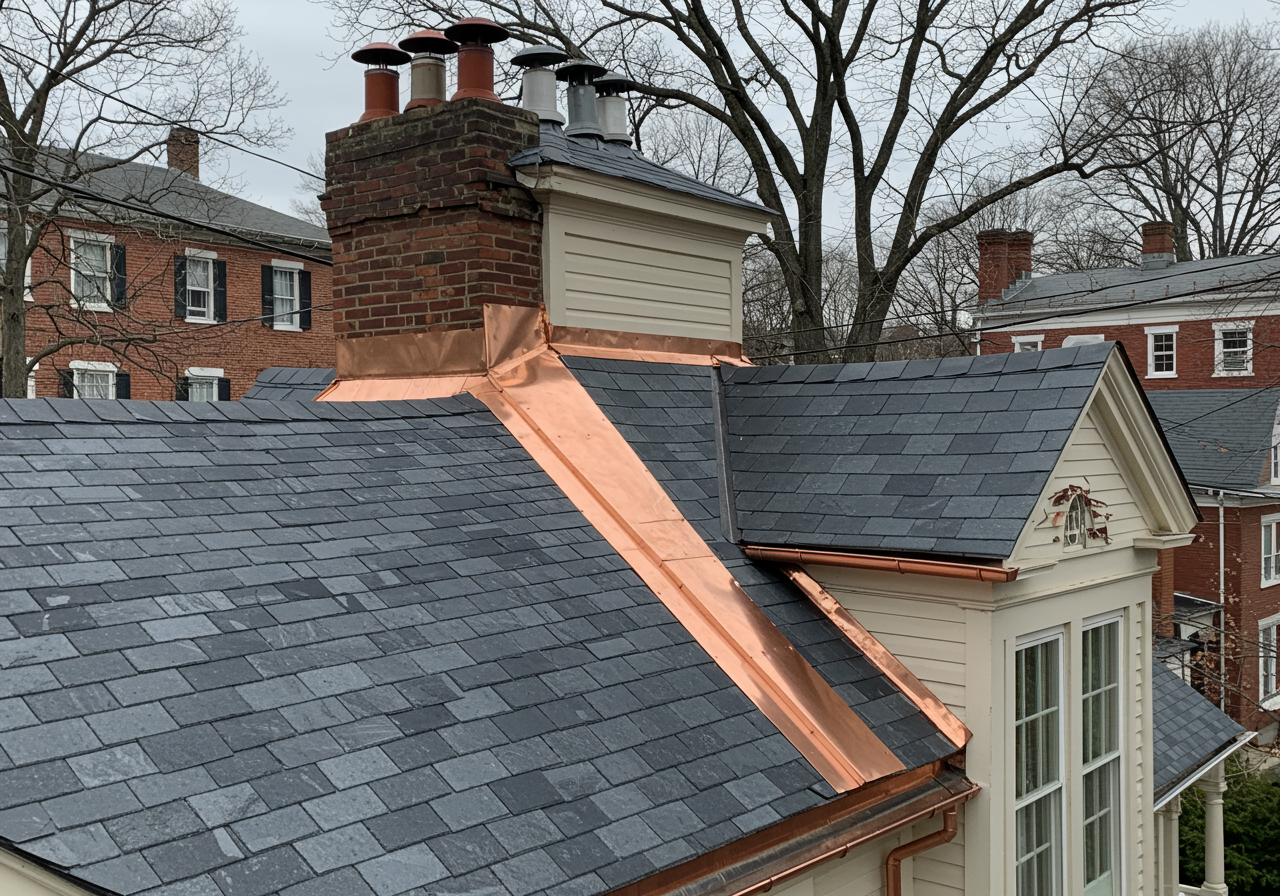
Historic Craftsmanship in New Haven
Notice the intricate copper flashing and hand-cut valley details on this Westville restoration—these are the elements that determine if a roof lasts 10 years or 50.
Financing and Protecting Your Historic Investment
Restoring a historic roof is a major capital expenditure, often hitting the $20,000 to $45,000 range for a full-scale project. However, because New Haven is part of a Certified Local Government (CLG) program, there are often state-level tax credits available for historic preservation. You can sometimes get back a significant portion of your costs if you are restoring an owner-occupied home.
But here is the Dana Jackson reality check: Financing is where the hidden costs often hide. If a contractor offers you "0% financing," they aren't doing it out of the goodness of their heart. They are likely paying a 10-15% "dealer fee" to the bank, which they've already baked into your project price. I always tell homeowners to get the "cash price" first, then see what the financing does to that number. Put the numbers on paper before you sign anything.
Get Your Free Roof Quote
Enter your zip code to get started
The goal isn't just to get a roof that doesn't leak; it's to protect the value of one of your biggest assets. In a city like New Haven, where the architecture is our identity, doing it right the first time is the only way to save money in the long run.
Frequently Asked Questions

About Dana Jackson
Verified ExpertDana Jackson is a Homeowner Advocate & Cost Analyst who helps Connecticut families navigate the financial aspects of roofing projects. She specializes in finding the best value and avoiding common pricing pitfalls.