
Key Takeaways
- Ice dams form when warm attic air melts snow on the roof deck, which then refreezes at the cold eaves.
- Prevention costs ($2,100 for air sealing and insulation) are far less than reaction costs ($14,500 for complete roof failure).
- Gutters don't cause ice dams—they're just convenient scaffolds for ice to grow on.
- A 'cold roof' system with proper insulation and ventilation prevents ice dams and saves 15% on heating bills.
"If you find yourself standing in a Tolland County snowbank with a roof rake every February, you haven't fixed the problem—you're just managing a symptom of a house that's leaking money through the rafters."
Most homeowners in Coventry look at a massive icicle and blame the gutters. I'm here to tell you that the gutters are just the innocent bystanders. The real culprit is the heat you paid for downstairs ending up in your attic. When your roof deck hits 33 degrees while the outdoor air is still freezing, you've got a physics problem that no amount of gutter cleaning will solve. I've seen neighbors near Wangumbaug Lake spend thousands on "emergency steaming" every three years because they refused to spend $1,800 on proper air sealing. Let's look at the actual math of why your roof is melting from the inside out and how to stop the "thaw-freeze" cycle before it hits your drywall.
The Real Physics of the Coventry Ice Dam
Ice dams don't start on your shingles; they start at your ceiling fixtures. In many of the older capes and colonials we see around Coventry, warm air escapes through "bypasses"—tiny gaps around chimney flues, pull-down stairs, and recessed lighting. This warm air collects at the peak of your attic, warming the roof deck. When snow hits that warm wood, it melts, runs down to the cold eaves (which aren't over the heated living space), and flash-freezes.
I always tell people to think of their roof like a bridge. The part over your house is heated; the part over your porch or soffits is a frozen island. That's where the "dam" builds up, backing water under your shingles. If you want to dive deeper into how different materials handle this stress, our roofing insights library has a few deep dives on shingle resilience. The goal isn't just to move the ice; it's to keep the roof deck at the same temperature as the Great Outdoors.
The $2,140 Attic Insulation Reality Check
Most people think "more insulation" is the magic bullet. But if you throw fiberglass batts over an open air leak, you're just giving the warm air a filter to pass through. I recently reviewed a quote for a homeowner near Route 31 who was told they needed a $15,000 roof replacement to stop leaks. In reality, they needed $2,140 worth of spray foam air sealing and blown-in cellulose.
Prevention vs. Reaction Costs (CT Averages)
When you look at those numbers, the "preventative" spend is the only one that builds equity. If a contractor tries to sell you a "waterproof" roof without looking in your attic, they are selling you a bucket, not a fix. You want to see R-49 to R-60 insulation levels for our part of Connecticut, but only after those air leaks are plugged.
Why Your Gutters Aren't the Villain
I hear it every year: "Dana, if I just get larger gutters, the ice won't have anywhere to sit." Wrong. Gutters don't cause ice dams, though they certainly provide a convenient scaffold for them to grow on. In fact, even if you removed your gutters entirely, the ice would still dam up at the roof edge.
The only role gutters play is that they can become heavy enough with ice to pull away from the fascia board, causing structural damage. If your gutters are already sagging, getting a professional repair assessment is smarter than waiting for the next 10-inch snowfall to rip them off. I've seen 40 feet of aluminum gutter come down like a guillotine because of a 4-inch ice build-up. It's not just a leak issue; it's a safety hazard for anyone walking near the drip line.
A Step-by-Step Prevention Strategy for 2026
If you're planning to stay in your home for the next decade, you need a systematic approach. Don't let a "storm chaser" convince you that a few heat cables are a permanent solution. Those cables are basically a $400-a-year electricity bill wrapped around your shingles.
Conduct an attic 'bypass' hunt
Find where heat is escaping through gaps around chimneys, plumbing stacks, and light fixtures.
Seal gaps with fire-rated foam
Use fire-rated foam to seal gaps around the chimney, plumbing stacks, and light fixtures.
Verify soffit vents are clear
Ensure soffit vents are not blocked by old insulation that prevents proper airflow.
Install baffles at the eaves
Install baffles at the eaves to ensure airflow from soffit to ridge vent.
Upgrade insulation to R-49 or higher
Upgrade insulation to at least R-49 using blown-in cellulose or mineral wool.
I once helped a couple in Coventry who had spent three years "salting" their roof with nylon stockings filled with calcium chloride. Not only did it kill their foundation plants, but the salt also corroded their aluminum flashing. We replaced the salt-stocking method with four hours of air sealing, and they haven't seen a leak since.
The 'Quick Fix' Trap: Steam vs. Hammers
When the water starts dripping behind your window casing, panic sets in. This is when homeowners make expensive mistakes. I've seen people up on ladders with hammers and hatchets. One slip, and you've punched a hole through a frozen shingle, turning a minor leak into a catastrophic one.
Warranty Warning
If you have an active leak, hire a professional steam crew. It usually costs between $450 and $900 for a few hours of work. It's expensive, but it's the only way to clear the dam without destroying the granules on your shingles. While you're at it, check the NWS Historical Storm Database to see if recent local weather justifies a full insurance inspection for wind or hail damage that might be making your ice dam leaks worse.
Local Codes and Ventilation Realities in Coventry
Connecticut building codes are specific about "ice and water shield" membranes. In Coventry, you're generally required to have this waterproof barrier installed from the eave up to a point at least 24 inches inside the interior wall line. But here's the Dana Jackson truth: that membrane is a secondary defense. It's a "safety net," not a "prevention."
The 1:300 Rule
If your roofer isn't calculating your "Net Free Vent Area," they aren't doing their job. I always insist on seeing the math. If you have 1,200 square feet of attic, you need 4 square feet of total vent space—split evenly between the bottom (soffits) and the top (ridge). Anything less and you're just trapping moisture.
Contractor Red Flags: Spotting the Storm Chasers
After a heavy winter, Coventry gets flooded with out-of-state "specialists." They'll knock on your door and tell you they can "guarantee" no more ice dams. Be skeptical. Any contractor who promises to fix ice dams without entering your attic is someone you should walk away from.
Before you sign anything, check Connecticut's consumer protection laws regarding home improvement contracts. You have rights, including a three-day right to cancel. Also, watch their crew. If they aren't using proper harnesses or toe boards on a steep pitch, they are violating OSHA fall protection standards. If an uninsured worker falls off your roof, that "cheap" ice dam fix could become a million-dollar liability for you.
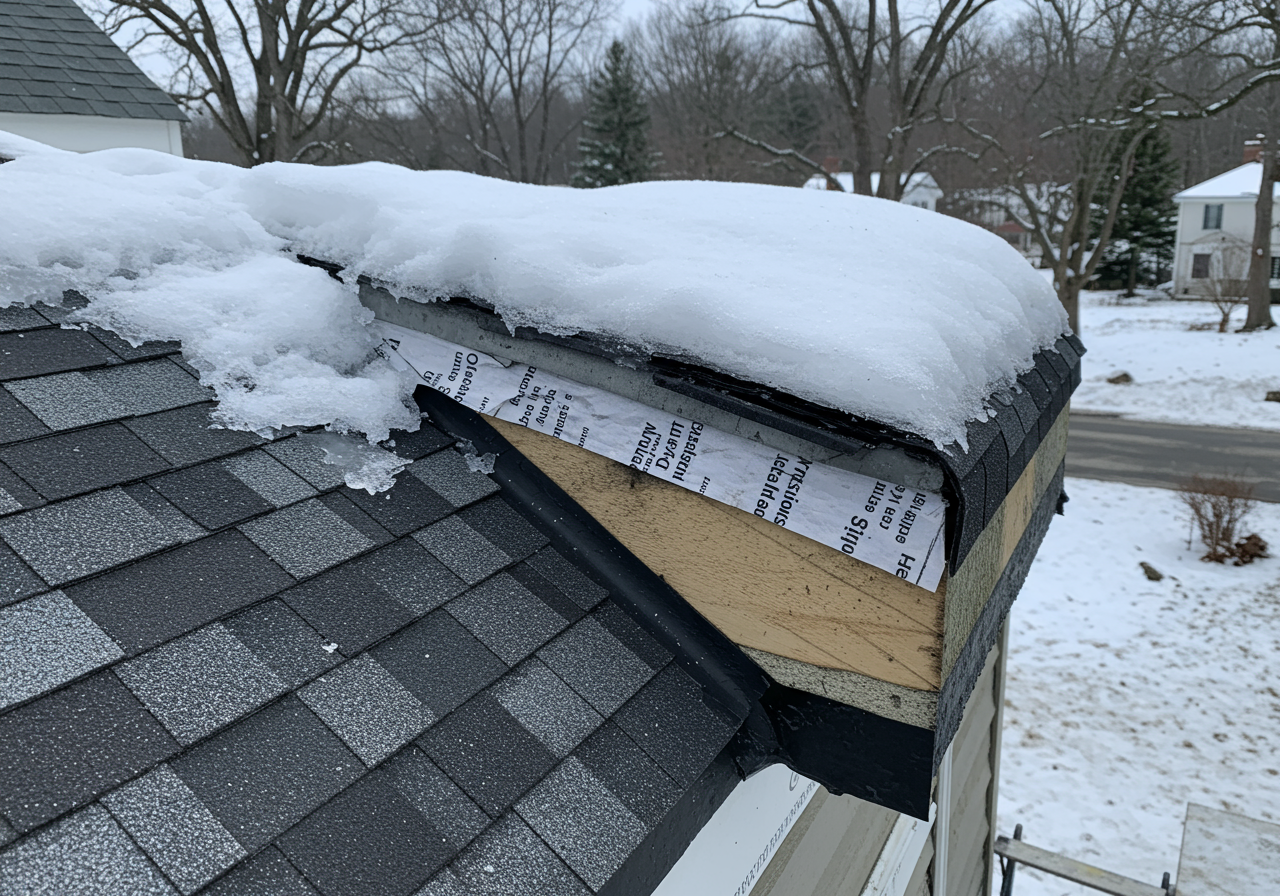
Proper Eave Protection
A professional roofing crew installing thick ice and water shield membrane along the eaves of a Coventry home during a winter renovation.
The Long-Term ROI of a Cold Roof System
The ultimate goal for any Coventry home is a "cold roof." This doesn't mean your house is cold; it means your roof deck stays within a few degrees of the outside air. The ROI here isn't just about avoiding leaks. A well-ventilated, well-insulated roof saves you roughly 15% on your winter heating bills and prevents your AC from working overtime in July.
I've seen dozens of cases where a $2,500 investment in attic remediation added $5,000 to the home's resale value because the home inspector couldn't find a single water stain. Don't just take my word for it— see what other CT homeowners experienced when they stopped chasing leaks and started fixing their homes' thermal envelopes.
Get Your Free Roof Quote
Enter your zip code to get started
In conclusion, ice dams are a message from your house that your money is escaping through the ceiling. Fix the heat loss, balance the ventilation, and you can stop dreading the February thaw. Put your numbers on paper, check your R-values, and don't let a contractor sell you a shingle-only solution for an attic-sized problem.