
Key Takeaways
- Litchfield's historic aesthetic requires materials that mimic wood or slate without the maintenance headaches.
- Materials must handle the heavy 'wet' snow loads common in the Northwest Hills.
- High-end architectural shingles and metal systems often offer a 60-70% return on investment at resale.
- Modern 'cool' roof technologies can shave 12% off summer cooling costs, even in our shaded hills.
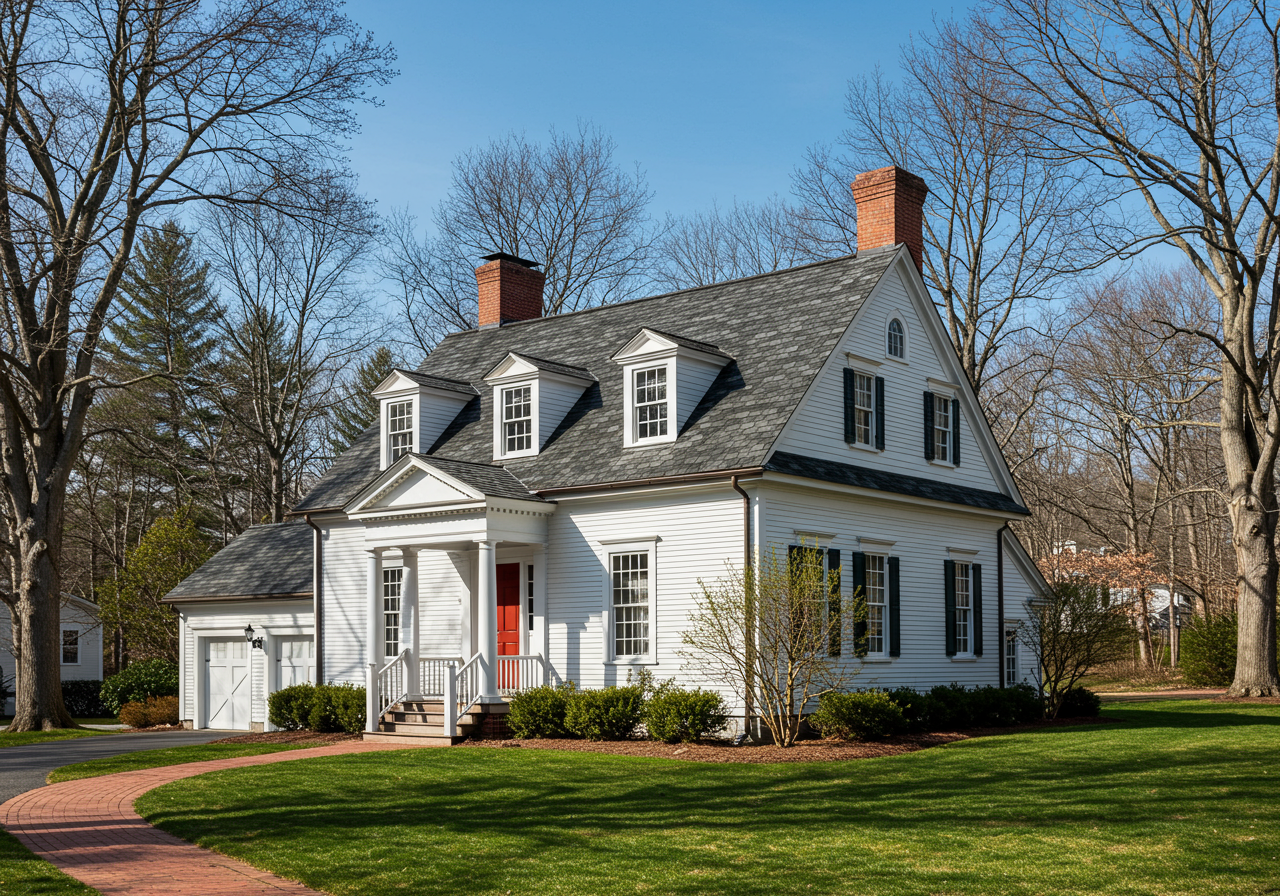
A classic Litchfield Federal-style home with architectural shingles complementing the historic architecture
Wide angle view showing the roofline against the Northwest Hills landscape
A few months back, I spent an afternoon with a family on North Street—the kind of classic Litchfield property that looks like it belongs on a postcard. They were struggling with a dilemma that hits many of us in the Northwest Hills: their roof was "fine" from a distance, but the 19-year-old asphalt was curling at the edges, and they were tired of the annual "ice dam anxiety." They wanted a material that didn't just keep the attic dry but actually elevated the Federal-style architecture of their home. We sat on their porch, looking at samples, and realized that in a town as design-conscious as ours, your roof is basically the "hat" of your home's outfit. If it doesn't fit the style or the climate, the whole look (and your resale value) suffers.
The Litchfield Aesthetic: Why Material Choice is a Neighborhood Statement
When you're driving past the Litchfield Green or heading toward Bantam, you notice a specific rhythm to the houses. We have a heritage to protect here. Choosing a roofing material isn't just a technical decision; it's a conversation with your neighbors. I always tell homeowners that if you live in a colonial or a converted barn, a bright blue shingle is going to feel like a shout in a library. You want a whisper.
Balancing Historic Charm with Modern Durability
The challenge we face in Litchfield County is finding that sweet spot between 18th-century looks and 21st-century performance. Many of my neighbors are moving toward synthetic shakes. They give you that deep, rugged texture of hand-split cedar but won't rot when the March dampness settles in. I remember a project near Milton where the owner was adamant about real wood, but after we looked at the FEMA guidelines for low-slope protection on his porch addition, he realized a synthetic-metal hybrid was the only way to prevent the leaks he'd been fighting for three seasons.
Sheri's Style Tip
Asphalt Shingles: The Practical Hero of Litchfield County
Let's be real: about 74% of the roofs I see in our neck of the woods are asphalt. But there's a massive difference between the flat, "paper-thin" shingles of the 90s and the heavy-duty architectural shingles available today. I've seen houses in the Northwest Hills transform overnight just by switching to a high-definition shingle that has some actual "heft" to it.
Why Architectural Shingles Win Over Three-Tab
The wind doesn't just blow in Litchfield; it swirls through the valleys. Standard shingles can catch that wind like a sail. Architectural shingles are laminated and much heavier, which is why they usually come with 110-mph to 130-mph wind ratings. If you're starting to see granules in your gutters or bald spots on the peaks, it might be time to get an estimate for a full replacement rather than just patching the problem.
Roofing Lifespan by Material in CT
The Metal Revolution in the Northwest Hills
I used to hear people say that metal roofs were only for barns or commercial buildings in Torrington. That's changed. I'm seeing more standing-seam metal roofs on residential homes in Litchfield than ever before. Why? Because they shed snow like a dream.
Standing Seam vs. Stone-Coated Steel
Last winter, a friend of mine near Mount Tom State Park watched as three feet of snow slid right off her new metal roof in one clean "whoosh," while her neighbor spent the weekend on a ladder with a roof rake. It's a safety issue as much as an aesthetic one. If you love the look of traditional shingles but want the "forever" nature of metal, stone-coated steel is a fantastic middle ground. It gives you the profile of a heavy shingle but the iron-clad protection of steel.
Watch Out for Ice Dams
And if you're worried about the upfront price, you can calculate potential costs to see how the numbers balance out over the 50-year lifespan of a metal system compared to doing two asphalt jobs in the same timeframe.
Slate and Synthetic Alternatives: Luxury That Lasts
We have some truly grand estates in Litchfield that were built with genuine slate. It's beautiful, it's permanent, and it weighs about as much as a small car. I once worked with a couple who wanted to restore an old carriage house, but the structural engineers told them the rafters couldn't handle the weight of real slate.
The Weight of Tradition (and the Roof Structure)
This is where synthetic slate has become a game-changer. You get the "Borough of Litchfield" look without having to reinforce your entire home's skeleton. It's made from recycled polymers and looks so convincing that even from the sidewalk, it's hard to tell it isn't stone.
Synthetic Slate vs. Real Slate
Pros
- Significantly lighter weight
- Lower installation labor costs
- Impact resistant (hail/branches)
Cons
- Higher upfront cost than asphalt
- Requires specialized installers
- Newer technology (shorter track record)
If you're currently dealing with a few broken slates or a persistent drip near the chimney, sometimes a targeted professional repair is all you need to buy a few more years. But if the "flashing" (the metal bits around the edges) is rusted through, it's usually a sign the whole system is reaching its limit. For those looking for financial assistance with these major upgrades, USA.gov provides a portal for home repair assistance that can be a lifesaver for preserving historic properties.
Did You Know?
Did you know that 'cool roofs' aren't just for California? Even in Connecticut, a roof that reflects more sunlight can reduce your attic temperature by up to 43°F on a humid July afternoon.
Get Your Free Roof Quote
Enter your zip code to get started
In the end, your roof is the first line of defense against everything Connecticut throws at us—from the heavy slush of March to the blazing sun of August. Whether you're aiming for the rugged charm of a synthetic shake or the clean lines of a modern architectural shingle, make sure it's a choice that makes you smile every time you pull into the driveway. After all, a house in Litchfield isn't just a building; it's a piece of the hill.