
Key Takeaways
- Historic homes require specialized decking replacement that can add $3,700+ to your quote—always ask for line-item pricing.
- Connecticut code allows two layers of shingles, but the weight on 150-year-old timber frames can cause structural sag costing $20,000+ to fix.
- 95% humidity in January creates a 'steam room' effect that accelerates cedar shake failure—synthetic alternatives save thousands.
- Copper flashing costs $25-40 per linear foot vs $8 for aluminum, but provides 1:1 ROI during home appraisals in Litchfield County.
Right now, the air in New Milford is sitting at a damp 37°F with a heavy 95% humidity. If you own one of the classic saltboxes or Victorians near the Village Green, that moisture isn't just making the morning chilly—it's actively testing the limits of your roof's ventilation. In January, we see a lot of "phantom leaks" in Litchfield County, which are often just condensation trapped in old, uninsulated attics. Before you assume you need a total replacement, you need to understand the unique financial and structural rules that apply to our local historic stock.
1. The Hidden Cost of "Grandfathered" Structural Codes
A common mistake I see homeowners make is assuming that because their home has stood since 1880, it's "grandfathered" into modern safety. That's a myth that gets expensive fast. When you strip a roof in Connecticut, the International Code Council standards usually require the underlying deck to be up to current par.
If your contractor finds "spaced decking" (those old 1x6 boards with gaps between them), they can't just nail new shingles over them. They have to sheath the entire thing in plywood. I recently looked at an estimate for a home on Aspetuck Ridge Road where the homeowner was quoted $12,000, but the final bill hit $15,700 because the contractor "forgot" to mention the 45 sheets of CDX plywood required by code. If the quote doesn't explicitly mention the price per sheet for decking replacement, you're looking at a trap.
2. The Two-Layer Limit in Litchfield County
I've had people tell me, "Dana, can't we just throw a second layer of shingles on to save cash?" In New Milford, the answer is almost always a hard no—especially for historic properties. While CT code technically allows two layers, the weight is the killer.
The Weight Problem
Most of our local historic rafters are "true" lumber, which is strong, but they've also weathered a century of New England winters. They have "memory" in the wood. Adding a second layer increases the risk of a structural sag that will cost $20,000+ to jack back up. Always pay for the tear-off. It's the only way to see if your 1850s chestnut rafters are actually holding firm.
3. Why January's 95% Humidity Slaughters Old Cedar
With humidity levels hitting 95% this week, your roof is effectively sitting in a steam room. For historic homes with cedar shakes, this is the danger zone. Wood is hygroscopic—it drinks that moisture. If your shakes weren't installed with a "breather" mesh underneath, they stay saturated.
I've seen cedar roofs in the Northwest Hills fail in just 14 years because the installer treated them like asphalt. They didn't account for the micro-climate here. If you're seeing dark streaks or moss, that's not "character"—it's a sign your roof is failing to dry out. When you get an instant roof estimate through our platform, make sure you specify if you're looking for synthetic cedar, which gives you the look without the rot-prone maintenance of real wood.
4. The Real Math on Copper Flashing vs. Aluminum
If you live in a designated historic district, the commission might insist on copper flashing. This is where the "heritage surcharge" really kicks in. Copper is currently trading at a premium, and the labor to install it is a specialized skill.
"Copper isn't just an aesthetic choice in Connecticut; it's a 70-year investment. If a contractor suggests 'painted aluminum' for a chimney flashing on a Victorian, they are devaluing the property by five figures."
Expect to pay $25 to $40 per linear foot for copper, compared to $8 for aluminum. But here's my advocate tip: copper is one of the few roofing upgrades that actually shows a 1:1 return on investment (ROI) during a home appraisal in Litchfield County. It signals to a buyer that the home was maintained with a "no-expense-spared" mindset.
5. Calculating the Weight Load of 2026 Materials
We're seeing a trend toward "heavyweight" architectural shingles. They look great because they mimic the shadow lines of slate. But a square (100 sq. ft.) of these can weigh 450 lbs. If you have an old Cape with 24-inch rafter spacing, that's a lot of stress.
Roofing Material Lifespan (Years)
Before you sign, ask: "Has anyone checked the rafter span?" If they haven't been in your attic with a tape measure, they aren't a contractor; they're a salesperson. You can how our matching process works to find pros who actually understand the structural nuances of New Milford's older inventory.
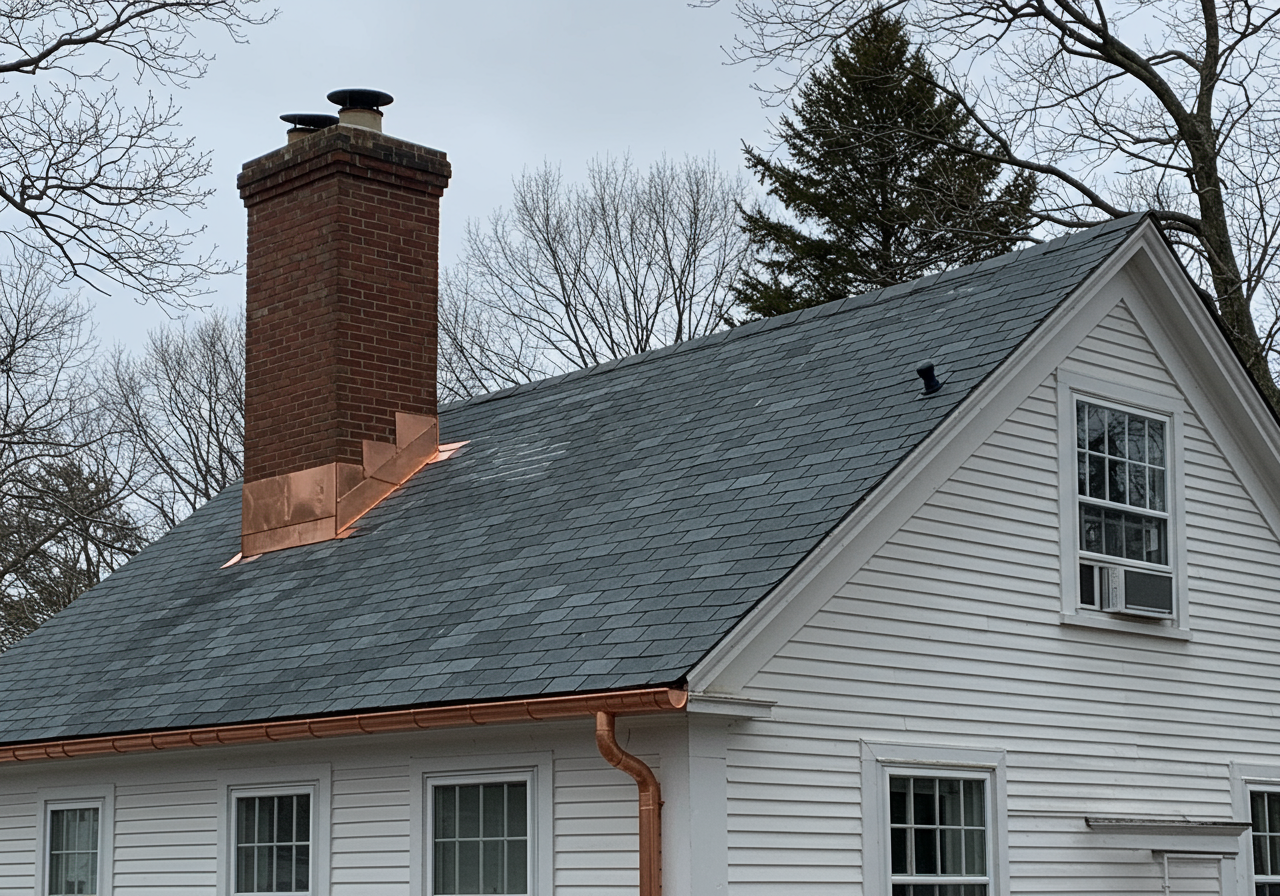
Preserving New Milford Heritage
A restored colonial home in Litchfield County featuring historically accurate architectural shingles and copper drip edges.
6. The Ice Dam Reality at 37°F
January in New Milford is "Ice Dam Season." At 37°F, snow on your roof melts during the day and freezes at the eaves at night. On historic homes, which often have "boxed eaves" or ornate crown molding, this ice can back up under the shingles and rot out your decorative trim.
Most people think more insulation is the answer. It's not. The answer is ventilation. I've seen $30,000 roofing jobs ruined because the contractor didn't install a ridge vent or properly baffeled soffit vents. If your attic is the same temperature as the 37°F air outside, you won't get ice dams. If it's 60°F up there, you're in trouble.
7. Negotiating the "Historical Surcharge"
Contractors often see a big old house in New Milford and think "deep pockets." I call this the "historical surcharge." To beat it, you need to see the line-item math.
Ask for a breakdown that looks like this:
- Material: Shingle brand and weight.
- Underlayment: Is it cheap felt or high-temp Ice & Water shield?
- Flashing: Linear footage and material type.
- Permits: In New Milford, permit fees are based on the value of the work. Make sure they aren't padding this number.
If you're looking for financial help, check USA.gov's home repair portal for potential grants or low-interest loans specifically for historic preservation and energy efficiency.
8. Verifying the Hands That Touch Your Heritage
Not every roofer is a "historic roofer." There's a massive difference between a crew that hammers out 20 squares of asphalt on a new build in Brookfield and a craftsman who knows how to tie into a 100-year-old masonry chimney.
Verify the CT HIC License (Home Improvement Contractor)
Check the Connecticut Department of Consumer Protection website to ensure they're licensed and in good standing.
Ask for 3 local New Milford references from homes built before 1920
Historic homes require different techniques—make sure they've actually worked on similar properties.
Check for specific liability insurance that covers 'open roof' periods
Historic roofs take longer to complete, leaving your home exposed. Ensure their insurance covers extended work periods.
Ensure they provide a written workmanship warranty of at least 10 years
Historic roofs are investments—protect yours with a solid warranty that covers both materials and installation.
I once helped a homeowner who hired a "budget" crew for a slate repair. They used galvanized nails instead of copper ones. Within five years, the nails rusted through, and the slate started sliding off like a deck of cards. The "savings" cost them double in the long run. Don't be that homeowner.
Get Your Free Roof Quote
Enter your zip code to get started
January in New Milford isn't the easiest time to think about roofing, but with the current 4 mph winds and cloudy skies, it's the perfect time for an inspection. You can see exactly where the heat is escaping and where the dampness is settling. Take care of the old girl; she's been through worse than a 37°F drizzle, but she deserves a roof that's built to last another century.