Key Takeaways
- Proper site protection (plywood over pavers and nets over landscaping) is the non-negotiable first step for Darien homes.
- A standard 2,500 sq. ft. roof in Fairfield County generates roughly 3.5 tons of debris that must be managed.
- Technical precision during the 'flashing phase' prevents 92% of future leaks, particularly around chimneys and dormers.
- Local Darien noise ordinances typically restrict heavy construction to between 7:00 AM and 6:00 PM on weekdays.
On one side of the Post Road, you'll find a homeowner watching a crew drop debris onto their prize-winning hydrangeas without a second thought; on the other, a project where you wouldn't even know a roof was being replaced if it wasn't for the rhythmic pulse of nail guns. The difference isn't just the price tag—it's the logistics. In a town like Darien, where property values often hover in the multi-millions, the "how" of a roof replacement matters just as much as the "what." Most contractors can nail a shingle, but few can manage a $24,800 project without turning your driveway into a disaster zone.
Here is the reality of the situation: a roof replacement is a controlled demolition of the largest surface area of your home. If you don't have a roadmap for the noise, the dust, and the 40-yard dumpsters, you're going to have a long week.
Pre-Construction: Beyond the "Drop Cloth" Mentality
Before the first shingle is pulled, the site needs to be hardened. I've seen $15,000 paver driveways in Tokeneke cracked because a dumpster was dropped without wooden sleepers underneath. A professional crew doesn't just show up; they scout the perimeter. They look for delicate light fixtures, expensive irrigation heads, and those specific "Gold Coast" landscaping features that cost a fortune to replace.
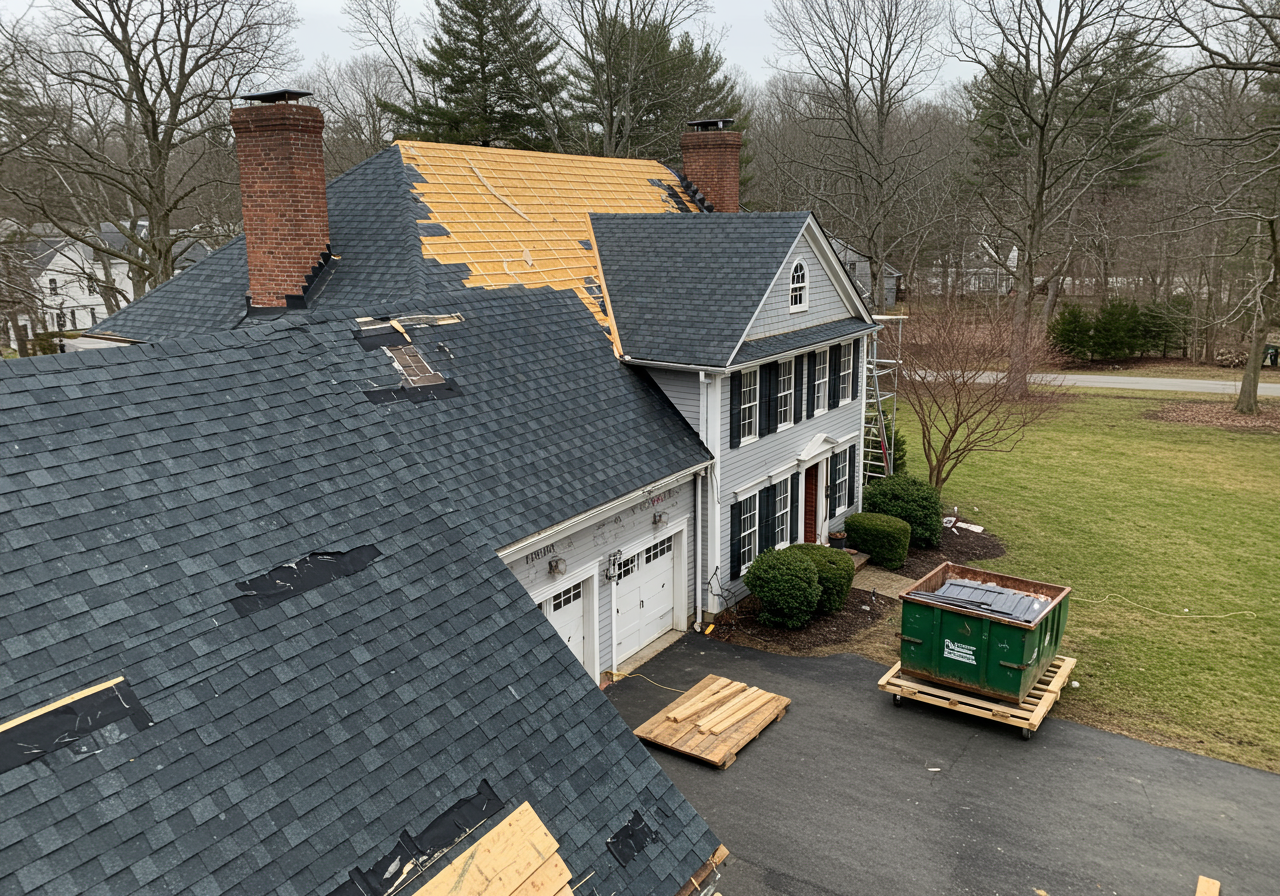
Professional Roof Replacement Site Protection
Proper site protection with plywood over pavers and catch-all netting systems keeps your Darien property safe during the replacement process.
In my experience, the best crews utilize "Catch-All" netting systems. These aren't your hardware store tarps. They are high-tensile nets suspended from the gutters to the ground, creating a slide for debris that keeps your mulch beds pristine. If a contractor tells you they'll "just be careful," that's a red flag. You want to see physical barriers. While minor leak mitigation might only require a ladder and a bucket, a full-scale replacement involves a massive influx of materials and labor that requires a tactical plan.
Protecting the Attic and Interior
Look, people forget that when we start ripping off old organic felt or plywood, things get dusty. I always advise homeowners to cover anything valuable in the attic with cheap plastic sheeting. The vibration of the pneumatic nailers—which we typically set to 95 PSI for standard architectural shingles—can occasionally rattle pictures off the walls on the top floor. It's a small detail, but it's one I've seen save a lot of heartbreak over family heirlooms.
Pro Tip for Darien Residents
The Tear-Off: What Happens When the Shingles Come Off
Once the protection is in place, the "tear-off" begins. This is the loudest part of the process. We aren't just removing shingles; we're stripping the house down to its bones (the roof deck). This is the only time we can truly see if your home has structural issues. In older Darien Colonials, we often find "skipped sheathing"—1x6 boards with gaps between them—which was common before plywood became the standard.
Estimated Project Timeline (Days)
If the decking is soft, it must be replaced. I've had to explain to many homeowners that "nailing into rot" is a recipe for a 5-year failure. According to the Department of Energy's insulation standards, this is also the ideal window to check your attic ventilation. If your roof deck looks charred or blackened from the inside, your attic isn't breathing, and your new $20,000 roof will cook from the inside out.
Managing the Debris
A typical 30-square roof (3,000 square feet) produces about 60 to 80 squares of old material once you account for multiple layers. We use specialized debris trailers that can be driven right up to the roofline, minimizing the distance trash has to travel through the air. This is a far cry from the old-school method of just throwing everything off the side and hoping for the best.
The Installation: Precision Over Speed
After the deck is prepped, the "dry-in" happens. We install ice and water shields—specifically something like Grace Ice & Water Shield—along the eaves and in the valleys. In Connecticut, code requires this to extend at least 24 inches inside the warm wall line to prevent ice dams. If you have a modern home with a flat section, we follow FEMA's low-slope protection guide to ensure the transition between the slope and the flat roof is seamless.
Precision matters. I've seen crews "high-nail," where they miss the designated nail strip on the shingle. When that happens, the shingle isn't actually secured to the one below it, and the first 50-mph gust will peel your new roof like an orange. My crews use a 6-nail pattern for every single shingle in Darien, given our proximity to the Sound and the high-wind potential during winter storms.
Architectural Shingles vs. Synthetic Slate
Pros
- Cost-effective ($5.50-$8.00 per sq ft)
- Quick installation
- Widely available colors
Cons
- Shorter lifespan (25-30 years)
- Less 'prestige' look for historic homes
- Heavier per square than some synthetics
Before you sign a contract, I highly recommend verifying local contractor ratings to see how they handle the final 5% of the job. That last 5%—the chimney flashing, the ridge vent alignment, and the final magnet sweep—is where the experts separate themselves from the amateurs. If you're looking for more technical data, our technical shingle guides offer a deep dive into specific brand performance in coastal climates.
Site Protection
Landscaping covered, dumpsters placed on sleepers.
Tear-Off
Removal of old shingles down to the wood deck.
Deck Inspection
Replacing rotted plywood and securing loose boards.
Dry-In
Installation of ice/water shield and synthetic underlayment.
Flashing
Installing custom copper or lead at chimneys and walls.
Shingling
Precise 6-nail installation of your chosen material.
Cleanup
Final magnet sweep and removal of all equipment.
If you are feeling overwhelmed by the options, there are resources like USA.gov's repair assistance portal that can provide guidance on financing and federal standards for home improvements. However, for most Darien homeowners, the best path forward is finding a partner who understands the local architecture and the high expectations of the neighborhood.
Get Your Free Roof Quote
Enter your zip code to get started

About Daniel Roberts
Verified ExpertDaniel Roberts is a Senior Roofing Consultant with over 15 years of experience in the New England residential construction industry. He specializes in storm damage assessment and energy-efficient roofing systems.