Over the last three centuries, Wethersfield has seen just about every atmospheric tantrum New England can throw. From the Great Colonial Hurricane of 1635 to the more recent "Snowtober" that snapped our ancient oaks like toothpicks, the homes in "Ye Most Ancient Town" have a history of resilience. But that history is etched into the rooflines. When you walk through Old Wethersfield, you aren't just looking at architecture; you're looking at a 300-year case study in moisture management. In my years tracking Hartford County weather patterns, I've noticed a shift. Our winters are becoming more erratic, with those late-February "false springs" followed by sudden deep freezes that turn minor shingle gaps into major structural headaches.
Lately, I've been hearing from more neighbors near the Silas Deane Highway who are weighing the "DIY vs. Pro" debate. It's tempting. The internet makes shingle replacement look like a game of high-stakes Tetris. But Connecticut's climate doesn't care about your YouTube tutorial. Between the humidity coming off the Connecticut River and the ice dams that love our colonial-style eaves, the margin for error is razor-thin. If you mess up a flashing detail on a Tuesday, you might not know it until a Nor'easter hits on Friday—and by then, your attic insulation is a soggy mess.
Key Takeaways
- Cost vs. Value: While DIY can save roughly 45% on labor, it voids most manufacturer warranties and can decrease home resale value in historic districts.
- Wethersfield Climate Risks: Improperly sealed shingles are prone to 'blow-offs' during the 50+ mph gusts common in the Connecticut River Valley.
- Structural Hazards: Professional crews identify 'soft spots' in the decking that most DIYers overlook, preventing future collapses.
- Liability Realities: Homeowner insurance often won't cover falls or property damage caused by uncertified roofing work.
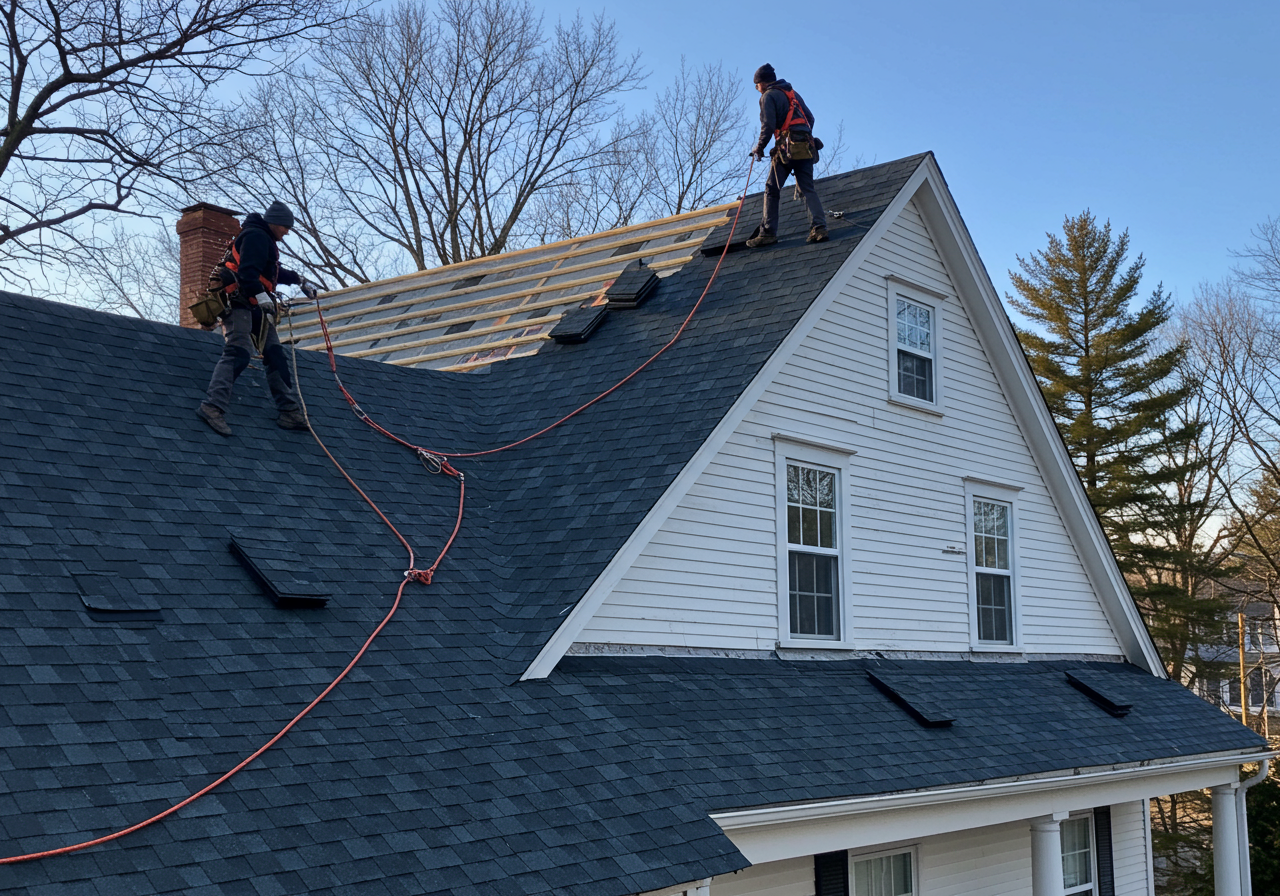
Wethersfield Roofing Challenges
Historic homes face unique weather challenges that require professional expertise
The Wethersfield Climate Factor: Why "Good Enough" Fails
In our corner of Hartford County, the weather is the ultimate building inspector. We deal with a specific phenomenon I call the "River Valley Squeeze." As weather systems move across the state, the Connecticut River acts as a funnel, often accelerating wind speeds right over our rooftops. If you're replacing shingles yourself, you might think a standard three-tab shingle is fine. But for a home near the Cove, you're looking at wind uplift forces that can strip a DIY roof in a single afternoon.
The February Thaw Trap
We are currently in the thick of February. In Wethersfield, this usually means a cycle of freezing and thawing that is brutal on asphalt. When a DIYer installs shingles during a cold snap, the adhesive strip (the "seal lap") doesn't always bond immediately. It needs consistent solar heat to activate. If you nail down a roof on a Saturday and a wind event hits on Monday before that seal has set, your shingles will flutter like a deck of cards. Professionals often use localized heat or specialized cold-weather adhesives to bypass this, something most weekend warriors don't have in their garage.
Wind Loads and the "Ancient Town" Geography
Wethersfield's flat geography means there isn't much to break the wind before it hits your gables. I've looked at FEMA's protection guides for various roof systems and the data is clear: the way a shingle is fastened—the specific "nailing zone"—determines whether it stays on or becomes a projectile. Most DIY mistakes I see involve "high-nailing," where the fastener is placed above the reinforced strip. In a storm, the shingle simply zips right off the nail head.
The $8,430 DIY Myth: Real Costs Revealed
Everyone looks at a roofing quote and sees the labor cost as "money saved" if they do it themselves. But let's do some real-world Wethersfield math. I spoke with a homeowner near High Street last year who tried to save $9,000 by doing his own ranch-style roof. By the time he rented the dumpster, bought a decent pneumatic nailer, paid for the materials at big-box retail prices (no contractor discount), and spent four weekends on the project, his "savings" had dwindled to about $3,200.
Tool Acquisition vs. Rental
To do a roof right, you don't just need a hammer. You need a reliable fall protection kit (OSHA isn't just for pros; it's for staying alive), a specialized shingle tear-off tool, a compressor, and a high-quality nail gun. If you buy these, you've sunk $1,200 before the first shingle is pulled. If you rent them, the clock is ticking. In February, if a snowstorm hits mid-project, you're paying rental fees for tools sitting in your shed.
Waste Disposal Fees in Hartford County
Getting rid of old shingles is the hidden nightmare of DIY roofing. Asphalt is heavy. A typical Wethersfield roof might produce 3 to 4 tons of waste. Local transfer stations have strict rules, and if you don't have a commercial account, the "tipping fees" can be astronomical. A professional contractor includes the dumpster and disposal in their bid, often at a fraction of what you'd pay as an individual.
DIY vs. Pro Cost Breakdown (Typical 2,000 sq ft Roof)
*Long-term risk includes potential warranty voiding and future repair costs
Structural Integrity and the "Weekend Warrior" Risk
A roof is more than just the shingles you see from the curb. It's a system. One of the biggest issues I see with DIY projects in our area is that homeowners treat it like a skin graft when it's actually major surgery. When you strip a roof down, you're looking at the "bones" of the house.
Identifying Rotted Sheathing
Wethersfield's older housing stock often hides secrets under the shingles. I've seen DIYers lay brand-new architectural shingles over plywood that has the consistency of wet cardboard. Why? Because they didn't want to deal with the "scope creep" of replacing decking. A pro will verify their contractor's license and insurance, but more importantly, they have the eye to spot delaminated wood that won't hold a nail. If your nails don't bite into solid wood, that shingle is gone the next time we get a 40 mph gust.
Nailing Patterns and Wind Resistance
There is a specific science to how many nails go into a shingle based on the pitch of your roof. In Connecticut, we generally aim for a six-nail pattern for high-wind areas. I've seen DIY jobs where the homeowner used four nails because "that's what the package said," ignoring the fact that their house sits in a high-exposure area near the river. Those two extra nails per shingle are the difference between a dry living room and a $20,000 insurance claim.
"The most common failure I see in unpermitted DIY roofing isn't the shingles themselves—it's the flashing around chimneys and valleys where water finds the path of least resistance."
The Step-by-Step Reality: DIY vs. Pro
If you're still considering the DIY route, you need to understand the physical toll. Roofing is arguably the most grueling trade. It's not just the height; it's the repetitive motion and the constant awareness of your center of gravity.
Complete tear-off and deck inspection (1-2 days)
Professionals systematically remove old shingles, inspect every square foot of decking for rot, and identify structural issues before they become expensive problems.
Installation of drip edge and ice/water shield (critical for CT winters)
This waterproof membrane goes along the eaves and in valleys. DIYers often skip it or install it incorrectly, leading to ice dam damage.
Underlayment and starter shingle placement
The starter course creates a seal at the eaves. Without proper alignment, wind-driven rain can lift shingles from the bottom up.
Main field shingle installation using calibrated nail patterns
Each shingle must be precisely aligned with proper exposure and nail placement. One row off can create a leak path that's invisible until the next storm.
Ridge vent and cap installation for proper attic ventilation
Without adequate ventilation, your attic becomes a moisture trap that rots shingles from underneath. This requires precise calculations based on attic square footage.
Preparation and Safety
I cannot stress this enough: Wethersfield roofs are often steeper than they look. A 6/12 pitch is standard here, but if you're on a Victorian in the historic district, you might be looking at a 10/12 or 12/12 pitch. Without professional toe boards and a harnessed fall-arrest system, one slip on a stray granule is life-altering. Pros use specialized "roofer boots" and staging that makes the work safe and efficient.
Flashing and Detail Work
This is where 90% of DIY roofs fail. Flashing—the metal bits that go around your chimney, skylights, and in the "valleys" where two roof planes meet—is an art form. It requires custom bending and precise "weaving" of the shingles. If you don't step-flash a chimney correctly, it will leak. Not might leak—it will leak. I always suggest that homeowners see what other CT homeowners experienced before deciding to tackle these complex junctions themselves.
DIY roofing often voids manufacturer warranties
Warranties and Resale Value in Wethersfield
We live in a town that prizes its real estate. When it comes time to sell that Cape or Colonial near Standish Park, the first thing a buyer's inspector is going to look at is the roof.
Manufacturer Requirements
Most high-end asphalt shingles come with a "limited lifetime warranty." Here's the catch: that warranty is often contingent on the shingles being installed as part of a complete "system" by a factory-certified installer. If you do it yourself, you might get a warranty on the materials (e.g., the shingles weren't defective), but you get zero coverage for labor or consequential damages. If the roof fails and ruins your drywall, you're on the hook.
Home Inspections During Sale
I've seen Wethersfield home sales fall through because the "new roof" was done without a permit or by the homeowner. A savvy inspector will spot the lack of a starter course or improper ventilation immediately. They'll flag it as a "non-professional installation," and the buyer will ask for a $15,000 credit to have it redone. You might save $5,000 today only to lose $15,000 at the closing table. It's worth checking our blog library for more on how professional certifications impact home value.
Building permits are required for roof replacements
Making the Decision: When to Call the Pros
Look, I'm all for a good weekend project. I'll spend a Saturday painting shutters or fixing a garden fence any day. But a roof is your home's primary defense against a climate that is increasingly unpredictable.
The Safety Threshold
If your roof is higher than a single story or has a pitch steeper than a 4/12 (a gentle slope), it's no longer a DIY job. The risks to your physical safety far outweigh any monetary savings. Furthermore, professional crews in Wethersfield can typically strip and dry-in a standard roof in 8 hours. A DIYer might leave the roof "open" to the elements for days, praying the forecast holds. As a weather specialist, I can tell you: the Hartford weather radar has a funny way of developing "popup" showers right when your plywood is exposed.
Timeline Realities
By hiring a local, verified contractor, you aren't just paying for shingles; you're paying for a timeline. You're paying for the peace of mind that when the next "Big One" rolls up the coast, your attic will stay dry. According to the Department of Energy's guide on roofing and insulation, a properly installed roof also integrates with your attic's ventilation to lower your cooling costs—something a DIYer often messes up by blocking intake vents with too much insulation or improper shingle overhang.
Get Your Free Roof Quote
Enter your zip code to get started
I've spent years watching the clouds over Wethersfield, and if there's one thing I've learned, it's that the sky always wins against a poorly installed roof. Whether you're near the Great Meadow or up by the golf course, your roof is a shield. Don't let a "weekend project" turn into a decade of damp ceilings.
FAQ

About Noah Knight
Verified ExpertNoah Knight is a Connecticut Weather & Climate Specialist who helps homeowners understand how New England's unique weather patterns affect their roofing systems. He combines meteorological knowledge with practical home maintenance advice.