
Key Takeaways
- Connecticut's freeze-thaw cycles cause 40% of roof failures.
- Most asphalt roofs in CT last 15-20 years, not the advertised 30.
- Early repairs can save $10,000+ vs full replacement.
- Ice dams are preventable with proper insulation.
February in Deep River has a way of exposing every shortcut taken on a roof over the last decade. As the freeze-thaw cycle hits its peak this month, I'm seeing more than a few "emergency" calls from homeowners along River Road and over near the Chester line who are just now realizing their shingles weren't rated for the specific microclimate of the Middlesex shoreline. The damp, heavy air coming off the Connecticut River doesn't just feel colder; it actively works against the adhesive strips on your roof.
Choosing a material isn't just about picking a color that looks good on a Colonial or a Cape. It's about technical specifications—wind uplift ratings, thermal expansion coefficients, and moisture absorption rates. In my years of climbing ladders across Middlesex County, I've seen $15,000 roofs fail in eight years because the material wasn't suited for our humidity, and I've seen $30,000 investments that look brand new after two decades. The difference is rarely luck; it's almost always the spec sheet.
If you're standing in your driveway looking up and wondering if you can squeeze another three years out of those curling tabs, you need to understand that Deep River presents a unique challenge. We get the coastal winds, the inland snow loads, and the summer humidity that turns attics into ovens.
1. The Shingle Standard: Architectural Asphalt in the Shoreline
Most of the estimates I write in Deep River are for architectural asphalt shingles. They are the workhorse of Connecticut. But here's the thing: not all "30-year" shingles are created equal. When I'm calculating your specific roof replacement costs, I'm looking at the weight per square—usually aiming for something in the 240-lb to 300-lb range.
In our area, brands like GAF (specifically their Timberline HDZ line) or CertainTeed Landmark are the gold standard. These aren't the flat, three-tab shingles your grandfather used. They are multi-layered, which gives them a dimensional look and, more importantly, a much higher wind resistance. Most of these carry a 130-mph wind warranty, provided they are installed with the correct six-nail pattern rather than the standard four. I've seen high-wind events in the valley strip shingles right off the deck because a contractor got lazy with the nail gun.
The reality of asphalt in a shoreline town like Deep River is the risk of gloeocapsa magma—that black streaking you see on north-facing slopes. If you're choosing asphalt, you need to insist on shingles with copper or zinc granules. These are often marketed as "StreakFighter" or "StainGuard." It's a small detail on a spec sheet that saves you from having a roof that looks twenty years old after just five summers of Connecticut humidity.
2. Standing Seam Metal: The 50-Year Coastal Investment
I've been a vocal advocate for metal roofing in Deep River for a long time, particularly for the modern farmhouse styles popping up and the historic renovations near the village center. We're talking about 24-gauge or 26-gauge steel with a Kynar 500 resin finish. This isn't the corrugated tin you'd find on an old tobacco barn; it's a sophisticated engineered system.
The "standing seam" part is critical. It means the fasteners are concealed under the metal panels. In a town that sees significant snow, this is a lifesaver. When snow slides off a screw-down metal roof, it eventually shears the heads off the exposed fasteners, leading to leaks you won't find until the plywood is rotted. With standing seam, the roof can expand and contract—a must when February mornings start at 15°F and afternoons hit 45°F.
The upfront cost is higher—often 2.5 to 3 times the price of asphalt. But when you look at the lifecycle, the math changes. An asphalt roof in Deep River might last 22 years if you're lucky. A Kynar-coated metal roof is a 50-year-plus asset. For homeowners planning to stay in their "forever home" near the water, investing in a full roof replacement using metal is often the smartest financial move they can make.
Asphalt vs. Metal in Deep River
| Feature | Architectural Asphalt | Standing Seam Metal |
|---|---|---|
| Lifespan | ||
| Wind Resistance | ||
| Initial Cost | ||
| Maintenance | ||
| Ice Dam Risk |
3. Synthetic Slate and Shake: High-End Aesthetics Without the Weight
Deep River has some stunning Victorian and Colonial Revival architecture that looks best with slate or cedar. However, real slate is incredibly heavy—often requiring structural reinforcement of the rafters that can add $10,000 to a project before a single tile is laid. Real cedar, on the other hand, is a fire hazard and a magnet for the moss and lichen that thrives in our river-valley air.
This is where synthetic materials like DaVinci Roofscapes or EcoStar come into play. These are made from virgin resins or recycled polymers. I recently walked a project where we used a synthetic slate, and from the sidewalk, even an experienced eye couldn't tell the difference. They carry Class 4 impact ratings (the highest possible for hail) and Class A fire ratings.
One thing I always tell clients: check the temperature during installation. If a contractor tries to install certain synthetics when it's 20°F in February, the material can be brittle. You want a crew that understands the "cold-weather" installation specs for these high-end polymers. They are virtually maintenance-free, which is a huge selling point for busy professionals moving into the Middlesex area who don't want to spend their weekends cleaning gutters and treating wood.
4. The Ice Dam Factor: Why Material Choice Matters in February
Regardless of whether you choose metal or asphalt, your roof is only as good as the "invisible" layers. In February, Deep River roofs are prime targets for ice dams. This happens when heat escapes your attic, melts the snow on the roof, and the water refreezes at the cold eaves.
In Connecticut, building code requires ice and water shield, but the minimum isn't always enough for our winters. I typically spec two rows of a high-temp self-adhering membrane (like Grace Ice & Water Shield) to ensure we are at least 24 inches inside the heated wall line. I've seen countless minor shingle repairs turn into massive interior drywall jobs because the ice and water shield stopped exactly at the wall line.
Material choice influences how ice dams behave. Metal roofs shed snow quickly, often preventing the dam from forming in the first place. Asphalt shingles, with their rough granules, hold onto snow. If you have a low-slope roof—common on some of the mid-century additions in Deep River—you shouldn't even be looking at shingles. You need a membrane or a standing seam system that can handle standing water during the spring thaw.
Did You Know?
Deep River's proximity to the Connecticut River creates a microclimate where humidity levels stay 10-15% higher than inland CT towns, accelerating moss growth on asphalt shingles.
5. Wind Resistance Ratings: Protecting Homes Near the Connecticut River
While we aren't directly on the Sound, the Connecticut River acts as a wind tunnel. During a nor'easter, the gusts coming up the valley can be brutal. I've spent hours reviewing NOAA's storm events database and the data shows that Middlesex County gets hit with "straight-line winds" far more often than homeowners realize.
When selecting your material, look for the ASTM D3161 Class F or ASTM D7158 Class H ratings. These are the gold standards for wind resistance. But the material is only half the battle. The "starter strip" is where most roofs fail. If the contractor uses "tab-blue" (cutting up regular shingles to use as a starter), the wind will catch the edge and peel the roof like an orange.
A proper installation in Deep River must include a dedicated starter shingle with a heavy-duty adhesive bead. I also recommend a "drip edge" with a minimum 2-inch flange. It's a $500 upgrade on a whole-house project that provides the structural backing shingles need to resist lifting during a storm.
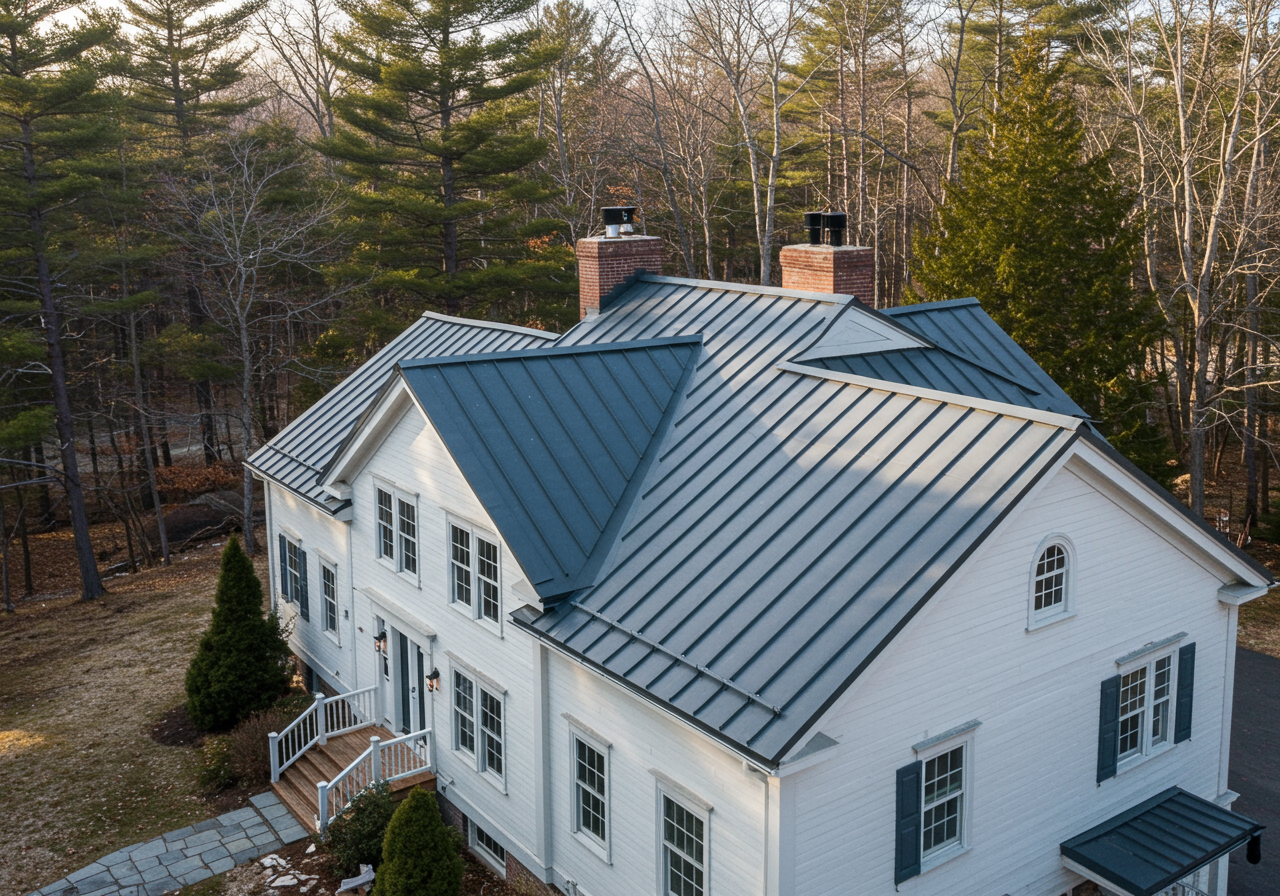
Wind-Resistant Installation
A 24-gauge standing seam metal roof being installed with heavy-duty clips to withstand coastal gusts in Deep River.
6. Cedar Shakes: The Traditional Look vs. Shoreline Reality
There is a romanticism about cedar shakes in New England. They weather to that beautiful silver-gray that defines the coastal aesthetic. However, I have to be the bearer of bad news for many Deep River residents: real cedar is a high-maintenance relationship.
If you insist on real wood, you must use pressure-treated Western Red Cedar. Without the treatment, the humidity here will rot the shakes from the underside out. I've pulled up cedar roofs that looked fine on top but were completely mushy underneath because they weren't installed with a "cedar breather" (a nylon matrix that allows air to circulate under the wood).
Most people are moving toward "composite" cedar shakes. These give you the deep grain shadows of a hand-split shake without the curling, cracking, and termite issues. Plus, you get a consistent warranty. According to Connecticut's home improvement laws, your contract must clearly state the warranty terms, and it's much easier to hold a manufacturer like GAF or DaVinci to a 50-year polymer warranty than it is to chase a lumber mill for a failing wood shake.
7. Energy Efficiency: Reflective Materials and Your Summer Cooling Bill
We talk a lot about winter in February, but Deep River summers can be oppressive. Your roof is the primary driver of your home's cooling load. A standard black asphalt roof can reach 160°F on a July afternoon. That heat radiates directly into your attic and then your living space.
If you're looking at metal, look for "Cool Roof" colors that have a high Solar Reflectance Index (SRI). Even some asphalt shingles now come with "Cool Roof" granules that meet Energy Star requirements. In my experience, switching from a dark shingle to a high-reflectivity material can lower attic temperatures by as much as 20 degrees.
This isn't just about comfort; it's about the longevity of the shingles themselves. Heat is the number one enemy of asphalt. It bakes the oils out of the mat, leading to "granule loss" and brittleness. A well-ventilated roof with reflective materials will easily outlast a poorly ventilated dark roof by five to seven years.
"In the shoreline market, the most expensive roof you'll ever buy is the one you have to install twice because the first guy ignored the wind-uplift specs for Middlesex County."
8. The Warranty Trap: Reading the Fine Print on Material Ratings
The term "Lifetime Warranty" is one of the most misunderstood phrases in roofing. In the manufacturer's world, "lifetime" usually means as long as the original owner owns the house, and it's often prorated after just ten years. In a town like Deep River, where homes stay in families for generations, this matters.
You want a "labor and material" warranty that is backed by the manufacturer, not just the contractor. If your local roofer goes out of business in three years, that "workmanship warranty" is worth the paper it's printed on. I always tell people to verify their registration through the CT eLicense portal and ensure they are certified "Master Elite" or "Select ShingleMaster" by the brands they sell.
These certifications allow the contractor to offer extended warranties that cover the entire system—underlayment, flashing, and ventilation—for up to 50 years, non-prorated. It adds about 5% to 8% to the total cost, but it's the only way to truly sleep soundly when a February blizzard is howling off the river.
Expert Pro-Tip
Summary of Material Advice for Deep River
When you're weighing your options this February, don't let the price tag be the only metric. In Deep River, your roof is a shield against a very specific set of environmental pressures. Architectural asphalt is a solid, budget-friendly choice if you pick a high-wind rated product. Standing seam metal is the ultimate "set it and forget it" solution for the shoreline. And synthetics offer that historic charm without the maintenance nightmare.
The most important thing you can do is get an honest, data-backed estimate. Don't settle for a "napkin quote." You need a breakdown of the gauges, the fastener schedules, and the underlayment specs.
Ready to see what a high-spec roof actually costs for your Deep River home?
Use our instant estimator to match with local pros who know the Middlesex shoreline.
No credit card required • Free to use
Get Your Free Roof Quote
Enter your zip code to get started